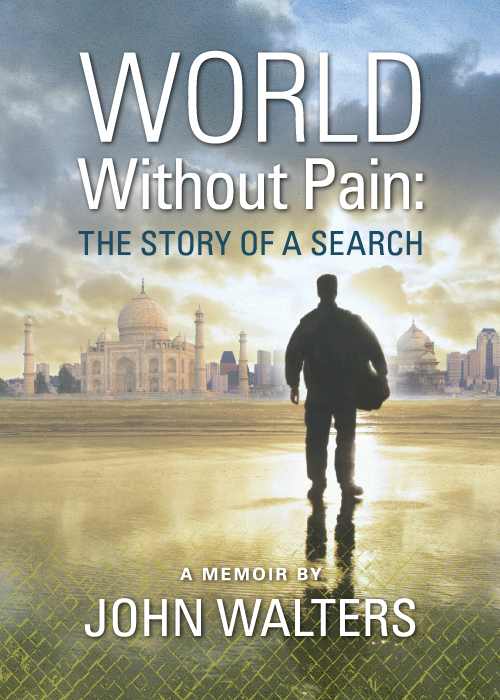
World Without Pain: The Story of a Search by John Walters – Now Available!


My new memoir, “World Without Pain: The Story of a Search” has just been published and is now available at Amazon, Smashwords, and other outlets.

 Here is the description from the back cover:

 “In the 1970s, after the Altamont Rock Festival, the Manson Family cult murders, and the fiasco of the Vietnam War many young people, disillusioned by the hippy movement, began to leave their homelands and travel to the far places of the world.  Hoping to find drugs, sex, freedom and excitement, they more often were confronted with destitution, despair, disease, loneliness, and culture shock.

As a young writer wishing to break out of the familiar rut in which he was stagnating, Walters hit the road during this time, first toEurope, then onward to the Indian Subcontinent.  He sampled Buddhism and radical Christianity; he wandered alone in the Himalayas; he listened to strange gurus spouting stranger doctrines; he watched the people around him deteriorating and dying in the lands of the East.  As he traveled onward he became fascinated with the road itself, and determined to discover its secrets. He wondered what it was that gave the road its alluring power, and he forsook everything else to find out.

His story will appeal to those who lived through the turmoil of the 60s and 70s, to those who are hungering after spiritual fulfillment, to writers and other artists in search of their voice and their inspiration, and to anyone who loves a true story of adventure and excitement in strange lands.”

 You can find the print copy at Amazon here:  http://www.amazon.com/World-Without-Pain-Story-Search/dp/1461177723/ref=sr_1_1?ie=UTF8&s=books&qid=1305968410&sr=1-1

 There is also a Kindle edition available at Amazon.

 Smashwords has it in other electronic formats here:  http://www.smashwords.com/books/view/59806

Posted in Uncategorized | Tagged , , , , , | Leave a comment

Book Review: The Books in my Life by Henry Miller

Henry Miller at his best is a virtuoso writer.  He can write about anything and it is entertaining.  He is with words like Jerry Garcia was with guitar:  you didn’t really give a damn whether he was actually playing a song or not; he could go on jamming for hour after hour and have the audience completely enthralled.

There are sections like that in “The Books in my Life”, but unfortunately to get to them you have to read through a lot that is not Miller’s best.  Don’t get me wrong:  even Miller’s mediocre work is better than almost anybody else’s.  But it’s not Miller’s best, and that’s the point.  When Miller gets going, nothing can stop him.  He hops, skips, dances, jumps through hoops, spreads wings and soars, dives down into the sewer and comes up smelling like roses.  For me, his best work is in the “Tropics”:  “Tropic of Cancer” especially, and to a lesser extent “Tropic of Capricorn” and “Black Spring”.  After those, there are “The Rosy Crucifixion”, “The Colossus of Maroussi”, and “Big Sur and the Oranges of Hieronymus Bosch”.  This book, “The Books in my Life” does not quite make it into such esteemed company, although certain sections do.

In one of the most entertaining sections Miller compares Walt Whitman with Dostoyevsky.  Now there’s an odd couple!  But he does it with wit and insight and erudition.  The sections on Blaise Cendrars, Rider Haggard, and Jean Giono are also interesting – not for their literary insight but because of the way that Miller launches off and writes of that which he knows best:  himself.  As he points out in the introduction, this volume is part of his autobiography, the story of his life which he has been telling in every book he has written.  It was supposed to be the first of several volumes on the books he’s read, but to my knowledge this, the first, is the only one that saw print, perhaps the only one he wrote.

What it reads like, actually, is a blog post, and as I read it I had the feeling that Miller would have made a great blogger.  Apart from his books he loved to write voluminous letters, and I think he would have embraced the opportunity to present them to the world on the Web.  He never was one to hold back.

One of the final sections is titled “Reading in the Toilet”.  At last, I thought:  a kindred spirit – for I myself find the toilet one of the best places in the world in which to sequester myself and absorb good literature.  Imagine my shock and disappointment to find out in his essay that he is against the practice.  He believes that the voiding of the bowels should be a single-minded pursuit, unaccompanied by reading material.  Reading this was one of the few times I have ever been disappointed in Miller.  How could he fail to see the singular pleasure of killing two birds with one stone by accompanying the mundane task of the daily throne-sitting with the pleasure of a great read?  Ah, well.  What can one say?  No one sees eye-to-eye about everything.

Another thing that struck me was that despite the fact that Henry Miller has been such an important influence on me as a writer, we have such dissimilar tastes in literature.  At the back of the book there is a list of one hundred books that influenced Miller most.  Not one of my own favorites, a list of fourteen of which I recently posted, is included therein.  Not that it matters.  Miller wrote this book in 1950, and I made my list in 2011; that’s a gap of 61 years.  Much of what is available to me he would never have heard of.

Would I recommend this book?  Well yes, but with a qualification.  It is not a good introduction to Miller, because as I said, he is not at his best.  If you’ve never read Miller before, start with “Tropic of Cancer”.  That will really plaster your face in it.  That’s where he burst out into the world newly born as a writer for the first time, still dripping with blood and amniotic fluids but dancing and singing and shouting for all he is worth.  And he’s worth a lot, good old Henry Miller.

I’m a professional writer; I make my living by my words.  I’m happy to share these essays with you, but at the same time, financial support makes the words possible.  If you’d like to become a patron of the arts and support my work, buy a few of my available books or available stories.  Thanks!

Posted in Book Reviews, Reading | Tagged , , , | Leave a comment

My Favorite Short Stories: Part One

One of my favorite literary forms is the short story.  Another is memoir.  So here is a perfect combination:  memories of some of my favorite stories.  I have not put a number in the title because I don’t know how many I will write about eventually, in this and future posts.  No matter.  And I will not herein deal with all of my favorite stories; I will choose one each from my favorite writers.  If there are several I would call my favorites by one writer, I plan in the future to center on one author or another and highlight a list of stories by that particular person.  For now, though, here is a smattering of the best of the best.  I have read thousands of stories in my time, hundreds of which I would call great.  A list like this is of course by its nature idiosyncratic and incomplete, and I am basing my decisions not only on literary merit but impact on me personally.  But if, like me, you are always on the lookout for good reading material, it will have served its purpose if I have managed to turn you on to some of these great reads.

So here are the top five:

1.  “I Have No Mouth, and I Must Scream” by Harlan Ellison.  There is no doubt in my mind that for me this story merits first place.  It changed my life.  The reading of it was one of the most significant events of my life, for by the end I had made the decision that there was nothing else for me but to become a writer.  Never had I read something so compact but at the same time so devastating.  It knocked me for a loop; it floored me.  It has one of the greatest endings in literary history, even though the ending is predicted in the title.  At the time Ellison was becoming a great shining light in what was known as the “new wave” in science fiction, a fact of which I was completely unaware.  I was unaware of most things in those days.  I had gone to university without a motivation, without a clue as to why I was there.  I floundered in loneliness and inertia, and drugs exacerbated the problem.  I chose my subjects at random from term to term, having no clue as to what I would do with my education in the future, and in second term, I think it was, I happened upon a course in science fiction literature, using as a text an anthology of stories edited by Robert Silverberg.  As I remember all the stories in that book were enjoyable, but two stood out for me so much that I remember them even now, more than forty years later.  One was “The Game of Rat and Dragon” by Cordwainer Smith, and the other was “I Have No Mouth and I Must Scream”.  As I said, mere enjoyment does not express my appreciation of this story.  It affected me so profoundly that it altered the course of my life.  After I read it I had a goal, a purpose, a direction.  In that regard it lifted me out of the sludge – the slough of despond, you might say – and even though it took me years to break out of my depression, coming to a realization of my destiny was the first step.  As for the story itself, it is a chronicle of an endless journey through hell, full of startling, shocking imagery which, as I mentioned, comes to a devastating conclusion.  It made me seek out other books by Harlan Ellison; for a long time he was my favorite author.  It even led me, eventually, a few years later, to study under Harlan Ellison himself at the Clarion West Science Fiction Writers Workshop.  And the rest, as they say, is history.

2.  “Sundance” by Robert Silverberg.  This is another “new wave” story, deliberately experimental, told alternately in first, second, and third person present and past tense.  That alone would not give it distinction, however.  Experiment for its own sake is a vain exercise.  What sets “Sundance” apart is the fact that its experimental style is perfectly blended with the subject matter of the story itself:  the psychology and background of the protagonist, and the situation in which he finds himself.  There are not many great science fiction stories about Native Americans, but this is definitely one of them.  It was on the final ballot for the Nebula Award along with another Silverberg story, “Passengers”.  Silverberg withdrew “Sundance” in favor of “Passengers”, feeling that as “Passengers” was more conventional it had a better chance of winning.  He was probably right (“Passengers” did win the award), but my personal opinion is that “Sundance” was not only more deserving of the award that year but is one of the greatest short stories of all time.

3.  “The Women Men Don’t See” by James Tiptree, Jr.  Choosing a Tiptree story for this list is a difficult undertaking.  So many of her short stories are brilliant beyond words that it is impossible to single out one which is better than the others.  I could have chosen, for example, “Houston, Houston, Can You Read?” or “The Girl Who Was Plugged In” or “The Milk of Paradise” or “On the Last Afternoon” or one of several other possibilities.  “The Women Men Don’t See”, however, has a unique quality; it begins in the normal world, the world of men and women and their chance encounters and interactions, and slowly, slowly, in the midst of descriptions of scenery and storm, slips into a deep pit of the surreal from which there is no escape.  The conclusion at the end is so unusual, and so profound, that at the time there was nothing like it in all of literature.  I am opposed to those who say that fantasy or science fiction or speculation or blatant action must begin at the first page or they will throw aside the story.  I prefer a slow start and a gradual buildup, somewhat in the nature of foreplay before the inevitable climax.  That’s what this story gives us.  But don’t get me wrong – it is never boring, not a single word of it.  It is fascinating through and through.  Tiptree was a master of sparse, trimmed-down language in which every word had devastating effect, and nowhere is her word-mastery more evident than in this story.

4.  “The Apostate” by Jack London.  It is difficult for me to choose a single London story as well.  I am a great fan of his Klondike stories such as “The White Silence” and “In a Far Country” and I was tempted to choose one of those.  I also came near to choosing his terrific novelette “The Red One”.  But I selected this for several reasons.  First of all, it is one of his lesser-known works, but one of his best.  In addition, unlike the other above-mentioned works, this one is surfeited with realism – too much realism for some, I would say.  It is autobiographical, but London uses the sordid details from his past to great effect in telling this story of the crushing, grinding physical and psychological burden of child labor.  It describes a life of endless pre-dawn wakeups, the drudgery of working many hours under terrible conditions in factories, the never-ending exhaustion.  If that were all that was told, however, it would not be the wonderful work of literature that it is.  No, there is more.  It is the liberation at the end that makes it great, that lifts it above other works that describe similar conditions but leave the reader, as well as the characters, in degradation and despair.  Not this one.  At the end, after the suffocating hell, there is the breath of freedom.  That is the beauty of it.

5.  “The Aleph” by Jorge Luis Borges.  Borges is a master of the short story of intellectual intricacies and conundrums.  I like many of his stories of fantasies, dreams, mazes, puzzles.  What sets this one apart is that the characters are drawn in great detail, and the fantasy, which at first is, as usual for Borges, a puzzle, by the climax makes great sense.  I love his lists of page after page of intricately described details, especially when the narrator glimpses the Aleph for himself; impossible as it is to truly describe it he, as had the poet who discovered it before him, makes an attempt to do so, and it is a glorious attempt.  It is an exuberant spattering of language like paint upon a canvas, but at the same time it is meticulous, precise, and evocative.  Every time I read this story it is as if it is a fresh discovery.

I’m a professional writer; I make my living by my words.  I’m happy to share these essays with you, but at the same time, financial support makes the words possible.  If you’d like to become a patron of the arts and support my work, buy a few of my available books or available stories.  Thanks!

Posted in Book Reviews | Tagged , , , , , , , , , , | Leave a comment

Driving in Greece

This morning I played around with an article I had written some time ago called “Greek Rules of the Road”.  It was meant to be a humorous piece, flippant even; in it I postulated what the laws would sound like were they composed to reflect the way Greeks actually drive.  When I was done I asked my wife to have a look at it; as one driver to another, I thought she’d get a kick out of it.  Instead, she didn’t like it.  It was exaggerated, she said.  She insisted that things were improving, that it wasn’t that bad anymore.

I didn’t understand her reaction, and I pondered it for a long time.  I respect her too much to simply dismiss her opinion, so I wondered how I could have so misjudged what it would be.

The answer, I think, is in the comparison.  She is comparing what it was like to drive in Greece a decade or so ago, and what it is like now.  I am comparing what it is like to drive in Greece with what it is like to drive in the United States.

Here it is common for drivers to go twenty, thirty, or forty kilometers per hour over the speed limit and think nothing of it.  Nobody else around will think anything of it either.  Sometimes when I am hugging the speed limit cars or motorcycles pass me as if I am standing still.  I have never seen the police give chase in such an instance; were they to do so that is all they would have time to do, at least until people got the point.  Here it is common, not everywhere but at certain less-traveled intersections, to run through red lights if one can see that no one is coming from any other direction, or to not bother to slow down at stop signs if the way seems to be clear.  In the village where we used to live there are some one-way streets that drivers routinely ignore and drive up the opposite way; if you honk at them they will either ignore you, think you daft, or gesture at you obscenely.  It is a common tactic on the highways for speeding vehicles to signal their intent to pass and desire for you to pull over by coming up behind as if they intend to ram you, wildly blinking their lights; this they will do even if you yourself are already going the speed limit or beyond.  Another common tendency is that many drivers, if you with a turn signal indicate your intention to move into the left lane to pass the slow-moving car in front of you, will step on the accelerator and speed up so that they can get ahead of you first before you make your move.

These habits, which are so second nature here that people don’t even give them a thought, would be appalling to US drivers.  It wouldn’t be long before the perpetrators of such deeds lost their licenses and faced huge fines.  But here, there is no basis for comparison.  Yes, I might admit that things have gotten slightly better than they were ten or fifteen years ago, but then again, things go in cycles.  I remember several years back, for a week or so, police were stopping motorcycle riders everywhere for not having helmets – and fining them too, I heard.  Now they drive with or without helmets with impunity, according to taste.  True, a few more might wear helmets than used to do so in the past, but then again, many do not, and they are not called to task for it.  I have heard of the odd occasion when the police stopped drivers for infractions and fined them; but, as I say, it was the exception – so unusual as to become a topic of conversation.  Usually when police set up checkpoints they are looking for illegal immigrants, or for vehicles without proper papers.  A year or two ago signs appeared everywhere on the highways warning that speeds were being checked by radar; I have yet to hear of anyone brought to task for an infraction, or to see anyone slow down because of the signs.

Having said all this, however, I must add that it is not too difficult to navigate Greek roads.  One adjusts; one goes with the flow, gets used to doing what the other drivers are doing.  By this I don’t mean flagrantly breaking the law as the worst of the offenders do; no, I mean carrying on about one’s business and avoiding the frequent nut-cases on the roads.

This also brings to mind what I have noticed as both good and bad points of Greek character.  Greeks can be friendly, magnanimous, helpful, willing to bend rules for friends, neighbors, relatives, and other acquaintances, loving freedom more than rules and restrictions; however, they can also be stubborn, irascible, feisty, and bull-headed.  Both their good and bad traits manifest themselves on the road.

Americans though, for all their love of freedom, are much quicker to obey rules, to stand in a straight line and wait their turn, to accept whatever correction authority might deem proper to give.

I believe that part of this tendency among Greeks to take rules lightly stems from the fact that many, at least here in Thessaloniki, just in the last generation, have moved here from villages.  In the villages it is standard practice to bend rules; after all, everyone knows everyone and can predict what they will do and when they will do it.  If you see your friend by the roadside you stop your car, double- or triple-parked if need be, or even right out in the middle of the road, and have a chat.  If other vehicles come along and want to pass, you leisurely conclude your conversation and then get out of the way.  I have seen this in the villages in which we live, even up to the present, with a fair amount of frequency.  It works fine when you are only dealing with a few thousand inhabitants.  But when such an attitude is transferred to a city of a million people, it doesn’t work so well anymore.  Adjustments need to be made.  And they will be, eventually.  In the meantime, one copes as best one can.

Posted in Greece: A Memoir, Travel | Tagged , , | Leave a comment

Book Review: Selected Short Stories by Rabindranath Tagore

If you don’t know who Rabindranath Tagore is, you should.  He was a Bengali writer, the first non-European to win the Nobel Prize for literature.  It was awarded primarily for his book “Gitanjali”, a collection of poetry.  Besides poetry, though, he wrote plays, novels, songs, non-fiction ranging from travelogues to history to essays, and, of course, short stories.

When he began to write his short stories in the late 1800s there was little literary precedence in Bengali; he claims he had to invent language for the form as he composed.  At the time he had gone off into the countryside to manage some estates for his family.  He lived on a houseboat on the Padma River, and daily was in contact with the common folk who comprise the characters in his tales.  His affinity with and love for them is evident in the empathy he displays for them all:  he writes of families torn asunder by contention and jealousy, of arranged marriages, of child brides, of wandering mendicants, of devotees of Hindu gods, of the rich destroyed by their riches and the poor by their poverty, of teachers and their students, of servants and their masters, of parents and their children; he even writes a few about ghosts and haunted palaces.  All of them are set in the milieu of the time:  the Hindu- and Bengali-speaking northeast of India during the British Raj.  The British, however, are mentioned only peripherally; the stories are about Indians and India.  Though the customs and beliefs are very different from what we are used to in the modern West, Tagore’s talent is great enough to get us into the minds of his characters so that they become familiar to us and we can see them as beset with humanity as we ourselves are.

Tagore is an artist.  Apart from the believable characters there are beautiful descriptions of the Bengali countryside:  sunshine and storms, droughts and floods, plains and rivers, trees and flowers, as well as the scents and sounds and feel of the country villages.

This book is of particular interest to me because I lived for several years in Bangladesh and in West Bengal, India.  I studied elementary Bengali at Dhaka University.  I lived for a few months in Santiniketan, where Tagore lived and founded an ashram.  I can still read Bengali, but alas, I have forgotten most of the vocabulary.  I would like to read Tagore in the original.  Someday, perhaps.

In the meantime, this is an excellent translation.  Sometimes when I have read translated works, for instance of Shusaku Endo’s “Deep River”, I have been disappointed; while the quality of the original cannot help but shine through, it is evident that something has been lost in the transition from the author’s language to English.  I can’t say that this is the case here.  The translation (by William Radice) is very smooth, very elegant.

Would I recommend this book?  Unequivocally.  Anyone who loves short stories should read this book, or you are missing out on a master of the craft.  Some of the stories are stronger than others, it’s true, but that is true of any short story collection.  Some of my particular favorites are:  “Taraprasanna’s Fame”, “Wealth Surrendered”, “Kabuliwallah”, “A Problem Solved”, “Thakurda”, “The Hungry Stones”, and “The Gift of Sight”.  The stories are all quite short and can be read in a sitting, which is good because many of them are best appreciated as whole entities.

I’m a professional writer; I make my living by my words.  I’m happy to share these essays with you, but at the same time, financial support makes the words possible.  If you’d like to become a patron of the arts and support my work, buy a few of my available books or available stories.  Thanks!

Posted in Book Reviews | Tagged , , , , , , , , | 5 Comments

Freedom

Today I am in the process of uploading an electronic version of my story “Painsharing” to two different venues, Amazon’s Kindle, and Smashwords, which distributes to several other online bookstores.  It is taking hours because many other authors are uploading their works at the same time.  Some say it is a tragedy that anyone who wants and is willing to learn simple formatting can publish their writing; they say that the Web will be inundated with mediocre to terrible writing and that no one will be able to find the gold for which we all search.  I, however, consider it a triumph.

My reasoning works thusly:  if there is even one great writer rejected by traditional publishing for his or her unorthodox but brilliant work, then the flood of crap is worth it so that writer can emerge and be recognized.  I am reminded of Henry David Thoreau, considered a literary master now; he was forced to self-publish “A Week on the Concord and Merrimack Rivers” at his own expense.  Have you ever read that book?  It’s a classic of travel writing, full of brilliant description of scenery and local history, and insight into philosophy, writing, literature, and so on.  And I am reminded of Henry Miller, sitting alone in a Paris hovel writing “Tropic of Cancer”.  Talk about unconventional works – that must be the epitome.  Not only was it unpublishable due to its idiosyncratic style – it also ended up being banned for decades in the US due to its so-called pornographic content.  Being flat broke and recently abandoned by his wife, Miller would not even have been able to self-publish; he needed a sponsor, Anais Nin, to finance the project through to completion.  It hit the world like a literary bomb and inspired hundreds of thousands, including myself, with its vitality, honesty, and originality.  I think that throughout history there have been many other masterpieces like these that have never seen the light of day, and the world of literature shines less brilliantly because of it.

There are, of course, two sides to the coin.  Many books exist which never should have been published, and many more exist which we are all probably thankful that they weren’t.  However, that is not the point.

I am speaking of freedom. 

Throughout history artists have needed sponsors.  In Michelangelo’s time wealthy nobility bankrolled artists’ careers.  In the more recent past, publishers have sponsored writers, in return for a lion’s share of the profits.  And publishers have guarded the portals of literature.  If you danced their dance and agreed to their terms, you got published.  If not, you didn’t.  You remained a nobody clerk in podunkland, unheard-of and unlamented.  Unless you were rich and could publish and distribute at your own expense, you had no recourse – and if you did self-publish you were derided as a charlatan, a fraud, an upstart, a claimant to talent you did not possess.  And why?  Not because anyone had read your book and found it lacking, no – merely because of the method of its delivery to the marketplace.

All that has changed, and the change has come about so recently that the world of publishing is still reeling from the shock.  Now it is possible for a writer to publish his or her own book electronically and even on paper with a minimum of effort to learn the proper formatting, layout, and so on.  The book can be out there and readers can discover it.

What does this have to do with freedom?  Writers no longer need to feel an agent or a publisher leaning over their shoulder making sure that their work conforms to convention or to what is currently selling in the marketplace.  Writers can write what they want – what they must – and present it to readers and let the readers themselves decide.  The gatekeepers are gone, or are at least marginalized.

I believe that this will, in time, when writers realize the freedom they possess, spawn brilliant new work – work that writers might never have even tried to write, knowing that no mainstream editor would touch it.  A new era of publishing and of literature is upon us.  Yes, there will be crap – most of what is written will be, as has always been the case.  But there will be masterpieces too, wonderful books that might never have existed had this new era of freedom not burst upon us.  These new books make it worth it all.

To writers, then, I say:  let it rip.  Be free.  Don’t be like a creature who has spent its life in a cage, who once the cage is removed is so used to the tiny confines it has known all its life never ventures forth into the wild.  Be bold.  Be different.  Be innovative.  You don’t have to do it anyone else’s way anymore.

And to readers I say:  you are the new patrons of the arts.  Support your local writer by buying his works.  Cast your vote with your pocketbook.  The new world of the arts will evolve in whatever direction we all see fit, based upon the choices we make.  Let’s make the right ones.

Posted in On Writing | Tagged , , , , | 1 Comment

Book Review: Inside Hitler’s Greece: The Experience of Occupation 1941-44

You want a horror story?  Forget Frankenstein and Dracula and Stephen King and Lovecraft.  Read this book.  What Greeks went through during the Second World War is grotesque to say the least and indescribably horrific to say the most.

It starts with a description of the famine in Athens at the beginning of the occupation.  What happened was that the Third Reich came in and commandeered everything.  They took whatever food they could find, whatever equipment from the factories they could use, shipped it off to Germany, and left the Greeks to fend for themselves.  In the absence of food or any way to procure some, thousands died.  Women, children, families all starved to death.  People fell on the streets of Athens and were unable to get up, and wagons came and carted off the corpses.  Everyone suffered, except the profiteers and the army of occupation.  For many of them it was like a holiday, because they were reassigned in warm sunny Greece instead of the eastern front.  Families sold everything to feed their children.  Parents starved to death so they could give everything they could obtain to keep their children alive, and then the children ended up as urchins in the streets.  The situation did not ease up until international grain shipments began to arrive in the summer of 1942, over a year later.  This is the first trauma described in detail in this book.

After that, there is a description of the politics of the insurgents which I have to admit bordered on boring.  A bit too much detail for my tastes.

But then, it describes the concentration camps within Greece to which dissidents, or anyone suspected of being dissident, were sent.  Terrible conditions, almost certain death.  Few who entered ever came out.

Next, the plight of the Jews.  Greece was one of the centers of Jewish culture in the East, especially Thessaloniki, to which many Jews fled in the 1400s when they were banished from Spain by Ferdinand and Isabella.  They thrived in Thessaloniki, even under the Ottoman Empire, so that at independence in 1912 they were the dominant culture in the city.  Then came the Third Reich and the Final Solution.  It is estimated that 50,000 Jews lived in Thessaloniki at the beginning of World War 2; so many were sent off to Auschwitz and exterminated that after the war there were only 2000 left.  Comparable statistics apply to most of the rest of Greece, although Athens and certain other areas managed to save more of their Jews than others.  When it was all over, Greece lost a higher percentage of Jews than any other country in Europe.  It was a terrifying rounding up of people as if they were pestilent; it was done by surprise, by deceit, by subterfuge – you can’t even find anything in fiction to compare to it.

The thing is, this is fact and not fiction.  It makes it all the worse.  The evil was real, and walked among us.

In Athens just before liberation the Right and the Left tore into each other.  Murder was common on the streets.  The extreme Right, in the guise of anti-communism and with the cooperation and help of the German Army and the SS, rounded up whole neighborhoods of people.  Hooded Greek informers would go through the crowd and identify those they supposed to be communist sympathizers; some were shot on the spot, thousands of others were sent to concentration camps for extermination or deportation to Germany.

And what happened next?  Greece tore itself apart with civil war.  It was the nature of the times.  There were the communists and the anti-communists, and each of them were convinced of the righteousness of their cause, and there was nothing for it but to duke it out.  Much more blood was shed before the situation stabilized and people could get on about their lives.

This book is not easy reading.  It is definitely not for relaxation.  I wanted to know more about the country in which I reside, and I got more than I bargained for.  The curious thing is, all of this is buried now in the past.  I asked my wife about her grandparents and what happened to them during the war.  She wasn’t sure.  They lived, mind you, in one of the hot zones of the resistance, high in the mountain villages near Kozani, where whole villages were burned to the ground, where guerillas lived off the land, where traditional values were put to the test and found wanting in the face of terrors previously unknown.  They preferred to forget, these relatives.  They preferred not to pass on the stories to the grandchildren.  Too much blood had been spilled, too many lines in the sand had been crossed.  Better to forget.

But no.  This book brings it all back.  It is hell, and nobody wants to remember hell, but sometimes you have to.  You have to tell others how it happened, and why it happened, and what the outcome was.  They may not learn but there is the chance that they might, and then the horrors of the past might not be repeated.  That is the value of this book.

I’m a professional writer; I make my living by my words.  I’m happy to share these essays with you, but at the same time, financial support makes the words possible.  If you’d like to become a patron of the arts and support my work, buy a few of my available books or available stories.  Thanks!

Posted in Book Reviews | Tagged , , , , , , | 2 Comments

Greece: A Memoir; Part 4: Delphi (1976)

Back in Athens I stayed just one night and then was on the move again.  This time I hitchhiked through the hills to the northwest to Delphi, site of the ancient oracle.  It was a long, hot trip, and I remember at one point passing a crossroads in an unusual sudden intense downpour.  Right at the intersection of small hill roads leading in various directions was a concrete bus stand, and I had a sudden urge to get off there, strip down to bare skin, wait until all traffic passed, and frolic in the rain, thus accomplishing two things:  first, washing the filth and sweat off my body, and second, washing my spirit as I did a Zorba-dance of life.  Common sense overcame impulse though, and I continued with the trucker with whom I’d found a ride.  I was practical enough to realize that I might stand in that isolated spot for many hours before another generous driver stopped, and it was late afternoon already and I didn’t want to get caught in the pitch dark of the countryside.

Another fit, this time of tension and dislocation, hit me when I got to Delphi.  The town was perched on a steep green hillside and there was only one main street; it was loaded with trappings of tourism like garish restaurants with foreign food like hamburgers and pizza mixed with the traditional Greek cuisine, travel agencies, and souvenir shops.  It was also, compared with other places I had been, mobbed with tourists of every size, shape, and fiscal condition, toting day-packs and cameras and maps and all sorts of other tourist do-dads.  I was so put off by the sight that I decided to pass right through without stopping, to keep going with the trucker, who was heading for the ferry crossing to Patra in the Peloponesse.  As the driver was heading down the steep switchback on the other side of town, though, I reconsidered.  Tourist swarm notwithstanding, the village was in a beautiful location.  The hills were so emerald green they seemed to glow, as did the wildflowers with gemlike radiance.  It was a very famous location to which I might not have opportunity to return.  And there was one other thing:  another traveler had told me that Delphi was renowned for being the abode of good dreams, that if you slept out in the open on the hillside you would surely have one.  This rumor I wanted to test.  So, I had the amiable trucker drop me off, and lo and behold, no sooner had I jumped off the truck than another trucker picked me up and brought me back up the hill.  It was the fastest ride I had ever had in Greece, and I took it as a sign.

Then I found out the bad news:  Delphi was expensive.  I can’t blame the locals for cashing in on all the invaders, but the meals were out of my price range.  I wandered into a restaurant at random, probably thinking to order a small soup so I could fill up on the free bread.  It was between mealtimes and the place was almost deserted, so the owner, a young man with an obvious limp, came up and chatted with me.  He told me that if I would help him serve tables in the evening he would stake me to a real meal, not just soup but full-course with all the trimmings.  Not really thinking about what it would involve, I agreed.  He brought out plate after plate of food, and retsina to wash it all down.  We chatted for a long time until the sun set and tourists began to arrive for dinner.  Soon the place was full, and the owner was rushing around taking orders.  I, on the other hand, had forgotten about our bargain, sitting as I was in a rosy retsina glow;  he came over, sweating and harried, to remind me.  Dutifully I got up and grabbed some plates and took them to a table; then I realized what I had gotten myself in for.  The customers were a group of European tourists, young people like myself, and they treated me with distain, as a servant, as an inferior.  I hadn’t been prepared for that.  Obviously I should have thought the situation through before I agreed, but the prospect of a good filling meal had got the better of my judgment.  Now, faced with the prospect of an entire evening being treated like shit by fellow travelers, I reneged on my promise, apologized to the restaurant owner, grabbed my bag, and walked out.  In retrospect it was a lousy thing to do; I had give my word, after all, and had even accepted payment in advance.  But something came over me and I just couldn’t handle the situation.

By this time night had fallen.  The streetlamps were dim, but the lights from the shops, restaurants, hotels, and so on filled the main road with a kaleidoscope of color.  Most of the mob had retired to their meals or other forms of entertainment so the street was curiously deserted.

I chose a path between buildings and headed down the hill.  After the one row of commercial establishments there was open countryside.  I walked out onto the tall grass of the hillside, and when I felt I was far enough from the noise and bustle I spread out my sleeping bag.

A spray of brilliant stars shone overhead.  I watched them for a long time, then took off my contact lenses and went to sleep.

I don’t know what I dreamed, but yes, I did have wonderful dreams.  I was convinced that the dream legend was true.  I awoke refreshed, inspired, invigorated.  I was ready once again to face the world and whatever it threw at me.

Back up on the main road, the restaurants and most other establishments were still closed.  I walked to the edge of town, stuck out my thumb, and caught a ride onwards.

Posted in Greece: A Memoir, Travel | Tagged , , | Leave a comment

Ten Plus Two of My Favorite Films (Part 2)

Yes, I’ve changed the title.  The first post, a few weeks ago, was “Ten Plus One”, and now it says “Ten Plus Two”.  That’s because I realized there was a film I’d left out of the original list that had to be there.  The five films I mentioned previously were:

1.  Doctor Zhivago.

2.  Butch Cassidy and the Sundance Kid.

3.  Star Wars (the original trilogy).

4.  Gandhi.

5.  Parenthood.

Now, before I continue, I want to reiterate that this is a list of my personal favorites, chosen because they have resonated with me.  Perhaps none of these would be on your list, or perhaps your list would include these and more.  Let me know; I am always on the lookout for good movies.  As I said last time, these are not in order of quality but roughly in the order I encountered them for the first time.

6.  Modern Times.  This is the oldest film on the list.  Hollywood was transitioning to talkies when it was made, and it is Chaplin’s last mostly-silent film.  There is very little dialog; it is almost purely visual.  That doesn’t matter, because Chaplin was a master of the visual, and never more so than in this picture.  As far as I’m concerned this film is his masterpiece.  It has everything:  social commentary, romance, uproarious comedy, adventure, tragedy, triumph.  It even has the melody to one of the greatest songs ever written (by Chaplin himself):  “Smile”.  He was a one-man show in a sense, as he produced, directed, acted, and wrote the music.  But the supporting cast, especially Paulette Goddard, who plays his romantic interest, are superb as well.  This film bears watching again and again and again, and every time it is as fresh as the first.  I would venture to say it even has relevance to our own modern times, when so many are out of work, disillusioned by the system, and seeking for real values in life.

7.  Chaplin.  I’m a fan of Richard Attenborough’s work:  this film, “Gandhi”, and “Shadowlands” especially.  I find this movie immensely intriguing.  Chaplin was a genius, of that there was no doubt.  He came into film in its infancy, intuitively realized what could be done with it, and had the talent and business acumen to exploit it to great effect.  The story of his life is fascinating, to say the least.  The directing, supporting actors and actresses, photography, and so on, are all superb, but there is one thing that raises this film to mythic status:  Robert Downey Jr.’s performance as Chaplin.  It is one of the greatest acting triumphs of all time, and he should have won the Oscar for it.  As it was, Al Pacino took home the prize for his awesome performance in “Scent of a Woman”.  That’s a tough call.  Sometimes they should hand out two awards and be done with it.  Anyway, awards aside, Robert Downey Jr. owns the character of Chaplin; I don’t think there’s another person on the planet who could have played him so effectively.

8.  Flashback.  Okay, okay, this is my guilty pleasure.  I know this movie doesn’t come up to the brilliance of the others on the list, but I love it anyway.  I watch it frequently and always have a great time.  As an old ex-hippy myself it touches my heart.  When near the end Kiefer Sutherland breaks down and cries as he watches the home movies of his hippy parents it gets me every time.  And that psychedelically-painted bus bursting out of the garage to the tune of “Born to be Wild” is a tremendous scene.  I like the music too; it’s replete with great songs from the sixties.  Whenever I want to just kick back and relax and have a fun cinematic experience, I can always count on “Flashback”.

9.  American Beauty.  For social drama this one can’t be beat.  When I first saw it I was stunned.  It is amazing how the characters are built up so brilliantly throughout the film, and then in the end one by one they are exposed for who they really are, shown to have all been covering up, living a lie, deceiving themselves and everyone around them.  Except for Lester, that is, played with unerring brilliance by Kevin Spacey, who has broken out of the rut in which he had been entombed, has been making a bid for freedom, and is killed for his trouble.  But at least he dies happy, which is more than one can say for those he left behind.  And to top it all off, during the end credits one of my favorite Beatles songs, “Because” is played, and it fits it all perfectly.

10. The Lord of the Rings.  I include here the trilogy which includes “The Fellowship of the Ring”, “The Two Towers”, and “The Return of the King”.  Each is a brilliant film on its own, but together they comprise one incredibly long film with a continuous story line.  I heard about this film years before it was released and anxiously awaited its coming.  The books are at the top of my all-time reading list; I have read them over a dozen times.  I never intended, nor do I now, to compare the films with the books.  They are different experiences.  If I had to choose I would take the books, but thank God I don’t have to have one or the other; I can have both.  From the first moment of the first film I was in awe, when the haunting music begins and the elvish voice speaks.  I would have thought it impossible to do justice to the story on film, which makes Peter Jackson’s achievement remarkable.  True, there are some things I would have done differently, deviations from the storyline in the books I would not have made, but the pluses far outweigh the minuses, and overall I have to say that the films are a resounding success.

11. The Last Samurai.  I didn’t have much of an idea of what I was in for when I went to see this film, but I was immediately enthralled.  It is not only full of visual beauty but of the values of honor and courage and friendship.  It is a classic story of a man starting out as the enemy of a culture he does not comprehend, but once within begins to appreciate its value and eventually is willing to fight side-by-side with his former enemies to preserve it.  Tom Cruise gives one of his greatest performances; he is completely credible from beginning to end.  Though I do not believe in the degree of violence the story espouses, still it inspires me, makes me want to be better, to stand up for what I believe in, to act honorably and courageously myself.

12. The Namesake.  Ah, this is a beautiful film.  It is based on a novel by the Bengali-American writer Jhumpa Lahiri, and it tells the story of a Bengali couple, after an arranged marriage, who move to the United States and raise a family.  It shows the woman’s initial culture shock and homesickness and eventual adjustment; the raising of their children in the new land and the children, as they become teens, absorbing the contemporary American culture and becoming alienated from the customs of their parents; the father’s death and how the family copes with it; and the mother’s eventual return to the land of her birth.  The actors who play the parents are famous Indian actors, and they break your heart with their subtle, heartfelt performances.  Kal Penn plays their son, caught between two cultures, and he turns in a brilliant performance too.  Perhaps it resonates in a special way with me because I lived so long in Bangladesh and in West Bengal in India.  I was able to follow most of the Bengali dialog in anticipation of the subtitles, which was fun – but it was not only my past experience in West and East Bengal that caused me to love this film.  It is a one-of-a-kind experience, a thing of beauty.

So those are some of my favorite films.  What are yours?

Posted in Movie Reviews | Tagged , , , , , , , | Leave a comment

Book Review: A Crown of Feathers and Other Stories by Isaac Bashevis Singer

Soon after starting to read this collection I found myself comparing Singer’s stories with those of Jorge Luis Borges.  First of all, both writers deal with elements of the fantastic, though Singer is concerned mainly with that which has to do with Jewish folklore and legend, and Borges delves much further into the out-and-out bizarre and surreal.  In addition, both writers, in many of their stories at least, write of idiosyncratic characters from their native lands:  Singer of Jewish communities in Poland, and Borges of rough common folk in Argentina.  And finally, both often insert themselves into their stories as themselves, playing the narrator or an observer who objectively observes and comments upon the main events.

I think I prefer Borges personally, because I enjoy the intricacies of his fantasy worlds, the mind-puzzles, the conundrums.  But that is not to take away from the value of Singer’s stories.

To be honest, the first several stories didn’t impress me much.  They were rambling and disjointed and without coherent theme.  But then I read “The Son from America” and after that I was hooked.  This story is a perfect little parable, the kind of story you read and afterwards think that it couldn’t be improved upon.  It tells about an elderly couple who live in a tiny poor village in Poland.  Their son has gone to America and they haven’t seen him for years.  One day he shows up, rich and prosperous, with all sorts of plans to improve the lifestyle of his parents and the other villagers, but then he gradually comes to realize that they are all content and have need of nothing.  That and the closing story, “Grandfather and Grandson”, which deals with a devote old man’s reaction to the events of the Russian Revolution, were my favorites in the collection, but basically every story in between these two was a good solid interesting tale.  Maybe the stories are presented chronologically and after a certain point Singer really hit his stride; I don’t know.  But that’s how it worked out with me.

This collection was co-winner of the National Book Award in 1974 with “Gravity’s Rainbow”.  Though I have read some Pynchon, “Gravity’s Rainbow” is one that I have not yet tackled, so I can’t really compare the two.  It seems, at first glance, that they are unlikely bedfellows:  the traditional and the avant-garde.  I don’t know offhand what else was published that year; I do know that the Pulitzer judges settled on giving no award in 1974, though the committee had voted unanimously in favor of “Gravity’s Rainbow”, evidently thinking that the novel was too outlandish to be honored.  But my point is, though I thought “A Crown of Feathers” was a good solid collection of stories, I’m not sure I feel it’s of award caliber.  Then again, awards are merely a matter of taste, after all.  It is, however, a good read, and a fascinating insight into the Jewish milieu in Poland and New York in the early half of the twentieth century.

I’m a professional writer; I make my living by my words.  I’m happy to share these essays with you, but at the same time, financial support makes the words possible.  If you’d like to become a patron of the arts and support my work, buy a few of my available books or available stories.  Thanks!

Posted in Book Reviews | Tagged , , , , , | 2 Comments