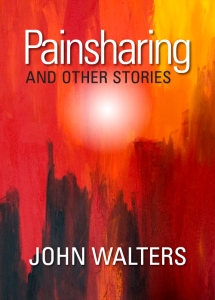
Painsharing and Other Stories by John Walters – Now Available in Paperback!

My second short story collection, “Painsharing and Other Stories” is now available in paperback through Amazon.  You can order it here.  It’s still available for Kindle here and in other electronic formats at Smashwords here.

Here’s the description from the back cover:

After nuclear war, a survivor of the monster-populated ruins of Oakland California joins the crew of a clipper ship sailing the waters of the Pacific; a typhoon shipwrecks him on a tropical island whose inhabitants share a bizarre secret.

An unlikely team investigating the deaths of the crew of an interstellar spaceship near Pluto are confronted with a life-or-death conundrum stranger than anything they could have imagined.

On a distant planet the ultimate civil punishment is to be genetically deformed into an abhorrent beast and forced to live in the forbidden compound called Purgatory as slaves of the State.  When authorities arrest and condemn the woman he loves, a man determines to find and save her, even if he must descend into Purgatory itself.

In these and other gripping science fiction tales John Walters explores possible futures on Earth and other worlds.

Posted in Uncategorized | Tagged , , , , , | 2 Comments

Standing Up to Intimidation

I’m a pushover.  I have been all my life.  I don’t easily get feisty and quarrelsome, and I don’t easily question what others tell me.  I want to believe that they are sincere; I want to believe that people naturally tell me the truth, even though I have overwhelming evidence to the contrary.  I always say, “I’m not going to let other people’s bad behavior influence the way I decide to behave.”  And in an abstract sense, this is correct.  We should make our own moral decisions no matter what others do.  But there comes a point when others cross too many lines and even easy-going fellows such as myself must take a stand.

To illustrate what I mean I have come up with three examples from literature and film.  I
bring these up from memory and these memories may not be clear, but they will be sufficient for the points I want to make.

First of all, for an example of the epitome of a milquetoast, I offer “Gimpel the Fool” by Isaac Bashevis Singer.  I read this short story years ago, and had a hard time and a difficult search on the Internet before I found the title again.  But the story itself has remained
vividly with me all this time.  Gimpel is a baker in a village in eastern Europe.  He is the butt of the villager’s jokes because he is so trusting.  His wife constantly cheats on him; his
children are not his own; his neighbors treat him with scorn and ridicule.  Through it all he maintains his simple honesty and does not, though he is tempted, give in to the baser and less worthy spirits which surround him.  He keeps his integrity, but at what price?  I remember wondering, after I had read the story, whether his naiveté was worth the price
he paid, being labeled and treated as a fool for so many years.  But this is an example of the flip side of the deal.  Some people who are seemingly intimidated by others are merely serene souls with a greater sense of morality, who do not want to give in and descend into the pettiness around them.

Then I thought of Peter Finch’s character Howard Beale in the movie “Network”.  This is
an example of a wimp who snaps and has a profound change in personality; he becomes a dynamic presence in the media with his famous rant, “I’m mad as hell and I’m not going to take this anymore.”  The network he works for, which was going to fire him, sees his ratings soar, and he becomes a symbol of defiance and outrage.  He is the ultimate mouse turned into a lion, and he pays the ultimate price in the end for his rebellion.  But at his peak, when he persuades his massive audience to open their windows and shout out, “We’re mad as hell and we’re not going to take it any more,” causing city streets to resound with the cry of rebellion, don’t we all feel sympathy with him and wish we could scream the same?

Finally, I turn to one of my favorite characters in American film, Lester Burnham in “American Beauty”.  Talk about the ultimate, the consummate pathetic milquetoast:  that’s Lester.  Despised by his wife, his daughter, his bosses, his colleagues, and his neighbors, he despises himself even more.  He is flabby and sycophantic and utterly without the ability to stand up for himself.  But then, he reaches a crisis point and changes.  Ostensibly the change is brought on by his smoking pot and lusting after a teenage cheerleader, but to suppose these surface manifestations are the primary motivations would be overly
simplistic.  He reached a point where he had had enough.  He didn’t want to take it anymore, and he decided not to.  He re-crafted his life to re-create himself as an entirely new person, a phenomenon those around him were not able to accept.  That’s the trouble with standing up to intimidation, if you have been yielding to it all your life so far:  people will not accept it.  They will fight back; you have to be prepared for that.  In Lester’s case, in the end he was killed – but he died happy, which is better than living the shit-eating life he endured before his metamorphosis.

So, three different examples, three different reactions to intimidation, and I still don’t know if I got the point across that I intended.  Gimpel fought intimidation by manifesting moral superiority.  Howard Beale fought it by shouting out to the world.  Lester Burnham fought it by changing.  I can’t say which approach is correct – perhaps a combination of all
three.  In my case that’s what seems to do the trick.  Some people who know me intimately say that I am too honest, too truthful; I hate to tell even a little white lie:  I feel the impurity will come back to haunt me.  I shout to the world through my books, my stories, my memoirs, my essays, my website.  And I am sculpting myself continually as best I can, trying to change for the better.  And why?  There are many reasons; I would hate to be accused of being overly simplistic.  But one of the reasons is this:

I’m mad as hell and I’m not going to take it anymore.

All right, let’s add a postscript.  If I end this here the ending will be overly simplistic.  And to be honest, as I said, I really am an easy-going person.  Though with open eyes I can see what’s happening out there I rarely get angry about it.  I am very slow to anger, if truth be
told.  But I do want to tell the truth.  And stand up to intimidation.  It reminds me of what I once read about yoga:  that there is a reason it is called a practice, and that is because you never get it right – you just keep trying every time to do it better.  What brought all this on was my reading about the great changes happening in publishing nowadays.  I read about the attitudes of publishers and editors and agents and other writers; there is a surfeit of material on this subject.  And it is important for me to keep up with such trends.  But the temptation for such an easygoing one such as myself is to sway with the breeze,
to ebb and flow with the tide, to be overly influenced by the opinions of those around me.  This I must not do.  At this point I must take a stand, and do what is right for my own writing, my own career.  I have chosen to steer a course that includes both traditional publishing and self-publishing; I require independence because I choose to write in so many diverse fields and genres and I do not wish to compromise what I have to say.  Some may applaud and some may criticize, but in the end, all praise or condemnation aside, I must do what I must.

Posted in On Writing | Tagged , , , , , , , , | Leave a comment

My Emancipation Proclamation

I ruminate how to start.  I want to say it succinctly but I want to say it all.  The only way is to dive in.

I am a writer.  I have been a writer since I was about seventeen years old.  I realized it during that crazy year at Santa Clara University; it’s one of the only positive things, in fact, that I salvaged out of that experience.  Writing is my talent; it defines me as an individual.
It was because of the writing that I took off on the road and traveled around the world and got myself into all sorts of bizarre and dangerous situations:  I realized that I had to live life in order to write about it.  Well, life intervened and for many years I put the writing aside, as we had our first children and they began to grow up – but around fifteen years ago I began to write again.  When I was younger I was beset with doubts that I didn’t know what to write about; now I am surfeited with ideas.

But even if I discount those lost years (and I rue that I lost them, that is, that I didn’t write my way through them) I have been writing altogether for about twenty-five years now.
When I was twenty I attended the prestigious Clarion West science fiction writing workshop.  Several years ago I joined Science Fiction Writers of America, a professional organization – though I must point out that I don’t write only science fiction and
fantasy.  I also write mainstream fiction, essays, and memoirs.  I have had stories published in a number of science fiction, fantasy, and literary magazines and anthologies in several countries, and most of those stories have been very well-reviewed.

About a year ago I started self-publishing some of my material.  I came to this decision after studying blogs and articles about the current state of publishing in the United
States and around the world.  The rise of electronic text and e-readers certainly plays a major role, but so does the state of world finances.  The largest publishers are huge corporations whose concern is not literature but their own bottom line.  Then there are smaller publishers which turn out only a few titles per year.  But large or small, all are struggling to adapt to major changes in the field.  Borders, one of the largest bookstore chains, collapsed into bankruptcy; Barnes and Noble, the largest, is reducing its shelf space for books and stocking other odds and ends which are not books.  In other words, shelf space for physical books is decreasing.  As a result, traditional publishers both large and small are producing less books, and they are more cautious about the books they do produce.  They tend to stick to known writers and the types of books that have sold well in the past, and are less open to newer writers and unique or original or quirky books.  At the same time, though, space for electronic books is unlimited, but traditional publishers, for many reasons, have been slow to catch on to the up-and-coming phenomenon of e-books.  Now these publishers are just starting to awaken to the importance of e-rights and are offering writers horrendous terms in order to secure them.  In addition, other contract terms are getting worse and worse and author’s advances are shrinking.

Well, I don’t want to bore you with too many details.  Suffice it to say that things are changing in the publishing world, and not changing slowly – it is in the midst of a storm
of change.  And one trend that is becoming more and more popular with new and established writers is self-publishing.  It used to be self-publishing was equated with vanity publishing, because it was so expensive to do it and there were no outlets for the completed books.  No longer.  There are a number of self-publishing venues online, which charge nothing for their services, offer viable sales outlets, and only take a percentage of sales.  Among these are Amazon’s Kindle Direct Publishing and CreateSpace, and Smashwords, an e-distributer.  At CreateSpace you can upload interior and cover files to publish an actual paper book; the others publish e-books.

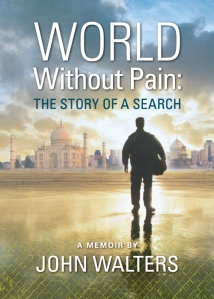
I began, as other published writers have, mainly with my backlist, that is, stories that had already been published.  It was an experiment, a test run.  I put together a collection, and also put the stories up individually.  Nowadays many people download individual stories to read on their phones or iPads or whatever.  Some of those early stories have decidedly mediocre covers – as I said, I was just learning.  But more recent ones have improved.  And the paper book covers are brilliant; loved ones who are graphic designers stepped in and helped me with them.  So far I have two physical books available for sale, “The Dragon Ticket and Other Stories” and my memoir “World Without Pain: The Story of a Search“.
In addition, in electronic formats there are around twenty or so individual stories and two more books:  “Painsharing and Other Stories” and “Love Children“, my first novel.  The
second story collection will be available on paper in about a month.

This is a phenomenon which will not go away.  As traditional publishers give up the ghost,
or constrict and shrink in fear of originality and innovation, artists will step in and make their work available themselves.  We don’t need publishers anymore.  They have been a sort of bastion, a citadel guarding the gates of art, but now that production and distribution are no longer solely in their hands they themselves must adjust to the changes
too.  I still, in fact, publish my short stories traditionally sometimes.  Just a few months ago my story “The Customs Shed” appeared in the anthology “Triangulation: Last Contact”.  But writers, including myself, now have a choice which we never had before, and I for one am taking advantage of it.  Royalties have begun to trickle in too.  May they become a flood.

It is a great feeling to see the writing on which I labored for so long available to readers.  And it is wonderful too to know that I can follow my muse and write whatever I feel led, without fear that powers-that-be can veto whatever they deem inappropriate.  They deride independent authors, and why?  Because they have set themselves up as watchdogs at the gates of literature, and they have been bypassed and bark in vain.  We are already inside the house, roaming freely wherever we will.

In closing, lest you think independent publishing is too much on the fringes, I will share a list of writers who in the past have self-published at least some of their work.  See if you recognize any of the names: William Blake, Willa Cather, T.S. Eliot, John Grisham, James Joyce, Stephen King, Edgar Allen Poe, Marcel Proust, George Bernard Shaw, Henry David Thoreau, Mark Twain, Walt Whitman.  They are all of them giants of literature; there are Nobel prize winners among them.  This is just a sampling; there are many more – not to mention the many best-selling contemporary authors who are turning to self-publishing.  Among them is J.K. Rowling, who is handling the electronic publishing of the Harry Potter books herself.

So support your local writer.  Buy a book.

Posted in On Writing | Tagged , , , , , , , , | Leave a comment

Short Story Author Highlight: Jack London

Jack London was an amazingly prolific writer.  Every day he got up early and before he did anything else he fulfilled his quota of words, which varied between one thousand and one thousand five hundred.  He wrote novels, autobiography, social studies, and much more, but in my opinion his best work shines forth in his short stories, of which he wrote
many.  It’s very difficult to choose just five to highlight, as he wrote so many great ones, so consider the stories I describe below as just a sampling, and go on to read more for yourself.  He had his weaknesses to be sure; he was chauvinistic and racist and pugilistic and espoused as a personal philosophy a strange mix of communism and individualism, but in his best work he rises above all that into the realm of art.  In my previous listing of my favorite short stories of all time I included “The Apostate” as his contribution, but I just as easily could have chosen one of the other stories listed below.  So here they are:

1.  The White Silence.  This one I almost put as my favorite of his works rather than “The Apostate”.  Three people journey across the Arctic waste on a sled drawn by huskies:
a man, Mason, his pregnant Indian wife, Ruth, and Malemute Kid, a recurrent character in several stories.  London masterfully describes the snow-covered wilderness, the shrouded trees, the pale pitiless sky, but most of all the overwhelming, awe-inspiring silence by which they are surrounded.  At one point they pause for a rest, and a branch breaks off one of the frozen trees and crushes Mason.  This leaves the woman destitute, as she had forsaken her people and cannot return to them.  Mason obtains Malemute Kid’s promise to help the woman.  Short of supplies, they wait a day but can find no game for food, and Mason falls into a coma.  In the end Malemute Kid is forced to shoot him and leave him high in a tree beyond the reach of wolves, that he might continue their journey and take Ruth to safety.  It’s a tragedy, yes, but a beautiful tragedy.  The prose is stark and poetic and brings tears to the eyes.

2.  The Red One.  Jack London wrote science fiction and fantasy as well as realistic literature; this long novelette, in fact, is a blend of realism and science fiction, and is one of my favorite science fiction stories ever.  He wrote it late in his short life, after his cruise aboard his ship, the Snark, through the Pacific islands, which then were little-visited and in places rife with cannibals and headhunters.  It concerns a man, Bassett, who becomes separated from his comrades and is trapped alone on an island pursued by savages.  He hears a strange thunderous yet sweet sound deep in the interior and becomes fascinated by it.  It turns out to be a huge red object of a metal unknown on Earth; it is some sort of alien artifact and is worshiped by the ignorant natives.  The price of his discovery is his life:  Bassett is captured and sacrificed to the huge sonorous red orb.  But he had been dying anyway, and in the end achieves a measure of peace and contentment and surcease from pain.  Another tragedy, yes.  London specialized in what he himself called death-appeal, struggles against pitiless environments and circumstances.  But there is beauty in such struggles, and in his unparalleled descriptions of such environments.

3.  Love of Life.  Two men, weak and short of supplies and food, hike across the barren tundra.  One of them sprains his ankle and the other leaves him there and walks on.  The story is of the abandon man’s fight for survival as he struggles to reach an outpost on the coast.  Day after day he continues, becoming weaker and weaker, searching for any scrap of food he can find.  A pitifully sick wolf begins stalking him, and eventually, after a terrible few days of being hunted, he struggles with the wolf and manages to kill it.  He
finds the body of his former companion on the way and his gold as well, but leaves it all there and crawls onward.  Unlike many London stories, however, this one has a happy ending.  He makes it to the sea and boards a ship which takes him back to civilization.

4.  In a Far Country.  Two men have joined many others in the rush to the far north to find gold.  In the company of more experienced travelers they journey through a primeval landscape as winter approaches.  Though all are exhausted, most of the party decide to trudge onward to reach a better place to winter.  The two novices, however, refuse to go further and determine to remain at a small cabin together to wait out the cold.  As winter sets in and their supplies begin to dwindle, they regard each other with suspicion and then
animosity.  Then follows a descent into madness, as the indifferent elements, loneliness, paranoia, and selfishness eat away at and consume them.  An awesome tale that builds up to a shattering climax.

5.  A Piece of Steak.  Jack London was very interested in prize fighting, and wrote several short stories and a short novel about it.  This is his best.  It concerns an aging Australian boxer with a wife and small children.  There is no money and little food left in the house, and he must win his next fight against a much younger opponent if his family is to eat.  He consumes the last bits of bread and flour gravy just before the fight, while his kids go hungry.  The young man with whom he competes is after glory, but he is concerned with survival.  London describes the fight, during which the old boxer ruminates on his
past career, with consummate skill.  For a time it appears as if the older man’s experience along with the young man’s overconfidence will see him through to victory, but in the end he lacks the strength to strike the knockout blow, and rues the fact that he hadn’t had just
a little piece of steak with his meal to give him the extra stamina he needed.  A heartbreaking ending, but inevitable.

As I said, Jack London is a great short story writer, and many others of his stories are well worth reading.  In addition, his novella “The Call of the Wild”, though long considered a children’s tale, is so much more.  It’s truly a masterpiece of adventure writing, and to miss it because it is ostensibly a dog story would be a mistake.  Give it a try, and enjoy.

Posted in Book Reviews | Tagged , , , , , , , | Leave a comment

Book Review: Dawn by Elie Wiesel

This book came to me by accident.  I was visiting the library at Anatolia High School in Thessaloniki one day and, as is occasionally the case, there was a pile of books on a table outside the door – books that had been purged from the collection, free for the taking.  I am wary of such books, as they are often not worth the trouble, either because they
are falling apart, or because they are lousy books.  But this one caught my eye because I had heard of one of Elie Wiesel’s other books, “Night”, due to it becoming one of Oprah’s book club selections.  Not that I follow her book club, but I read just about any article I
come across that recommends good reading material.

I figured “Dawn” might be some sort of sequel to “Night”, but it isn’t.  “Night” is an autobiography, the story of Wiesel’s internment in the Nazi concentration camps of Auschwitz and Buchenwald in 1944 and 1945, but “Dawn” is a novel.  It is considered, however, to be part of a trilogy, “Night”, “Dawn”, and “Day”, which draws on Wiesel’s Holocaust experiences.

“Dawn” is very short; my edition was 102 small pages with large print.  It is listed as
a novel but is a novella, really.  It is told in first person by a teenage survivor of Auschwitz and Buchenwald who has been recruited in Paris and then trained in Israel in terrorist tactics against the English.  This eighteen-year-old, Elisha, has been ordered to execute a captive British officer at dawn, and the story concerns his personal anguish at being given this task.  It takes place during the night before the execution, though there are flashbacks of earlier times.  There is a fantasy element as well, as ghosts from Elisha’s past show up to keep vigil and converse with him, including his father, his mother, the rabbi who was his teacher, some other friends and acquaintances, and a small boy who represents a younger version of himself.  Elisha realizes that the execution will change him, that he will become a murderer forever after he has done this deed, but nevertheless he feels compelled to follow through with it.

This book is not to be read for entertainment.  It is devastating, heartbreaking, depressing.  It shows a man at the mercy of a dark destiny which he cannot change, and shows war as an evil in which there are no winning sides.  It is told succinctly, in direct, spare, poetic prose.  There is no fat.  It is lean and abrupt, like a bullet in the brain.  It
is a parable, in that it could apply to any war in any age in which men who have no personal animosity towards one another nevertheless confront one another as enemies.

I recommend this book, but as I said, do not approach it lightly.  It is the type of literary
experience that changes people, knocks the silliness out of them, sobers them up, causes them to confront their humanity.  If you are up for this kind of experience, give it a try.

I’m a professional writer; I make my living by my words.  I’m happy to share these essays with you, but at the same time, financial support makes the words possible.  If you’d like to become a patron of the arts and support my work, buy a few of my available books or available stories.  Thanks!
Posted in Book Reviews | Tagged , , , , | Leave a comment

Loneliness versus Solitude

You can’t write about a subject like this unless you are going through it, or have gone through it.  And why should I be lonely?  I am surrounded by people.  I am almost never
physically alone.  Lately, nonetheless, I have been afflicted with loneliness, often intense loneliness.  Perhaps its because I am going through things in my life that are difficult to share.

Loneliness is like a cancer.  It eats away at you from inside.  It is rooted in desire.  You desire not just companionship, but a certain type of companionship.  It reminds me of my time, many years ago, on the road.  I had frequent, though fleeting, sexual liaisons with those I met in passing, but these relationships did nothing to assuage my loneliness.  Nor did having people around me.  For example, during my time at the firefighting camp in Northern California I was surrounded by all kinds of people, but I felt no kinship, no bond, with any of them.  My loneliness was something deep, something elemental.  I knew not what I sought or what would satisfy it, but I could not rest until I found it.  The loneliness debilitated me as would a disease.  It made me restless, dissatisfied, full of angst and despair, unable to fit in anywhere though I kept searching for a place to belong.

Solitude, on the other hand, is energizing.  Artists, philosophers, priests, prophets, all
seek solitude at some time or other.  Sometimes warriors seek solitude on the eve of battle.  Solitude is a good thing.  It gives calm, perspective, and peace of mind.  It bestows inner strength.  Invariably, if sought with the right motive and under the right circumstances, a person who finds solitude will be better afterwards for it.

But what is the difference between loneliness and solitude?  Merely a twist of the
mind.  And it came to me recently, as I have been struggling with an intense, gut-wrenching feeling of loneliness, that perhaps I could turn my negative loneliness into positive solitude, that is, something to be desired and sought after rather than something to work through and get over with or past.  Often people who crave solitude cannot find it.  Here I am in the position of feeling more alone than I want to feel.  Why not reach out and grasp the touchstone of decision, of free will, and turn my leaden loneliness into the gold of solitude?  After all, I cannot force decisions upon others.  It is only myself I can control, and that imperfectly.  But at least I can choose not to despair, and instead relish the opportunity that has been presented to me.  It will not last.  It never does.  But while I am alone, or at least feel alone, I should make the best of it, not the worst of it.  I will turn my chains into wings, my despair into hope, my tragedy into triumph.  I will not weep for myself, nor for others.  I will contemplate, I will pray, I will plan, I will dream.  In the Book of Proverbs it says, “The righteous man falls seven times and rises up again.”  So I will.  So I will, once again.  And as often as I must.

Posted in Uncategorized | Tagged , , , , | Leave a comment

Book Review: The Best from Orbit edited by Damon Knight

“Orbit” was a series of anthologies of original speculative fiction stories edited by Damon Knight in the 60s and 70s.  His aim was to expand the genre and select literary stories that would avoid the stereotypical spaceships and ray guns of pulp science fiction.  The series was quite successful and attracted some of the best writers in the field; the stories themselves won numerous awards.

I myself, as a young writer and avid reader of speculative fiction, followed the “Orbit” series for many years.  I didn’t always like or even understand all the stories, but there were enough gems therein to retain my interest.

I didn’t buy this anthology as an exercise in nostalgia.  In fact, I sought out and
bought this anthology – which after some years I found affordable used on Amazon – mainly due to one of its stories, a story that is in the list of my ten favorite short stories of all time:  “The Big Flash” by Norman Spinrad.  This story is not so easy to find, and I
hadn’t read it in years.  It’s a Cold War story.  The government decides to use
tactical nukes in Vietnam, and to stoke up popular opinion they raise up a rock
group, The Four Horsemen, to promote nuclear warfare.  The gambit “succeeds” far beyond their expectations.  Though it would seem the idea, in these more complex times, would be dated, such is not the case.  The story reads as fresh now as it had forty years ago when I first read it.

Concerning the rest of the stories, as with all anthologies, it is a mixed bag.  Some stories are dated, extremely so.  Some are joke pieces, some are slow and go nowhere.  But most are at least readable, and there are some other gems in the mix, such as “One Life, Furnished in Early Poverty” by Harlan Ellison, “Passengers” by Robert Silverberg, and “Mother to the World” by Richard Wilson.

It’s easy to see as you read through that Damon Knight had a predilection for a certain type of story.  By today’s standards some of his selections might seem odd, but at the
time he was fighting the general stultification and decay rampant in the field.  It was an era in which good literature was regarded with suspicion and taboos were numerous.  “Orbit” was part of the trend in the speculative fiction field which became known as “the new
wave”.  It was a much-needed blast of fresh air, a wake-up call to writers that science fiction and fantasy could be taken seriously as literature and could be written as serious literature.

Nowadays, some of the stories that at the time seemed so radical appear tame, and the literary pretensions of others are no longer considered pretentious.  But overall
there are enough good stories to make it worth the price of admission.  And for me, the Spinrad story alone was worth the long search and the price of the book.

Posted in Book Reviews | Tagged , , , , , , , | 3 Comments

Short Story Author Highlight: James Tiptree, Jr.

Most science fiction enthusiasts know that James Tiptree, Jr. was the pseudonym of Alice Sheldon, an employee of the CIA who killed her ailing husband and then herself back in 1987.  A brilliant biography called “James Tiptree Jr.: The Double Life of Alice B. Sheldon” by Julie Phillips won the National Book Critics Circle Award a few years ago.

Though James Tiptree Jr. is a pseudonym, I will use the name in this essay, as that is how she is know for most of her wonderful writing.  Usually when I list my favorite short story writers I list her at number one.  She wrote a few novels too, but it is in the short story genre where she excelled.  She wrote so many dynamic short stories that it is very difficult to choose just five, which is an arbitrary number to which I have limited myself.  In an essay on my favorite short stories I have already written about “The Women Men Don’t See”, one of her most famous stories, not because I consider it better than the others, but because it was so significant to the field when it first appeared.  Here are five more of her stories that blew me away:

1.  The Girl Who Was Plugged In.  This novelette won a Hugo the year it came out, and for good reason.  It’s a hip, fast-paced satire on advertising, the appeal of superstars, and the loneliness and alienation of the billions of unhip, unattractive ones who adore those that appear in the media.  The ugly P. Burke becomes the lovely ethereal Delphi and enters the world of glamour and riches, only to discover that it too is a world of ugliness, only it is the ugliness of hypocrisy and deceit.  The shattering climax is inevitable but masterfully told.

2.  And I Have Come Upon This Place by Lost Ways.  A group of scientists have come to a far planet to conduct research.  One of them, Evan, doesn’t quite fit in.  He’s too unorthodox; he doesn’t want to follow the rules.  On a high mountain called the Clivorn he spots a strange anomaly, but when he tries to point it out no one will pay any attention to him.  Risking everything to follow his hunch that it is important, he leaves the research ship as it is about to take off for home, fights his way past local aliens who try to stop him from setting foot on the sacred mountain, and climbs up to the summit to discover a strange alien artifact that has been there from beyond memory.  This encapsulated version cannot, of course, capture the power and sense of wonder of the story itself.  It ends in tragedy, as so many of Tiptree’s stories do, but leaves the reader with a sense of the overwhelming vastness of the universe.

3.  On the Last Afternoon.  This is a monster story, but though the monsters are huge and overwhelming and destructive, they are totally indifferent to the human colonists who have crash-landed and are trying to eke out an existence in a jungle clearing at the edge of an ocean on this alien world.  They are like a force of nature, like a hurricane or a tidal wave, but no less lethal to the tiny group of human survivors.  Once the humans realize the creatures are on their way they try to evacuate the vestiges of culture and technology they have managed to preserve from the wreckage.  One old man, Mysha, must risk everything to try to stop them.  The amazing thing about this story is the description of the alien invasion from the sea and the Earthlings’ attempts to stop them.  It’s hard to beat this kind of heart-pounding action writing.  The immense creatures that overwhelm the colony are some of the weirdest, most bizarre aliens ever presented in science fiction literature, and though they act out of instinct and not malevolence they are no less nightmarish and deadly.

4.  The Screwfly Solution.  Alice Sheldon originally published this story under the pseudonym “Racoona Sheldon”, but it was later included in collections by James Tiptree
Jr.  It won a well-deserved Nebula Award.  It’s a dark, creepy tale about a slow-spreading virus of the psyche that comes over men all over the world that causes them to begin to kill women.  At first those susceptible seem to be only the violent and fanatical, but then it
spreads until all women are in danger.  Tiptree frequently wrote about gender issues, and this is one of her most devastating, effective stories on the subject.  In the end, the reader discovers the reason for this wave of murders, but I will not spoil the story for you by revealing it here.

5.  Houston, Houston, Can You Read?  This is another story on the gender issue.  It won both the Hugo and the Nebula.  A spaceship bearing three men circles the sun and somehow ends up in the future, where all men have died in a plague and only women, who reproduce through cloning, remain.  The men come across a spaceship full of women.  At first they are rescued and welcomed, but then the differences between the two cultures
make it difficult and then impossible to get along.  The women come to the conclusion that the men have nothing to contribute that would make it worthwhile to integrate them into
the culture of the future.  Men have become redundant.  Tiptree smears the gender issue in the readers face, but she does it masterfully in the context of a science fiction adventure story, so that the reader is willing to get hit with a reality blast at the same time as she or he is being entertained.

There are other stories too, just as powerful, that I could have included here, such as “The Milk of Paradise”, “A Momentary Taste of Being”, “Slow Music”, and “Love is the Plan, the
Plan is Death”.  I urge you to seek out these stories and read them.  There is a great anthology that includes most of Tiptree’s best stories called”Her Smoke Rose Up Forever”.
It’s a good place to start.

Posted in Book Reviews | Tagged , , , , , , , , , , , | Leave a comment

Book Review: Henry Miller: The Paris Years by Brassai

“Brassai” is the pseudonym of Gyula Halasz, a Hungarian photographer who lived in Paris at the same time as Miller did, in the 1930s.  Henry Miller was quite enamored of his photos depicting the streets of Paris, which Brassai published in his first book, “Paris By Night”.  They met often, took long walks together (one of Miller’s favorite activities), ate, drank, and discussed anything and everything.  Brassai, as a result, knew all of the people
that Miller turns into characters in his books, and so is able to provide a fascinating insider’s look into Miller’s writings.

I found this book at the Strand Bookstore in New York, the one that advertises “18 miles of books”, though they neglect to mention that these books are stacked on shelves so high and claustrophobically close that it is difficult even with a high ladder to reach them.  For a book lover, of course, it’s worth the cliff scaling and neck craning and so on, because they really do have an enormous collection of used books.  The adventure started earlier, though, for my son and I, as we couldn’t find it at first and walked block after block in the blistering New York summer sun, baking between the towering buildings.  All part of the thrill.

This book though, the Miller book, was right out on a display table in a large pile.  They must have been remaindered copies; they were on sale for half price.  When I first spotted it, and up until I began to read it long afterwards in the wilds of the village country east of
Thessaloniki, Greece, I thought it was a biography of Henry Miller.  I have long been searching for such a biography, a comprehensive one that would lay bare the many secrets of his life so I could compare the man’s life with his work.  I thought maybe this would be at least a partial one, and figured the illumination of a few years was better than nothing.  Alas, that biography has still not yet been created.

This book by Brassai is not a biography but a series of essays on various aspects of Brassai’s relationship with Miller and on what he knew of Miller due to his association with him.  At first, upon discovering this, I was disappointed, but later when I took the book on its own terms I found much of interest.  The essay on Miller’s second wife June, for example, who provided the impetus to push him to relocate to France and was the
inspiration for the dark, conniving, complex, many-faceted, sexy, deceitful main female characters in several of his works, is alone worth the price of the book.  It’s also fascinating to read about how much trouble it was to get “Tropic of Cancer” published, how it was delayed time and again, how everyone except Miller, even the publisher, was afraid of censorship.  It’s interesting too when Brassai launches into comparisons between fact
and fiction in Miller’s works, bringing out the extreme exaggeration Miller indulged in for the sake of effect.  Brassai also writes of Henry Miller’s inspiration, his “voice”, when he would get into an almost trancelike state and pour forth some of his most effective prose.

In the end, entertaining though this book is, it is not the book I was looking for, and still look for.  I would like to see a detailed, comprehensive biography of Henry Miller by someone who loves the man’s work and has the patience to do the research necessary to separate fact from fiction.  That person is not me, alas.  I can envision the project, but I would not have the patience to see it through.  It would take much time, travel, and financing as well as patience.  But it is a sore need.  Miller is one of the most enigmatic writers of the twentieth century – even more, one of the most enigmatic and powerful writers ever.  His life deserves the attention of a serious study.  Some day soon, I hope, someone will undertake that great work.

Posted in Book Reviews | Tagged , , , | 2 Comments

Book Review: This Immortal by Roger Zelazny

Roger Zelazny exploded onto the science fiction scene back in the mid-sixties.  Two of his stories won Nebula Awards in 1966, the first year they were ever given:  “He Who Shapes” won the Nebula for best novella, and “The Doors of His Face, the Lamps of His Mouth” won for best novelette.  In addition, in the same year his novel “This Immortal”, which had appeared in “The Magazine of Fantasy and Science Fiction” under the title of “And Call
Me Conrad”, won the Hugo Award for best science fiction novel of the year, in a tie with the famous novel “Dune” by Frank Herbert.  Comparisons are inevitable, but I will
reserve them for later in the essay.

For years I have searched for this novel.  It has been long out of print, and unavailable for ordering as a new book from either physical or online bookstores.  And when I had found it used in online bookstores, it was always out of my price range.  Often I wondered why it was not reprinted in the British series of “SF Masterworks”, in which certain other
writers are overrepresented, and now that I have read it, I consider it a disservice that it was not.  Be that as it may, reprint lists are not representative of the general reading public’s taste but rather that of the editors of the series.  But on my last trip to the States, while browsing a small used book store in Seattle I managed to come across a good
copy of the book for the very reasonable price of two dollars.

It’s a short book, and that is unusual these days.  Most science fiction and fantasy books you see on the shelves are weighty tomes of one hundred to one hundred fifty thousand
words – more words for your buck, the publishers probably imagine.  But it was not always so.  Many of the classic award-winning novels of past decades were of shorter, more manageable length.  You can tell a great story in about fifty thousand words; it can be lean and tight, without extraneous stuffing to make it look fatter on a bookshop’s shelf.  So it is with this book.  There’s no fluff or fat or add-ons or ornaments.  Every word counts.

This book is a hell of a lot of fun.  In the beginning it seems a bit confusing and you wonder where it’s going.  But little by little Zelazny unfolds his story and you see that it is inevitable.  It’s complex and exciting, full of wild ideas and poetry and mythology.  Zelazny’s writing style was unusual and idiosyncratic; nobody wrote like he did.  I use past tense because he did not write long – in 1995 he died of cancer at the age of fifty-eight.

“This Immortal” exemplifies “typical” Zelazny, if anything Zelazny wrote can be called typical:  his use of mythological themes; his ability to set vivid scenes with minimal, starkly poetic description; a blend of heart-pounding science fiction action/adventure and deep intellectual acuity; brisk, snappy dialog; and a cast of interesting and diverse characters, of which the main one almost always seems more than a bit like Zelazny himself:  tall, lean, erudite, well able to defend himself, and habituated to cigarettes and alcohol.  It all makes for a great ride.

Now, at last, for the comparisons of this novel with “Dune”.  Uh – in fact, you can’t compare the two.  Contrast, perhaps, but not compare.  “Dune” is much more traditional:  a huge, complex, world-building book.  It is a wonderful book and just missed the list I previously published of my ten favorite novels of all time.  But it is nothing like “This Immortal”.  It is three or four times the length (if not more), has many more characters, and spans a much greater length of time.  And it is, as I mentioned, more traditional,
more classic.  “This Immortal” is innovative, brisk, flippant, seemingly almost off-the-cuff, as it were – more in the spirit and style of what was then being termed “the new
wave” in speculative fiction, a genre-shattering attempt of certain writers to burst out of narrow pulp confines into the realms of serious literature.  I like both “Dune” and “This Immortal”, and I think it was a great move that the Hugo Award that year was shared between them.  There is room for great diversity in speculative fiction.

I highly recommend “This Immortal”.  It’s entertaining, thoughtful, poetic, exciting, and stimulating.  I only hope you don’t have to wait as long as I did to find a copy.

Posted in Book Reviews | Tagged , , , , , | 1 Comment