Book Review:  The Devil’s Teeth: A True Story of Obsession and Survival among America’s Great White Sharks by Susan Casey

In the days when there were only four channels on TV, no cable, and no streaming services, my friend and housemate Rolf and I used to go to a lot of movies. On one occasion we went to a downtown theater to see Spielberg’s box office sensation Jaws. My friend usually manifested an image of bravado, but when we came out of the cinema he was visibly shaken, trembling even. When we ducked into a bar to have a pitcher of beer and play some pool, he could hardly hold his pool cue, let alone keep it steady. He confessed that he wasn’t afraid of much, but he had a strong, irrational fear of sharks. I think that there are many people with similar paranoia. After all, sharks are immense, savage carnivores of the deep, lying in wait in the depths to attack unwary prey.

The mystique and primal fear of sharks plays a large part of the allure of The Devil’s Teeth. The previous book I read by Susan Casey, The Underworld, Journeys to the Depths of the Ocean, is an account of historical and contemporary efforts to study the deep ocean and its denizens. In contrast, The Devil’s Teeth reads more like a memoir chronicling several visits that Casey made to the Farallones, an archipelago about twenty-seven miles west of San Francisco. The title of the book refers to the clump of islands, which are collectively known as the Devil’s Teeth. But surrounding the islands are the devils of the sea, great white sharks, which especially during the fall months of September through November, congregate in the waters off the islands in two groups. The scientists refer to a team of males as the Rat Pack, and a team of truly immense females as the Sisterhood.

The Farallon Islands are a protected area, and there is only one inhabitable house on the island of Southeast Farallon. For decades a team of scientists has lived on the island and studied its populations of birds and mammals such as seals, but during shark season specialists also study the great white sharks and their attack patterns. They scan for attacks from a lighthouse on a hill. When they spot them, they launch a boat that is smaller than some of the sharks, and head out to document the activities with underwater cameras held on poles.

For Casey’s first visit, she was allowed a permit for just a couple of days during shark season. She came back for a short time during the summer, when the island was covered in breeding birds, but this was not enough to satisfy her journalist’s curiosity. She was not allowed to stay longer on the island, so to be able to remain for an extended period during shark season, she rented a yacht and anchored it offshore, which was technically permitted. We normally associate the word “yacht” with luxury, but this boat was old and untrustworthy, with plumbing that spewed waste, a fridge that stopped working, and unreliable electricity. During storms the boat would pitch and toss, making sleep impossible. Nevertheless, Casey endured the discomfort for the opportunity to go on shark watches with the scientists and observe how they work.

This is a thrilling book about a unique, primitive part of the world that is in fact only a short hop off the coast from San Francisco and Silicon Valley. It seems strange to have such opposites in such close proximity. As I mentioned above, this book does not delve as deeply into background and history as Casey’s The Underworld. For instance, I would have appreciated, and in fact was hoping for, a historical overview of the study of white sharks. Instead, it focuses solely on the Farallones. In this context, though, it is fascinating and fully absorbing.

I’m a professional writer; I make my living by my words.  I’m happy to share these essays with you, but at the same time, financial support makes the words possible.  If you’d like to become a patron of the arts and support my work, buy a few of my available books or available stories, or to send a one-time or recurring donation click here. Thanks!

Posted in Book Reviews | Tagged , , , | Leave a comment

Book Review:  Playground by Richard Powers

My God this is a beautiful book. This is why I read: to discover gems like this. I don’t think it’s perfect; it gets a little confusing at the end and some of the threads remain unresolved. But it is absorbing through and though, and it has deep sympathetic characters, and it deals with important, cutting edge topics.

Ostensibly it concerns the proposal by a group of Americans to begin building, on the tiny Polynesian island of Makatea, floating cities whose inhabitants can live on the open sea. The concept of floating cities intrigues me, and that’s why I picked up the book. However, the floating cities idea never even comes close to initiation. It is a frame on which to construct a complex plot that involves the lives of four characters of starkly different backgrounds, the importance of protecting the ocean and its ecosystems, and the inevitability of advanced artificial intelligence.

Rafi Young, a young Black man deeply absorbed in literature and reading, forms an unlikely friendship with a young white man named Todd Keane, partially due to their mutual fascination with games such as Chess and Go. Todd goes on to become a tech billionaire (by inventing a complex game/social network called Playground) and one of the main financers of the floating cities project, while Rafi marries a part-Tahitian woman named Ina Aroita and goes with her to live on Makatea. The other main character is a French Canadian woman named Evie Beaulieu; her father helped invent the aqualung, and Evie’s early exposure to it helps to inspire a lifetime of exploring the ocean as a marine scientist. It is mainly through her eyes that readers experience the wonder and awe and vastness and importance of the ocean.

Powers tells the background stories of each of these main characters, alternating between these flashbacks and the situation concerning the floating city concept in the present day. At no time, though, do the cuts from scene to scene become confusing. Powers deftly and artistically weaves the disparate pieces into a coherent whole, so that we are carried along on what becomes a fast-paced ride from the past into an uncertain future. What is intriguing is that Powers does not make the solution simple. There are compelling arguments for both sides. If the floating cities are constructed on Makatea, it will mean well-paid jobs for the islanders, and among other amenities a new hospital and a new school. However, the construction will also cause irreparable damage to the marine ecosystems around the island and to the casual, comfortable way of life to which the island’s residents have grown accustomed.

I don’t want to give too much away, because part of this book’s appeal is in the excitement of discovering these things for yourself. What shines brighter and brighter as the story proceeds, though, is Powers’ genuine concern for the environment, a concern he passes on mainly through Evie’s life and observations as an undersea explorer and oceanographer. What also becomes clear early on is that Powers is a very powerful and poetic writer. He doesn’t merely tell the story; through his precise, complex descriptions he helps readers dive in and experience what is happening along with the characters.

All in all, this is a first-rate, absorbing novel that I highly recommend. And having now glimpsed his talent, I’ll be looking forward to reading more of Powers’ work.

Posted in Book Reviews | Tagged , , , | Leave a comment

Resolute for the New Year

That title above is not a typo. I intended to write “resolute” instead of “resolutions.” At this time of year, a lot of people announce various ambitions or goals that they promulgate as resolutions, but many of these resolutions turn out to be holiday whims or wishful thinking; they might be initiated with great zeal, only to be abandoned, in the light of reality, a few weeks down the road.

To be resolute, on the other hand, means to be bold and determined in pursuing a course of action, to be confident, decisive, adamant, implacable, unrelenting, steadfast, and single-minded. Resolutions fall by the wayside because they are only individual pieces of a larger goal; when they prove to be impractical and are abandoned, this can lead to discouragement and a diminution of self-worth. If you are resolute, however, you relentlessly proceed toward your objective even if you have to experiment with diverse means of getting there. Attempting and discarding specific methods denotes progress, not failure.

Do your best at what you are already doing. If you need to reset your goals, fine: do that. So much of life involves trial and error. But it’s not a game we are playing. We are doing it for real.

In my case, I have met many of my life’s goals. I wanted to travel, and I lived overseas for thirty-five years and visited numerous countries in North America, Central America, Europe, the Middle East, and Asia. I married. We had children. We raised them to be strong, intelligent, thoughtful, considerate adults. Now they are grown and gone, as they should be, and they are prospering.

The one area in which I have not succeeded as much as I had hoped concerns my writing. This has been a primary life focus for me since I was a teenager. I have written and published almost forty books, and over forty of my stories and essays have appeared in magazines and anthologies. However, I sometimes become discouraged because to most readers I am still unknown. That discouragement, if allowed to fester, could result in my giving up and throwing in the bloodied towel. But here is where remaining resolute comes in. I can’t force editors to buy my stories or readers to read them; those things are beyond my control. What I can do, though, is keep writing and attempt to make each piece the best it can be. Not long ago I wrote and published an essay called “Write Better Stories.” Someone on Facebook had put forth the question, “What is the best writing advice you have ever received?” My response was to quote my former teacher, Harlan Ellison, who said, possibly tongue-in-cheek, “If they are not buying your stories, write better stories.” Of course whenever I am working on a story, I try to make it the best thing I have ever written. But the underlying message of this advice is to remain resolute. Whatever you are doing, don’t give up. If you know you are on the right path, continue to move forward and make progress regardless of the obstacles that might be in your way. In the course of your journey, you may need to discard some methods (resolutions) and embrace others. No matter. The important thing is to persist. As for me, I have said it before and I’ll say it again concerning the writing: they’ll have to pry the keyboard out of my cold dead hands.

Posted in Uncategorized | Tagged , , | Leave a comment

Book Review:  The Wide Wide Sea: Imperial Ambition, First Contact and the Fateful Final Voyage of Captain James Cook by Hampton Sides

I love a well-written true life historical adventure, and this is a great one. It tells the story of Captain Cook’s third and final voyage, a voyage on which he was killed in the Hawaiian Islands. The depth of research and amounts of fascinating facts are amazing, but even more amazing is that despite the abundance of details, the author Sides manages to keep the story fast-paced and thrilling every step of the way.

This voyage is one that I am content to take from an armchair, thank you. It’s not that I don’t like traveling: I’ve roamed around the world, hitchhiking and taking public transportation across the United States, around Europe, across the Middle East, and around the Indian Subcontinent. The way was often rough, and I was often broke or near broke, but I almost always managed to find congenial companionship, good food, and a safe place to lay my head. The conditions on this third voyage of Cook’s, though, and presumably on the first two as well, were appalling to say the least, especially for the common sailors: dampness, heat, cold, filth, rats, cockroaches, close quarters, and often disgusting cuisine. Why did they do it? Well, for one thing, conditions weren’t much better at home and this was probably the only job for which they were suited. But besides that, they reveled in the adventure of exploring new lands; they looked forward to liaisons with willing Polynesian women; and most of all, they craved a share of a generous reward offered by the Crown if they located and navigated the fabled Northwest Passage over the North American continent from the Pacific to the Atlantic Ocean.

I had studied a bit about Cook’s journeys back in high school, but this is something I never knew, or at least I’d long since forgotten: that one of the primary goals of this third voyage of Cook’s was to search for a water route back to England through the Bering Sea and beyond. The trip took years, and along the way Cook charted the islands in the Pacific as well as the Northwest American coastline. He left just as the American colonists were signing the Declaration of Independence, and was unaware of the escalating Revolutionary War until many months later. He traveled from England to Cape Town, South Africa, and from thence to Tasmania, New Zealand, Tahiti, and other tropical islands. On his way to Alaska, he discovered Hawaii and its inhabitants, which no one in England knew existed. Then he made his way north, along the coastline of the Oregon Territory and Alaska, journeyed as far as he could before being stopped by solid ice fields, and then returned to Hawaii, where he was killed.

I’m not giving any spoilers here; you can find this all out in Wikipedia. What makes this book difficult to put down is the way that Sides tells the story. It is full of details, as I mentioned, but these details help to immerse you in the adventure, so that you can feel the sea spray, experience the frequent storms at sea, shudder from the bone-chilling cold, dread the unknown while sailing through thick fog, and revel in the calm interludes of abundance and romantic entanglements during stopovers in islands such as Tahiti. The author’s skill as a writer makes it all come alive, as if you are a participant in the action.

As I said, I am content to sit this adventure out in an armchair, but nonetheless I am thankful to Sides for making it possible for me to partake of it, at least vicariously. It’s a thrilling tale of a high-stakes voyage on the high seas that holds the attention from start to finish. Highly recommended.

Posted in Book Reviews | Tagged , , , , , | Leave a comment

Life Is a Gift

As I mention at the beginning of this essay, I wrote it a few weeks before Christmas. My first thought was to post it a week or so after Christmas, possibly even after New Year’s Day, because I thought it might not be upbeat enough for the Christmas season. But in fact, you’ll discover as you read that it has a happy ending. And after pondering the situation, I realize that gift-giving, for a lot of people, is a big part of Christmas. It is an opportunity, albeit flawed and rife with possibilities of error, to express love for those who are particularly special in our lives. Since December began, during meals I have been re-watching Christmas movies and Christmas episodes of series such as the Simpsons, Family Guy, American Dad, and Futurama, and it is amazing that so many of these focus on the topic of selecting and giving gifts. This essay concerns the greatest gift, one we have all received regardless of merit or lack thereof. It is freely received year-round by a lot of people, regardless of the calendar date. And so here are my words for you, on Christmas day, celebrating the gift of life.

I’m writing this a couple of weeks before Christmas, but I probably won’t publish it until after the holidays. It deals with some intense emotions, and I don’t want to bum anyone out. At the same time, I think that by the end it will ultimately be uplifting.

To dive right in: I had a down day. A very down day. Most of the time I am able to maintain a state of serenity and contentment, but once in awhile, every week or so, my mood takes a dive and I struggle, as if I am fighting to stay afloat in a sea of depression. The two main causes of this are part of my ongoing situation. One is that I live alone and I often deal with intense loneliness. You see, I’m an empty-nester. My ex and I raised our family in Greece, but as my sons matured into teenhood and adulthood, a massive economic crisis hit the country, and opportunities for higher education or employment became nonexistent. I decided I had to get them out of there and off to the States, where they had a better chance to thrive. My wife stayed behind with the youngest and I left with the rest of the boys, those, at least, who were not already in the States. Eventually, when she saw how well the boys were doing, she brought the youngest over too. So for about a decade I was a single parent, and my main focus in life was the welfare of my progeny. But then, one by one they left and went off on their own. A few years ago the youngest moved out, and I was left alone. That is as it should be; my sons should be off pursuing their destinies, and to a degree knowing that they are doing well mitigates the pain of loss. But I am used to being surrounded by a large family, and now there is just me. You would think that I would eventually get used to it. But I haven’t. As I said, I can usually keep my equilibrium and remain serene and content, but once in a while something tips the scales and I founder.

The other cause of my discontent is my financial situation. In Greece I taught English as a second language and I got quite good at it. I was well paid by the language schools I worked for and had as many private students as I could handle. My intention, when I returned to the States, was to continue teaching. When we landed in San Diego, I went around to every language school in the city and presented my resume and letters of recommendation, and some of the schools were impressed enough to want to hire me. However, a technicality prevented them. They said that I had to have a college degree, and I didn’t. So I looked for another job. I searched for months. I applied at a multitude of companies for all sorts of positions, including warehouse work, driver’s assistant for UPS, and salesman at a hardware store. A tech company almost hired me but then backed off because of my age; I would have been at least a couple of decades older than anyone else in the office. In desperation, I looked for writing work online, and eventually I found some, ghostwriting articles and blog posts. For awhile I worked exclusively for a private Medicare firm, writing articles for their blog, but most of the time it was piecework. Every day I had to search for assignments. But I usually found them. I wrote articles on travel, health, sports, business, finance, literature, and a variety of other topics. For a long time it was enough to keep my sons and I with enough to eat and a roof over us. A few years ago, though, those markets started to shut down. More and more businesses began to settle for inferior but cheaper AI-authored material, and one by one the websites where I had found employment closed. Now I am living off the scrapings of what was once a thriving occupation, and I keenly feel the loss of income. I barely get by month to month.

The thing that knocked me off my stability this morning was an email from the management of my apartment complex that they were sending around new contracts for the tenants to sign. Just a few months ago the manager had told me that they were doing away with contracts and all tenants would pay month to month. This sounded good to me, as I also had received notice of a substantial rent increase, and I was unsure if I would be able to come up with it. Month by month rental meant that I was not tied to an agreement for a specific amount of time.

Anyway, the email shouldn’t have thrown me for such an extreme loop, but it did. I wondered what the hell? What is it all for? It is so hard to survive, and all I had to look forward to was continuing loneliness. That’s when the thought struck me.

Life is a gift. Every moment of it. And most people seem to realize it and struggle to survive even under horrific conditions. Let’s face it: I might be lonely, but I have a good, clean, safe place to live, enough to eat, and loved ones who care for me, even if they are not in close proximity. People cling to the precious gift of life even under horrific conditions: as soldiers at war, as prisoners, as inmates in concentration camps, as castaways in remote locations, as patients in hospitals, despite agonizing injuries, illnesses, traumas, loss of limbs, loss of loved ones, loss of possessions. Through all of these things and more people strive to hold onto the gift of life. Yes, life is beset with sorrow; it is part of the human condition. However, it is also suffused with joy: the joy of accomplishment, of the attainment of goals, of the appreciation of natural beauty, and most of all of the love we share with those close to us and with all of our fellow humans. The fact is that life is precious but it is also finite. Sometimes we lose sight of our mortality, but sometimes it is good to be reminded of it, so that we cherish each moment and spend it wisely.

I promised you a happy ending. Well, the realization that life is a gift should be cause enough for joy, but here’s more. The problem with the lease I mentioned, the one that had set off my depression, was satisfactorily solved. When I went to the office and asked about it, the manager assured me that nothing had changed. I was still renting on a month by month basis; the leases were formalities insisted upon by the central office that did not apply to me. He said that all I needed to do if I had to move was to give notice twenty days early, and there would be no fines or other penalties. This reminded me of a lesson that I have had to learn many times in my life. Sometimes when we receive what we perceive to be bad news or circumstances appear adverse, we anticipate worst-case scenarios instead of patiently persevering until we find out for sure. At least that’s frequently been true of me. Often, as events transpire, I am reminded that things are seldom as bad as I imagine them.

Posted in Memoir | Tagged , , | Leave a comment

Strange Christmases – Part Two: Penang, Malaysia

On one of the strangest Christmases I have ever spent, when I was all alone on the island of Penang in Malaysia, I received an unusual but intensely valuable gift: a clue that led me toward my destiny.

This was during the period of my life when I lived and traveled overseas for thirty-five years. I had been living in Nepal, had met a woman from New Zealand, and had gone with her to her home country. When we broke up, I flew back to my home town of Seattle via Los Angeles (where I briefly visited another ex-girlfriend). After an interlude with my family in Seattle and a brief flurry of work to raise landing funds, I was ready to be off again. My mother worked for Pan Am Airways and was able to obtain tickets for me at ten percent of cost, so I flew from Seattle to San Francisco to Hong Kong to Jakarta. In Indonesia I joined an Australian friend on a road trip across the island of Java to Bali. When I returned to Jakarta, I flew to Singapore, and after spending a few days in that idiosyncratic city-state I took a train to Bangkok. There I moved into a communal home with other young travelers and taught private English lessons.

All went well until I’d been there almost a month and my visa was about to expire. To renew it I had to take a train ride to the Malaysian border and back. I was making enough money for self-support but I couldn’t afford the visa trip. What to do?

The answer came out of the blue. A Thai film production was looking for foreign extras to appear in a Thai-language movie. Since one of my roommates knew someone on the crew, she managed to get several of us hired. All we had to do was dress up like hippies and walk in a bedraggled bunch through a section of the Bangkok Airport concourse, where we would appear as background color behind the main Thai actors. For that brief appearance, the other foreign extras and I were not only taken to a fine restaurant and treated to normally-unaffordable cuisine, but also paid enough to cover my round-trip train ticket to Penang and back with enough left over for food and a few nights at a hotel.

And here’s the holiday tie-in: my visa trip happened to take place over Christmas. There was nothing I could do about it. If I waited to celebrate the holiday with my friends, I wouldn’t make it out of the country in time and would risk getting penalized for overstaying my visa.

So it was that on Christmas day I sat at an outdoor cafe in George Town, Penang, perusing an English-language newspaper travel supplement that someone had left at the table. And in it, there were two human-interest articles about India. I had already spent a few years altogether on the Indian Subcontinent, in India and Nepal and Sri Lanka, and I loved it. It was one of my most favorite places on Earth, and if it had not been for the ubiquitous visa vicissitudes, I might have been there yet. One of the articles, I recall, was about an isolated island in the Andaman cluster where primitive tribes were protected by law from civilization. I forget the details of the other article. The point is that they got me thinking about India and how much I missed it. I decided then and there that when I got back to Bangkok I would somehow raise the money to return. As I made the decision, I burst into tears.

Destiny indeed. For on that next visit to the Subcontinent, I would eventually meet the Greek woman who would become my wife and the mother of my five children. All in all, at that cafe in Penang on Christmas Day, I made one of the best decisions of my life.

Posted in Memoir, Travel | Tagged , , , , , | Leave a comment

Strange Christmases – Part One: Goa, India

As we enter into the winter holiday season, I find myself looking back to some of the unusual places where I have spent past Christmases. The first that comes to mind is Goa, India, in the mid-1970s. I had spent the summer hitchhiking around Europe; as I was enjoying Greece late in August, wondering what I should do next, knowing that the hot weather would soon wane, I began to hear of other young budget travelers heading across the Middle East to the Indian Subcontinent. This was in the days when the Overland Trail, also known as the Hippie Trail, was still open, and you could travel by hitchhiking or on cheap public transportation across Turkey, Iran, Afghanistan, and Pakistan all the way to India and beyond.

The idea deeply appealed to me. I had come this far partially due to the example of literary progenitors such as Ernest Hemingway and Henry Miller. They had got as far as Europe, but if I struck out farther east, I’d be accomplishing something that even they had never attempted. The problem was that I’d almost run out of money. So I first hitchhiked back up to a friend’s place in Holland, where I worked in factories for a couple of weeks and saved up two hundred dollars. I then set out on my journey through Holland, Germany, Austria, and communist Yugoslavia and Bulgaria to the Turkish border. I managed to hitchhike with European truckers all the way to Kandahar in Afghanistan before I switched to buses and trains. By the time I made it to Bombay (what Mumbai in India was then known as) I had heard from numerous travelers that they were headed for Goa to celebrate Christmas. Goa was on the coast south of Bombay, and because it had been a Portuguese colony, there was still a strong Catholic influence.

And so, as Christmas approached, I found myself in a warm tropical paradise with incomparable sand beaches, coconut palms lining the shores, unimaginably beautiful sunsets, and friendly welcoming people. Oh, and quite a few of the foreign women would sunbathe in the nude, oblivious to the crowds of Goans who would observe them from polite distances. It wasn’t exactly the white Christmas that Bing Crosby sings about, unless you count the color of the sand on the beaches, but it bustled with activity and its own version of holiday cheer. The accommodations and food were dirt cheap, and many Goans were eager to extend hospitality to the foreigners who had come for the season.

All went well for several days. However, it was on Christmas morning, as I recall, that I was strolling from the room in a thatched hut I shared with several other foreigners to the seashore when I passed a shack with a makeshift kitchen where a Goan was preparing and selling masala dosa. These are folded-over pancakes with potato curry inside, and when they are prepared properly, as these were, they are delicious. I had three, and then continued on my way to the beach. I did not, however, account for the cook’s lack of sanitary precautions. Later in the day, I began to feel uneasy, and not long afterwards, my stomach erupted in pain. For the next three days I lay on my bed too weak to move, except to make frequent trips to the outhouse, where the resident pig waited underneath to noisily consume whatever I discharged. Finally one of my roommates called an Indian doctor, who stabbed me in the ass with a needle-full of what I presumed was penicillin. I was soon able to travel again, although my stomach was tender for several days.

All in all, despite the malady, my Christmas in Goa was a wonderful interlude. After all, as a budget traveler on the Subcontinent I expected to catch some sort of illness now and again. It was one of the prices I paid for a glorious adventure, and it was well worth it.

Posted in Memoir, Travel | Tagged , , , , , | Leave a comment

A Christmas Gift for My Blog Followers

As a Christmas gift to readers, I have enrolled electronic editions of some of my books and stories in the Smashwords End of Year Sale, which runs from December 12th through January 1st. Complete books are half price, marked down from $3.99 to $1.99. Short stories and mini-collections of essays and memoirs are available to download for free. Take advantage of this sale to stock up on some great reading material.

If the discount price does not appear on my profile page, click on the link to the specific book you are interested in and you’ll see the deal.

Smashwords was the digital distributor I used when I first became involved in electronic publishing, and when I later switched to another distributor, I left numerous editions of my early works in the Smashwords catalog. You can find a complete listing at my author’s profile here.

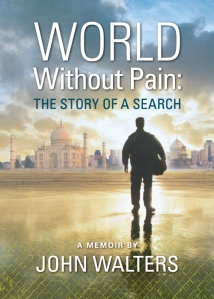
Among the books available at a half-price discount are my memoirs World Without Pain: The Story of a Search, After the Rosy-Fingered Dawn: A Memoir of Greece, and America Redux: Impressions of the United States After Thirty-Five Years Abroad; the novels Love Children, The Misadventures of Mama Kitchen, and Sunflower; the collections The Dragon Ticket and Other Stories, Painsharing and Other Stories, Dark Mirrors: Dystopian Tales, and Opting Out and Other Departures; and the essay collection Reviews and Reflections on Books, Literature, and Writing.

The stories available for free include some of my personal favorites such as “Dark Mirrors,” “The Customs Shed,” “Life After Walden,” and “Noah and the Fireflood.”

So head on over to Smashwords and pick up some thrilling and thoughtful novels, short stories, memoirs, and essays at deep discounts and even free. Merry Christmas!

Posted in Uncategorized | Tagged , , , , , , , | Leave a comment

Book Review:  Opposable Thumbs: How Siskel & Ebert Changed Movies Forever by Matt Singer

Before I read this book, I had no idea of the existence, let alone the popularity, of the Siskel & Ebert film criticism TV show and its various iterations such as Opening Soon at a Theater Near You, Sneak Previews, and at last simply Siskel & Ebert. The rise of their renown as the nation’s most famous film critics coincided with my departure for other continents in the 1970s and my return in 2012. Although I watched a lot of English-language TV when I was living in Europe, I never came across Siskel & Ebert’s shows. While raising a family in Greece, though, I did become aware of and learn to appreciate Roger Ebert’s written film criticism by means of his website RogerEbert.com. I didn’t agree with some of it, but I liked the way he expressed his ideas, and I often sought out his opinions after I’d seen a film and formed my own. I also read and enjoyed his memoir, Life Itself.

The title Opposable Thumbs refers to Siskel and Ebert’s “thumbs up, thumbs down” rating system, which became so famous that they trademarked the “two thumbs up” top rating. One of the main points that this book makes is that though these two men worked together for decades, they were often at odds with each other. In fact, their near-constant bickering on camera about the merits or drawbacks of various films is what fueled their popularity and drew millions of viewers to every episode.

In the beginning, Siskel and Ebert both worked as film critics at rival Chicago papers. Shortly after Ebert won a Pulitzer Prize for his film criticism, the local PBS station decided to initiate a show in which critics discussed movies, and these two were the obvious choices to star in it. The show eventually moved from PBS to national syndication, until it ultimately ended up at Disney’s Buena Vista studios. Siskel and Ebert became very wealthy and influential men, and also recognizable celebrities who made frequent appearances on top late-night talk shows.

As I progressed through this book, all of this was new to me. As I said, I never encountered mention of the show in Europe, and to this day I don’t think I’ve ever read one of Gene Siskel’s written reviews. I’ve also never seen an episode of the show. (Interlude: While writing this review, I took a quick side-trip to YouTube, and sure enough, you can find episodes of Siskel & Ebert there. I took three minutes to watch their review of the movie The Shawshank Redemption, which, by the way, they both loved.) The point is, though, that the true story of Gene Siskel and Roger Ebert’s unlikely but wildly successful partnership unfolded for me without any preconceptions on my part, just like a film that I’m seeing for the first time.

I love movies too; I always have. However, I am not enamored of most film critics. Nowadays, in this era of social media when anyone can post anything, there are simply too many people all offering their opinions at once, and it is hard to know who to trust. Back in the closing decades of the twentieth century, this was not the case; Siskel and Ebert reigned supreme. This book is a fascinating account of their rise from obscurity to celebrity. The one thing I would like to have seen is a list of their specific opinions about various famous films, perhaps in an appendix or whatever. Otherwise, this is an interesting account of an era that social media, in some ways, has rendered obsolete.

Posted in Book Reviews | Tagged , , , | Leave a comment

Books Make Great Gifts!

After Thanksgiving has come and gone, people commence a search for holiday gifts for family members, relatives, friends, acquaintances, in-laws, outlaws, colleagues, and sometimes total strangers. If you’re looking for fun, sophisticated, lively, intense, flamboyant, and otherwise variegated literary fare, I’ve thus far published over thirty-five volumes in a range of genres through Astaria Books. Here are some examples of choice gifts you can bestow upon your loved ones. If you click on the titles, the links are to Amazon, but for lists of links to other marketplaces, head for my website’s Available Books page.

Science Fiction:

After the Fireflood: A Novel – During the Fourth World War, the entire Earth is engulfed in a torrent of fire, transforming the landscape and obliterating all life.  Using terraforming, time travel, and other expediencies, human survivors from Moonbase and the outer colonies attempt to cope with their devastating loss, reconstruct the Earth’s surface, and reorganize Earth sociologically to ensure lasting peace, while others plot to claim the pristine reconstituted planet for their own purposes.

Bedlam Battle: An Omnibus of the One Thousand Series – In the late 1960s, humans and sympathetic aliens based out of Haight/Ashbury struggle to stop alien-possessed psychopaths intent on a murderous rampage. Four science fiction thrillers in one volume.

Love Children: A Novel – It is the mid-1970s.  The Summer of Love and the Woodstock Music Festival have come and gone.  Into the atmosphere of cynicism and doubt following the wild optimism of the youth revolution the Love Children, raised from birth by benevolent aliens, come home to Earth.  Sexually free, telepathic, and honest to the extreme, they are appalled to find that the planet they left behind is full of darkness and deceit. As they set about using their extraordinary powers to bring light and unity back to their world, they run up against a sinister alien force intending to keep it in darkness.

Dark Mirrors: Dystopian Tales – These tales offer terrifying glimpses of Earth’s future gone wrong. From the author’s afterword:  “When I postulate dark futures it is not to get you to despair.  When I hold up dark mirrors before your eyes it is not so that you will see the worst in yourself and do yourself in.  Far from it.  Some of our greatest illuminations come from deep dark prose.  Dark literature is not meant to overwhelm us.  It is meant to purge us, to provide catharsis.  It is a cleansing and purifying process.  We must be aware of the evil within before we can clean it out.”

Fantasy:

Caliban’s Children – Content is being siphoned from libraries and replaced with half-truths and lies.  Weather, time, and distances are distorting like images in a funhouse mirror.  People are discovering the ability to morph into animals.  At first it all seems idyllic and magical until a dark power begins to manifest itself, assert control, and demand obedience.

Ethan is a university student caught in the midst of a kaleidoscopic confusion he cannot understand.  After journeying into the wilderness seeking answers, he realizes he has to ally himself with the beasts of the Earth and venture into a bizarre, mutating, peril-filled city to rescue his lover and attack the source of the evil.

Fear or Be Feared: Fantasies – In these fourteen weird, surreal, frightening, and fantastic tales, unwary people discover that the world is very different from what they imagined.

Thriller:

The Fantasy Book Murders – After a famous fantasy writer is murdered in his castle-like mansion, two unlikely investigators discover a pattern of similar murders suggesting a serial killer. They begin to research the killings, starting with the most recent and working backwards into the past. Danger mounts as they uncover the backgrounds of the victims and the truth begins to resemble the fantasy writer’s most bizarre and horrific fiction.

Novels of the Counterculture:

The Misadventures of Mama Kitchen – Sarah Tabitha Jones, a twenty-year-old fascinated by the youth culture of the late 1960s, leaves her middle-class home and wanders to a wilderness commune and then to the Haight/Ashbury in search of truth. On the way she encounters many strange characters: bikers, draft dodgers, Vietnam War veterans, peyote worshippers, heroin dealers, Jesus people, feminists, violent anarchists, Black Panthers, and science fiction fans. She experiments with drugs and sex, but at the same time helps out those she can; though often disillusioned, she believes that hippies should unite to create a better world. In the midst of all this she finds herself pregnant. Eight and a half months later, undaunted, belly bulging, she travels to Woodstock for one last attempt at finding the love and unity she seeks. The Misadventures of Mama Kitchen will appeal not only to those who lived through the disconcerting era of the 60s and 70s but to those younger who are curious about what took place back then. It will also resonate with anyone who is idealistic and in search of personal fulfillment, as well as those who simply enjoy a wild tale: sometimes comic, sometimes tragic, sometimes violent, sometimes sexy, always extreme.

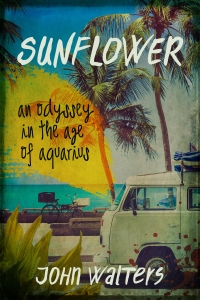
Sunflower: A Novel – In early 1970 a new era, the Age of Aquarius, is dawning. Penny, who adopted the name of Sunflower on the way to the Woodstock Music and Arts Festival, attends another rock concert touted as Woodstock West, at Altamont Speedway near San Francisco. Seeking to enhance the transcendent experience, she instead comes away covered in the blood of a man brutally stabbed to death in front of the stage. Has the new youth experience descended from idealism to anarchy? Confused and disillusioned, Sunflower embarks upon an odyssey across an America torn by violent anti-Vietnam War protests, racial tension, and gangs of hard drug dealers. From a search for a shared social experience it becomes a personal quest for fulfillment that leads her on a journey across continents.

Memoirs:

World Without Pain: The Story of a Search – In the 1970s, after the Altamont Rock Festival, the Manson Family cult murders, and the fiasco of the Vietnam War many young people, disillusioned by the hippy movement, began to leave their homelands and travel to the far places of the world.  Hoping to find drugs, sex, freedom, and excitement, they more often were confronted with destitution, despair, disease, loneliness, and culture shock. As a young writer wishing to break out of the familiar rut in which he was stagnating, Walters hit the road during this time, first to Europe, then onward to the Indian Subcontinent.  He sampled Buddhism and radical Christianity; he wandered alone in the Himalayas; he listened to strange gurus spouting stranger doctrines; he watched the people around him deteriorating and dying in the lands of the East.  As he traveled onward he became fascinated with the road itself, and determined to discover its secrets. He wondered what it was that gave the road its alluring power, and he forsook everything else to find out. His story will appeal to those who lived through the turmoil of the 60s and 70s, to those who are hungering after spiritual fulfillment, to writers and other artists in search of their voice and their inspiration, and to anyone who loves a true story of adventure and excitement in strange lands.

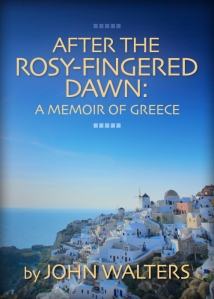
After the Rosy-Fingered Dawn: A Memoir of Greece – Greece has always been regarded as the birthplace of western civilization and a Mediterranean paradise.  In The Iliad and The Odyssey Homer uses the magical epithet rosy-fingered dawn to describe the sunrise over a land of myth, fascination, and mystery.  But when preconceptions and illusions are swept aside, what is Greece really like? John Walters has lived in Greece for over fifteen years.  He has hitchhiked over many of its roads; traveled by camper; journeyed by plane, boat, bus, car, taxi, motorcycle, and on foot.  He has lived and worked and raised a family among Greeks.  He offers insight from an intimate perspective on aspects of Greek society and culture of which tourists are unaware. Many have visited Greece and afterwards acknowledged that the country has profoundly changed them.  This memoir is for those who feel something special when they think of Greece and Greeks, those for whom Greece holds a special thrall, those who have visited and have their own memories of the place, and those who would like to visit someday and know that when they do they will obtain new insight, new clarity, and will never be the same again.

America Redux: Impressions of the United States After Thirty-Five Years Abroad – In 1976 John Walters left the United States in search of adventure and literary inspiration.  He lived for many years in India, Bangladesh, Italy, and Greece.  He married and had five sons.  Finally, faced with the economic catastrophe in Greece and the lack of opportunities for his sons, he returned to the land of his birth.  Without home, without job, without resources, he confronted his own country as if for the first time. This is a memoir of someone who, late in life, was forced to leave everything behind and start fresh in what for him had become a new land.  It will appeal to those who are confronted with major life changes in these troubled economic times; to those who, though they may desire rest and retirement, must continue toiling to make ends meet; for those who desire insight into the vast, multifaceted culture of the United States from a fresh perspective, unencumbered by familiarity.

Writing as a Metaphysical Experience – From the author’s introduction: “For me, writing is metaphysical because it is inseparable from who I am and my conception of the universe and my place in it.  My interpretation of writing goes far beyond the definitions of hobby, job, or career – it is rather in the nature of a calling.  It is something that blossomed from within me and, though invisible to instrumentation, has been as integrally a part of me as my flesh, bones, and internal organs.  How this transpired and how it manifests itself is the subject of this book. This is not a how-to book on writing, although in its course I offer many practical tips and suggestions.  It’s more like a travelogue, a story of the life’s journey on which my writing has led me.” This journey has led Walters on a decades-long quest from the United States to Europe to the Indian Subcontinent and back in the pursuit of voice, inspiration, and literary excellence.  On the way, he has written and published novels, short story collections, essay collections, memoirs, and numerous individual novellas, novelettes, short stories, and essays.


Posted in Uncategorized | Tagged , , , , , , , | Leave a comment