Ten Plus Two of My Favorite Films (Part 2)

Yes, I’ve changed the title.  The first post, a few weeks ago, was “Ten Plus One”, and now it says “Ten Plus Two”.  That’s because I realized there was a film I’d left out of the original list that had to be there.  The five films I mentioned previously were:

1.  Doctor Zhivago.

2.  Butch Cassidy and the Sundance Kid.

3.  Star Wars (the original trilogy).

4.  Gandhi.

5.  Parenthood.

Now, before I continue, I want to reiterate that this is a list of my personal favorites, chosen because they have resonated with me.  Perhaps none of these would be on your list, or perhaps your list would include these and more.  Let me know; I am always on the lookout for good movies.  As I said last time, these are not in order of quality but roughly in the order I encountered them for the first time.

6.  Modern Times.  This is the oldest film on the list.  Hollywood was transitioning to talkies when it was made, and it is Chaplin’s last mostly-silent film.  There is very little dialog; it is almost purely visual.  That doesn’t matter, because Chaplin was a master of the visual, and never more so than in this picture.  As far as I’m concerned this film is his masterpiece.  It has everything:  social commentary, romance, uproarious comedy, adventure, tragedy, triumph.  It even has the melody to one of the greatest songs ever written (by Chaplin himself):  “Smile”.  He was a one-man show in a sense, as he produced, directed, acted, and wrote the music.  But the supporting cast, especially Paulette Goddard, who plays his romantic interest, are superb as well.  This film bears watching again and again and again, and every time it is as fresh as the first.  I would venture to say it even has relevance to our own modern times, when so many are out of work, disillusioned by the system, and seeking for real values in life.

7.  Chaplin.  I’m a fan of Richard Attenborough’s work:  this film, “Gandhi”, and “Shadowlands” especially.  I find this movie immensely intriguing.  Chaplin was a genius, of that there was no doubt.  He came into film in its infancy, intuitively realized what could be done with it, and had the talent and business acumen to exploit it to great effect.  The story of his life is fascinating, to say the least.  The directing, supporting actors and actresses, photography, and so on, are all superb, but there is one thing that raises this film to mythic status:  Robert Downey Jr.’s performance as Chaplin.  It is one of the greatest acting triumphs of all time, and he should have won the Oscar for it.  As it was, Al Pacino took home the prize for his awesome performance in “Scent of a Woman”.  That’s a tough call.  Sometimes they should hand out two awards and be done with it.  Anyway, awards aside, Robert Downey Jr. owns the character of Chaplin; I don’t think there’s another person on the planet who could have played him so effectively.

8.  Flashback.  Okay, okay, this is my guilty pleasure.  I know this movie doesn’t come up to the brilliance of the others on the list, but I love it anyway.  I watch it frequently and always have a great time.  As an old ex-hippy myself it touches my heart.  When near the end Kiefer Sutherland breaks down and cries as he watches the home movies of his hippy parents it gets me every time.  And that psychedelically-painted bus bursting out of the garage to the tune of “Born to be Wild” is a tremendous scene.  I like the music too; it’s replete with great songs from the sixties.  Whenever I want to just kick back and relax and have a fun cinematic experience, I can always count on “Flashback”.

9.  American Beauty.  For social drama this one can’t be beat.  When I first saw it I was stunned.  It is amazing how the characters are built up so brilliantly throughout the film, and then in the end one by one they are exposed for who they really are, shown to have all been covering up, living a lie, deceiving themselves and everyone around them.  Except for Lester, that is, played with unerring brilliance by Kevin Spacey, who has broken out of the rut in which he had been entombed, has been making a bid for freedom, and is killed for his trouble.  But at least he dies happy, which is more than one can say for those he left behind.  And to top it all off, during the end credits one of my favorite Beatles songs, “Because” is played, and it fits it all perfectly.

10. The Lord of the Rings.  I include here the trilogy which includes “The Fellowship of the Ring”, “The Two Towers”, and “The Return of the King”.  Each is a brilliant film on its own, but together they comprise one incredibly long film with a continuous story line.  I heard about this film years before it was released and anxiously awaited its coming.  The books are at the top of my all-time reading list; I have read them over a dozen times.  I never intended, nor do I now, to compare the films with the books.  They are different experiences.  If I had to choose I would take the books, but thank God I don’t have to have one or the other; I can have both.  From the first moment of the first film I was in awe, when the haunting music begins and the elvish voice speaks.  I would have thought it impossible to do justice to the story on film, which makes Peter Jackson’s achievement remarkable.  True, there are some things I would have done differently, deviations from the storyline in the books I would not have made, but the pluses far outweigh the minuses, and overall I have to say that the films are a resounding success.

11. The Last Samurai.  I didn’t have much of an idea of what I was in for when I went to see this film, but I was immediately enthralled.  It is not only full of visual beauty but of the values of honor and courage and friendship.  It is a classic story of a man starting out as the enemy of a culture he does not comprehend, but once within begins to appreciate its value and eventually is willing to fight side-by-side with his former enemies to preserve it.  Tom Cruise gives one of his greatest performances; he is completely credible from beginning to end.  Though I do not believe in the degree of violence the story espouses, still it inspires me, makes me want to be better, to stand up for what I believe in, to act honorably and courageously myself.

12. The Namesake.  Ah, this is a beautiful film.  It is based on a novel by the Bengali-American writer Jhumpa Lahiri, and it tells the story of a Bengali couple, after an arranged marriage, who move to the United States and raise a family.  It shows the woman’s initial culture shock and homesickness and eventual adjustment; the raising of their children in the new land and the children, as they become teens, absorbing the contemporary American culture and becoming alienated from the customs of their parents; the father’s death and how the family copes with it; and the mother’s eventual return to the land of her birth.  The actors who play the parents are famous Indian actors, and they break your heart with their subtle, heartfelt performances.  Kal Penn plays their son, caught between two cultures, and he turns in a brilliant performance too.  Perhaps it resonates in a special way with me because I lived so long in Bangladesh and in West Bengal in India.  I was able to follow most of the Bengali dialog in anticipation of the subtitles, which was fun – but it was not only my past experience in West and East Bengal that caused me to love this film.  It is a one-of-a-kind experience, a thing of beauty.

So those are some of my favorite films.  What are yours?

Posted in Movie Reviews | Tagged , , , , , , , | Leave a comment

Book Review: A Crown of Feathers and Other Stories by Isaac Bashevis Singer

Soon after starting to read this collection I found myself comparing Singer’s stories with those of Jorge Luis Borges.  First of all, both writers deal with elements of the fantastic, though Singer is concerned mainly with that which has to do with Jewish folklore and legend, and Borges delves much further into the out-and-out bizarre and surreal.  In addition, both writers, in many of their stories at least, write of idiosyncratic characters from their native lands:  Singer of Jewish communities in Poland, and Borges of rough common folk in Argentina.  And finally, both often insert themselves into their stories as themselves, playing the narrator or an observer who objectively observes and comments upon the main events.

I think I prefer Borges personally, because I enjoy the intricacies of his fantasy worlds, the mind-puzzles, the conundrums.  But that is not to take away from the value of Singer’s stories.

To be honest, the first several stories didn’t impress me much.  They were rambling and disjointed and without coherent theme.  But then I read “The Son from America” and after that I was hooked.  This story is a perfect little parable, the kind of story you read and afterwards think that it couldn’t be improved upon.  It tells about an elderly couple who live in a tiny poor village in Poland.  Their son has gone to America and they haven’t seen him for years.  One day he shows up, rich and prosperous, with all sorts of plans to improve the lifestyle of his parents and the other villagers, but then he gradually comes to realize that they are all content and have need of nothing.  That and the closing story, “Grandfather and Grandson”, which deals with a devote old man’s reaction to the events of the Russian Revolution, were my favorites in the collection, but basically every story in between these two was a good solid interesting tale.  Maybe the stories are presented chronologically and after a certain point Singer really hit his stride; I don’t know.  But that’s how it worked out with me.

This collection was co-winner of the National Book Award in 1974 with “Gravity’s Rainbow”.  Though I have read some Pynchon, “Gravity’s Rainbow” is one that I have not yet tackled, so I can’t really compare the two.  It seems, at first glance, that they are unlikely bedfellows:  the traditional and the avant-garde.  I don’t know offhand what else was published that year; I do know that the Pulitzer judges settled on giving no award in 1974, though the committee had voted unanimously in favor of “Gravity’s Rainbow”, evidently thinking that the novel was too outlandish to be honored.  But my point is, though I thought “A Crown of Feathers” was a good solid collection of stories, I’m not sure I feel it’s of award caliber.  Then again, awards are merely a matter of taste, after all.  It is, however, a good read, and a fascinating insight into the Jewish milieu in Poland and New York in the early half of the twentieth century.

I’m a professional writer; I make my living by my words.  I’m happy to share these essays with you, but at the same time, financial support makes the words possible.  If you’d like to become a patron of the arts and support my work, buy a few of my available books or available stories.  Thanks!

Posted in Book Reviews | Tagged , , , , , | 2 Comments

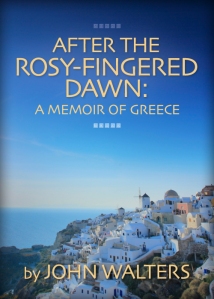
Greece: A Memoir; Part 3: Athens and the Islands (1976)

(This is an excerpt of a memoir-in-progress of my life in Greece.)

In Athens I found a cheap hostel in the Plaka, a cluster of old buildings and narrow streets at the foot of the Acropolis.  I shared a hot, stuffy, cramped room with several other travelers, but nobody seemed to mind much.  It was just an interim stop; everyone was on their way somewhere else:  some up over the hills to Delphi, some down south through Corinth to the Peloponnese, and some to Piraeus and thence to the islands.

That’s where I wanted to go too:  to the islands.  I had heard a lot about the beauty of the Greek islands, about the gentle, sweet, hospitable people and the clean beaches and clear water, but also about the parties and nude beaches.  I figured a trip to Greece would be incomplete without giving them a try.  Besides, I was still enthralled by Henry Miller, and he had spoken highly of the islands in “The Colossus of Maroussi”.

Meanwhile there was Athens to explore, or at least the part that could be reached on foot.

The Acropolis was accessible, of course, and so I dutifully took a walk up the hill to have a look at the Parthenon.  To be honest, I rarely bothered with the sights on my travels, though there were often famous monuments and statues and museums and buildings all around.  I wasn’t there on a sightseeing trip; that wasn’t my motivation at all.  I was there to gather experience as a writer, to learn whatever life on the road could teach me.  But I had some time to kill so I hiked up the hill in the blistering heat and sauntered around.  The sun shining off the bare white stones was almost blinding.  The Acropolis is impressive, there’s no doubt about it; I just wasn’t much into it at the time.

Later I roamed the streets of the Plaka looking for a meal.  Restaurants were everywhere, but I was traveling on a very low budget, and so I would study the menus (Greek on one side, English on the other) propped outside each restaurant looking for the most economical fare.  Sometimes hawkers would come out and try to persuade me to enter, but then I would shy away; they obviously mistook me for a tourist of means.

Finally, having chosen the restaurant that seemed most affordable, I would sit down, often with other travelers who had gone through a similar analysis of the culinary possibilities and had settled on the same place.  We would each order our food and sit together and laugh and talk and drink cheap retsina wine with its unique taste of pine sap, and the restaurant owners would decide we were old friends and present us with one bill, as was their custom.  It would drive them nuts as we’d calculate what exactly each of us had ordered and how much it cost; it was the Greek custom for friends to fight over the bill, to each insist on paying it, and they couldn’t figure out what they considered our selfishness and pettiness.  But none of us could afford that kind of magnanimity; we were all on shoestring budgets.

My usual evening meal, after I had thoroughly scrutinized the possibilities through several meals and restaurants, was yemista.  It was cheap because it contained little meat, though there was some; but it was a good filling plate of food, with large hollow tomatoes and peppers stuffed with rice and ground meat and smothered in olive oil.  If the main course didn’t fill me up I stuffed myself with the free fresh bread served at every table.

One evening I went out to drink ouzo with some acquaintances from the hostel.  I had been told that ouzo had quite a kick, but it crept up on you.  It was fine and mellow as long as you were sitting and sipping it but hit you when you tried to get up.  That, in a nutshell, is what happened.  Ouzo has a sweet licorice taste; it’s clear by itself but when you mix it with water it turns milky.  Anyway, we sat there together chatting and downing God knows how many drinks, and then finally, when I tried to stand and leave, I felt as if I’d just been punched by a prize-fighter and slumped back down into the chair.  I did eventually, with much staggering and weaving, manage to find my way back to the hostel, but it wasn’t easy.

In traveler’s hostels there were always guidebooks around to peruse, so I researched the various islands to decide where I might like to go.  In the end, the main factor in my decision was finances.  The fare to the islands farther away was too expensive.  I settled for a one-ticket three-island tour that included Milos, Safos, and Serifos.  So, on down to Piraeus, the port from which all boats departed; it was teeming with humanity in holiday garb, and with trucks, tour buses, vans, cars, motorcycles, and bicycles.  I booked deck passage, of course, which meant I could sit or sleep in any of the public areas in which I could find space.  It was peak season and the boat was packed out with both foreign tourists and Greeks on summer holiday.  There was barely room to stand, let alone sit or lie down, and if you wanted to go from one place to another you had to weave your way around backpacks and bundles and suitcases and kids and dogs and meals laid out on the decks and benches and crowds of people drinking beer or retsina and continually bursting out with raucous laughter.  Crowded as it was, it was a merry scene, and as the boat was dropping people off in several locations along the way, none of the islands enroute got too much of a mob on its own.

I exited on Milos with several other economy travelers.  The cute petite little village was before us and the clean sandy beach spread out in an arc just off the pier.  I had been told, I don’t recall by whom, that it was safe to leave one’s belongings about around a Greek island village, that the villagers had a reputation for honesty and no one would think of touching what was not theirs.  In the spirit of the location I walked along the shore until I found a nice place under a tree at which to camp, dropped my bag there, and headed back into town to see what I could see.  In retrospect it was an idiotic thing to do; even if it were true that I could trust every villager on the island, who said the same principle would hold true for the many tourists, who came from many different countries and cultures, the majority of whom were also economy travelers?  Be that as it may, nobody touched my bag and I had a great time on the island.  It was like a brief idyllic interlude in an otherwise constant struggle for survival on the road.  In the afternoon a village gentleman brought his net down to the sea, cast it into the clear water, and brought it out full of wriggling little fish.  He then started a small campfire on the shore, deep-fried the fish in olive oil, and gave the fried fish out for free to whoever gathered around.  He also produced some fresh bread to go along with them.  I had never been confronted with such generosity but he made it seem the most natural thing in the world.  The other villagers as well were polite and friendly and eager to please, not at all jaded by the multitudes of visitors, many of whom must have been much less courteous themselves.  The village was just like one you might see in a picture postcard, full of primary colors, especially white; the sand on the beach was soft and invited bare feet, and the water of the sea was clear and clean and warm and full of fish.

I stayed on Milos for one or two nights and then moved on to Safos, of which I remember nothing.  I suppose it was similar to Milos; I don’t know.  But the next island, Serifos, had something distinctive about it.  When I arrived at the village, which as I remember had a clean attractive conventional beach nearby, I heard of a nude beach on the other side of the hill behind the town.  That was interesting enough to warrant a visit, but the hill turned out to be higher than it appeared at first sight; it was a weary, muscle-aching, thirst-inducing climb over bare gray rock, and the aforementioned beach was in a rock basin that the sun had baked blistering hot.  The nudists were there, all right, but seemed pretentious and self-conscious, and – worst of all, at least from a male perspective – there were more men than women.  Some women were there, including extremely attractive ones, but it wasn’t worth it to me to endure the sight of all those pendulous pricks for the occasional glimpse of feminine comeliness.  The nude area was on the left as I came down the hill, and over to the right was another area of people clad in bikinis and bathing suits, and thence I forayed to take my swim.  So much for pseudo-radical pseudo-freedom.

Posted in Greece: A Memoir, Travel | Tagged , , , , , , | Leave a comment

Ten Plus One of my Favorite Films (Part 1)

I know, I know:  favorites lists are supposed to be of even numbers; eleven is odd.  Unfortunately, eleven films demanded to be on the list, not more, not less.  I suppose I could come up with a couple of dozen were I to give it sufficient thought, but this is how it is for now.  I realize that such a list is idiosyncratic; your list might not contain any of these films.  And I am not judging these films according to their inherent worth from a technical or critical point of view.  I am including them because they mean something to me personally, and they affected me in a personal way.

I love films, and I have loved them from an early age.  I used to watch many more than I have time to watch now, but even now I try to fit in one or two every weekend.  From the beginning, even before I knew I wanted to be a writer, as I watched I analyzed the plot and the characters and tried to imitate the style in my play.  For a time one of my brothers and I used to keep a notebook in which to rate each film that we watched with numbers of stars; back then we specialized in horror and science fiction films.  Later, as an adult out on the road, I always tried to catch a film now and then whenever I could.  As a result, I have watched movies in theaters in many countries:  Greece, of course, but also exotic places like Turkey, Iran, India, Bangladesh, Malaysia, and other countries too numerous to name.

I am faced with the dilemma of in which order to present these films.  I can’t really do it in order of preference; I think I will present the early ones first, and then the more recent.

And so, without more ado or preamble, here is the list:

1.  “Doctor Zhivago”.  This was my first great film love.  It was enthralling from the moment the splendid musical overture filled the theater.  The cinematography, acting, sweeping epic story, directing, and so on were all first rate.  When it came out I saw it at least four times at the cinema, and then when it began to appear on TV I always made sure I watched it again – and again and again.  At the Academy Awards it won five Oscars but I was dumbfounded that it lost Best Picture.  Even now it’s hard to beat as a grand historical epic love story.

2.  “Butch Cassidy and the Sundance Kid”.  This took over my primary affection (film-wise) when I was a teen.  I enjoyed the banter, the flippant disregard for danger, the comradery of the main characters, but also the perfect cadence of the script and the affinity of the actors and actress.  I watched this one nine times at the cinema and could have watched it more.  Several years ago I purchased a two-disc DVD, and I am still enthralled with this humorous, action-packed, one-of-a-kind western.

3.  “Star Wars“.  By this I mean the original Star Wars trilogy which includes “A New Hope”, “The Empire Strikes Back”, and “The Return of the Jedi”.  I returned from India for a visit home in the late 70s and I must have been one of the few souls in the universe ignorant of the existence of Star Wars.  Or, if I had heard of it in passing, it didn’t register as anything significant.  So when my mother offered to take me to “A New Hope” I had no idea what I was in for.  I had a marvelous time.  I can’t describe how much fun it was; the film was adventurous and spectacular and full of great courage and honor.  It was one of my most memorable cinematic experiences, not only for the movie itself but for the companionship of my mother and appreciation for her insight in sensing that I would enjoy it.  At my next visit home from India, coincidentally, “The Empire Strikes Back” had just come out, and she took me to that one.  By that time her cancer was already diagnosed and she was undergoing treatment.  This was one of the last special activities we did together, and as such is precious in my memory.  As for the film itself, it was darker than the first, resplendent with alien imagery, and with that dynamic ending when Darth Vader reveals himself as Luke’s father.  I had to wait until years later to watch “The Return of the Jedi”.  Someone got a hold of a pirate copy in Bangladesh but the sound and picture both were so bad that it was unwatchable.  I don’t think I saw a decent DVD of it until a year or two after my family and I had moved to Greece.  Anyway, I greatly enjoyed “The Return of the Jedi” as well, with its extreme alien grotesqueries and its ending with complex battles on many fronts and the ultimate defeat of the evil emperor.  A terrific iconic trilogy.

4.  “Gandhi”.  I first saw “Gandhi” while I was living in India, and it resonated with me not only for its accuracy in depicting the Indian experience, but for the obvious love and care the filmmaker (Richard Attenborough) had invested in the project.  Personally I feel that Gandhi is idealized in the film, but that doesn’t detract from the ambition and scope of the project, and the fact that it is still one of the best historical films ever made.  Every little detail is fascinating to me, having lived so long in the Indian experience myself, but more than that:  though I don’t agree with all that Gandhi believed in or espoused, I respect him as a man of integrity with the courage to stand up for his convictions and try to change the world, or at least his part of the world.

5.  “Parenthood”.  My wife and I agree on this one:  it’s our all time favorite comedy.  Some might find some of the situations exaggerated, but as the parents of five sons we have been through situations that have been at least as or even more extreme.  Whenever we are getting weary in well-doing as parents we tell each other that it’s time to watch “Parenthood” again; it always gives us a boost.  Because as traumatic as it gets, in the end the film still extols the fulfillment and value of being a parent.  We watch it at least once a year; sometimes more.  I recommend this one to any parent who sometimes wonders if it’s worth it all.  Take it from me, it is.

Posted in Movie Reviews | Tagged , , , , , | Leave a comment

Greece: A Memoir; Part 2: First Contact

(This is an excerpt of a memoir-in-progress of my life in Greece.)

I first entered Greece in the summer of 1976.  It was the culmination of a grand hitchhiking arc I had made through Belgium, Holland, Germany, Austria, and Yugoslavia.  I was a young writer with very little cash in pocket looking for life experience.  Still in the initial bursting joy of having liberated myself from the US and the rut in which I had been stuck, I was living one day at a time and making decisions moment to moment, with no itinerary and no ultimate physical goal.  My goal, if truth be told, was to set myself free as a writer.  I was emulating my literary idols:  Jack London, Jack Kerouac, Henry Miller, and so on.  I wanted to experience life robustly, and though I didn’t really know how, I wanted to learn.  I figured the only way was to get out there and do it.

So, as I say, I entered Greece with no real idea of where I would go and what I would do.  I had heard that the Greek people were hospitable, and, almost as a sign, on the side of one of the first roads I was let off at, an old man came out of nowhere and offered me a piece of fruit, smiled, and walked off.  I think it was a peach; peaches would have been in season then.  But the magnanimity of the gesture overwhelmed me.  Imagine:  to approach a total stranger and show such benevolence!  It was a very auspicious incident; it boded well for the future, I thought.

At that moment I felt at peace with myself and the world, standing there by the roadside, the trees shading me from the hot sun, the splendid deep blue sky a glimpse of eternity.

I was quickly disillusioned.

Nobody would stop for me.  As friendly as that old Greek farmer had been, the Greek drivers passing me did not share his openheartedness.  Driver after driver passed without so much as a glance in my direction.  It was if I did not exist.  Hitchhiking as a means of transport obviously was not an accepted part of their culture.  Hour after hour I stood there, incredulous, getting more and more miffed.  It didn’t synch with what had just happened with the farmer.  I had thought that Greece was greeting me with open arms; instead, I was getting the brush-off.  I didn’t realize at that point that Greeks are very complex and contradictory people, just like most people in point of fact, and they cannot be easily stereotyped or pigeonholed.

So there I stood for hours and hours.  At least the sun was warm and there was some shade, but I realized as I stood there that I was not entering some idyllic paradise but a country of the world and, just like any country, it would have its idiosyncrasies both positive and negative.

Finally, of course, I did get a ride.  It was with a Greek truck driver, and I would soon learn that apart from foreigners the truckers were almost the only people who would stop for hitchhikers on those roads.  I don’t know why they were the exception, as I couldn’t provide much company; they invariably spoke no English, and the few words of Greek I could manage to spit out were hideously mispronounced.  I suppose a silent companion is better than no companion, and they would often treat me to meals and bid me farewell like an old friend at our parting.

As I traveled I would stop and sleep wherever I could throw my sleeping bag.  One night in Greece I remember being directed to the concrete shell of an unfinished house near the edge of a village; I didn’t get much sleep there because mosquitoes plagued me relentlessly.

But I got by all right as I journeyed deeper and deeper into the country.

My first lengthy pause was at a beach near Volos, which is a city on the east coast about halfway between Thessaloniki and Athens.  It’s an attractive port city, not large enough to be oppressive.

As I remember I was in a bank checking on some money I was expecting; it hadn’t arrived, and I learned that it had been sent instead to Athens.  Because I was almost broke I decided to head for Athens as quickly as I could, but then I ran into a couple of Norwegian girls, one a tall buxom brunette, the other a petite blonde.  They told me they were on their way to a beautiful isolated beach up the coast, and they invited me to join them.  When I explained my financial situation they offered to pay for everything and in Athens I could pay them back.

Fine by me.

So we set out together, the Norwegian girls and I, they with their backpacks and I with the olive-green duffle bag I carried with me on my travels; we also had a supply of food to last us through a few days of isolation.  I don’t remember if we went by bus or taxi, but we ended up at an uncrowded beach, but the girls weren’t satisfied with that.  They wanted to find a pristine place unspoiled by tourists, so we hiked north up the coast until we found a beautiful cove with clear blue-green water and soft white sand, and that’s where we camped out for three nights.  In the heat of the day we would swim and sunbathe, and in the warm moon-lit night we would go skinny-dipping and then return to the shore to make out.  It was an idyllic interlude, one of those rare times when there is no stress, no hurry, nowhere to go and nothing to do that you don’t want to do.  It might have happened somewhere else I suppose, and I’m sure it has to other people, but because it happened to me in Greece it imbued Greece with a special magical aura that I carried with me for the next few weeks of my journey, almost until the end of this, my first stay.

When it came time to leave the girls accompanied me to Athens as we had agreed.  My pitiful little amount of money was there waiting at the bank, but when I offered the girls my share of the expenses they refused to take it.  They said it was their treat, kissed me goodbye, and went on their way.

Posted in Greece: A Memoir, Travel | Tagged , , , | Leave a comment

Book Review: Inventing Paradise: The Greek Journey 1937-47 by Edmund Keeley

Just before World War 2 a number of writers and poets came together in friendship in Greece and formed a group which included Henry Miller, Lawrence Durrell, George Seferis, George Katsimbalis, and other Greek literary figures.  Henry Miller writes about this “little band of friends” in his book on his Greek experience, “The Colossus of Maroussi”, and the others also wrote about it in various memoirs, journals, poems, and so on.  It was a grand, robust literary environment, and all of them reveled in it – but it was not to last.

The first part of this book describes how the various members of the group came to be involved and what their literary reactions were to the Greek pre-war experience.  It quotes extensively from prose and poetry in which each of them creates an idyllic Greece according to their own personalities, experiences, and backgrounds, a picture of Greece which has had a great influence on how many people see the country today.

But then, in the second part, the book takes on a very dark aspect, as the group is shattered by the onslaught of World War 2 and the Nazi invasion of Greece.  It follows each individual in their struggle not only for survival but for artistic expression of the devastation all around them.  This, in fact, is where the book really came alive for me and became more than just interesting.  For it is one thing to revel in a pseudo-paradise, part real and part a making of the imagination, but it is another to have that image shattered and confront the ugly brutal reality that remains.  It describes one poet trying to survive and save lives as a doctor in the Greek army, another performing acts of rebellion in the face of the German conquerors, another’s broken-hearted trauma as he sees his country being torn apart by its conquerors but is compelled to follow the Greek government into exile, Lawrence Durrell in exile in Egypt attached to the British government, and Henry Miller deported to the States and unable to maintain regular communication with the friends he had to leave behind.

Finally, in the third part, it describes what happened to each of them afterwards, at the end of World War 2 and during the Greek civil war which immediately followed.

What makes this book unique is its approach to the subject from a literary point of view.  As I said, throughout each of the chapters there are snippets of prose and poetry which the writers composed about what they were going through.  It’s a look not only into the events themselves but the souls of those who went through the events.  It’s tragic and triumphant at the same time as we see the hell of the war experience afterwards transformed into art.  Not that the book at all postulates that such human tragedy is worth it for the sake of the art that follows; not at all.  But rather it shows how art can help to overcome trauma and tragedy, both for the artists themselves and for their readers.

I recommend this book on several levels.  Firstly, from a historical point of view, it offers a unique perspective on Greece before, during, and after the Second World War.  In addition, it delves into the lives and struggles of major literary figures – George Seferis, for example, was later awarded the Nobel prize for literature.  And finally, it exemplifies how works of art in poetry and prose can transcend tragedy both for those who go through it and for future generations.

Posted in Book Reviews, On Writing, Travel | Tagged , , , , , , , , | Leave a comment

Treasure Hunt: Searching For Books in Thessaloniki

I’m a bookaholic.  I gotta have my books.  I can’t stand being without books.  And when I say books I mean the paper kind with binding and covers and so on.  I did, to be honest, at my wife’s prompting, look into getting a Kindle, but when I did a little research I got completely discouraged about it.  First of all, Kindles are much more expensive here in Greece, either to buy here or order; okay, I can get around that by having one of my sons buy one in the States and bring it here.  But then the troubles begin.  Everything I download has taxes added onto it so the price of e-books multiply out of control, sometimes to two or three times what they would cost if downloaded in the States.  I can’t leave the country every time I want a new book.  In addition, the e-book store available here in Greece is at least a third smaller than the one in the States.  There’s no way around that without leaving the country either.

So, forget the Kindle.  I don’t care that much anyway.  I like to hold a book in my hand; whenever I do I feel I am embarking on an adventure.  Maybe I’d get used to doing it the electronic way and I’d have the same sensation in time, but for the reasons above that’s not feasible now; so there it is:  I need paper books.

But where to get them?  Obvious first choice:  a book store.  Oops, no.  Not here.  There are English books available in a few bookstores here, but even the best one has a very limited selection:  one shelf of just a few hundred books.  They used to have some of the Science Fiction Masterwork series, but once those sold out they never got replaced.  Now the pickings are slim indeed.  I have been there twice recently.  I went the second time because I thought surely I must have missed something good the first.  But no.  I couldn’t find a thing I wanted to read.  Sigh.

Where else can I look?  Libraries might be the logical next choice.  Well, there are very few English libraries in Thessaloniki.  The British Council library closed down and was absorbed by a local college.  They charge an exorbitant price to use the few yellowed old British novels on the meager shelves.  Definitely not worth it.  Fortunately, years ago one of my sons won a scholarship to an elite private high school here, one of the best in Greece.  They have a library – two, in fact – one for the high school and one for the associated college, and the libraries are primarily in English.  They are tiny by US standards but they are a (literary) lifesaver.  I go there frequently, and whenever I am searching for books on my computer I do searches in their catalog, which is online.  I believe I am one of their best customers.

But, as I said, the library’s resources are limited.  It’s budget has been cut recently, and a lot of what I want to read is unavailable, especially new books, that is, whatever has come out in the last few years.  So where to find these books?

Online, of course.  Whatever I can’t find locally I order from Amazon.com.  When I can I order from the UK branch, because the postage is cheaper and, as a matter of fact, they have just initiated free super saver shipping to Greece.  But its catalog is much smaller, and so sometimes I must order from US Amazon.  The problem is, the postage is often about two or three times the cost of the book.  To get around this, I often order several books and have them sent to one of my sons if I know he is coming for a visit, and he couriers them to me.  If I’m in a hurry, I pay the postage.  It depends on my reading schedule.

I am always reading something.  I can’t stand finishing a book and not having the next book right there ready to go.  I suppose you would say I’m a chain-reader:  I light one off the smoldering remains of the other.  But then, to be ready, I have to plan ahead.  I try to know what I am going to read several books ahead so I can arrange to get them.  Usually, because there is so much I want to read in so many fields, I alternate reading fiction and nonfiction books.  Sometimes if I am contemplating, or have already begun, a piece of writing for which I will need to do research, I plan my reading accordingly.  For example, last year I wrote a novel set in the hippy era of the late sixties.  To prepare I read a book on the history of the Haight/Ashbury scene, another on communes in the 60s, and so on.  But I planned the reading ahead so that by the time I was ready to write about it I had already done the research without having to stop the writing itself.

Because I like to plan my reading ahead I do considerable research.  I search lists of all-time favorite books, lists of award winners, lists of recommended books in my special fields of interest, bibliographies in the backs of other books, reviews, blogs, recommendations from writers I trust, and so on – whatever I can that will help me find things I might not have heard of.  When I do come across mention of a book I think I might find interesting I look it up in Wikipedia, I read the Amazon reviews, I search for other reviews.  All of this may seem time-consuming, but it takes less time than reading a book only to be disappointed.  Besides, I enjoy it.  For me, a search for new reading material is like a treasure hunt.  As I said:  I love books.  Whenever a deed is done in love it is always a pleasure.

I might still get that electronic reading device someday, but I don’t know.  I like the paper books.  I like building a library.  I like watching those shelves fill up, knowing that my sons can come whenever they want and find treasures thereon.  That’s the thing:  it’s not just the paper.  It’s almost like filling the shelves with currency and gold and jewels.  Only better.

I’m a professional writer; I make my living by my words.  I’m happy to share these essays with you, but at the same time, financial support makes the words possible.  If you’d like to become a patron of the arts and support my work, buy a few of my available books or available stories.  Thanks!

Posted in On Writing, Reading | Tagged , , , | 5 Comments

Greece: A Memoir; Part 1: Introduction

(This is an excerpt of a memoir-in-progress of my life in Greece.)

For years I have had a fantasy of getting hold of a camper somehow and traveling around Greece and writing about the experience.  In my mind it was always tied to some sort of mythical affluence – you know, the kind we always have in the not-too-distant future whenever we are daydreaming.  I would do the job right, not missing any of the important locations, staying at campgrounds long enough to take in the sights and absorb the local atmosphere and write it all down.  In this fantasy sometimes I traveled alone and sometimes I had company, but that was not the important thing.  What was important that my muse directed my path, and I had enough leisure time and wealth to let it do so.

Recently I woke up.  It didn’t take a slap in the face; it just occurred to me that such a trip was unnecessary.  I have already lived in Greece for over fifteen years.  I have lived in both Athens and Thessaloniki and in a small village in Halkidiki.  I have hitchhiked over many of its roads, and I have traveled by camper over many of them too.  I have journeyed by plane, boat, car, taxi, on foot and on the backs of motorcycles.  I don’t have to do all of that again.  It would be nice to, of course, but all I really have to do is remember and write about it.  And when I get down to it, I don’t really want to write a travelogue anyway.  What Greece is to me is not what it is to you or to anyone else.  Experience is shaped and filtered through individual minds and hearts, so that by the time it comes out it is flavored with unique personality.

This is my impression of Greece.  Hope you like it.

Currently I live with my Greek wife and two of my five sons in a village in the hills east of Thessaloniki.  From the hill on which we live you can see the white arc of the city spread around the dark waters of the Thermaic Gulf.  We live in a residential area between two villages; in a sense it is a suburb of Thessaloniki.  A few years ago there was a housing boom and it looked like the city would spread right up into the hills, but then Greece’s economy crashed and the villages are riddled with fully- and half-constructed housing that nobody can afford to buy.  By car or by bus the city can be reached in about twenty minutes; nevertheless it is far enough away for us to avoid the confusion, noise, and smog.  Our village is quiet, peaceful, clean, and orderly.

But stunning though the view is of Thessaloniki and the bay, it is not the most awe-inspiring view in the area.  If you walk or drive up over the top of the hill and look down the other side, you can see across the Gulf to majestic Mount Olympus.  On a clear day when the sky is deep blue and the cobalt-blue waters of the Gulf are still, the sight of the home of the gods is stunning, breathtaking, uplifting, whether it is summer and the craggy summit is stark brown, or winter and it is covered in blinding white snow.  The green hills that drop down to the waters of the Gulf are speckled with houses, and I have often wished I could live on that side so every day I could observe the mountain and its changes; but that is beyond our means just now.  Instead I can relish the sight every time I drive by, which is often.  I just have to be careful I don’t get too enthralled and go off the road.

Just a twenty-minute drive to the east are beautiful sandy beaches; in the summer the sea water is bath-warm.  An hour or so of driving to the southwest takes you to a mountainous area where there are ski resorts and hiking trails.

Well, it all sounds idyllic but honestly I don’t intend this as some sort of travel brochure.  Living here has its ups and downs, its pros and cons, just like living anywhere else.  Greeks can be generous and magnanimous and hospitable, but they can also be narrow-minded and bull-headed and petty.  My kids have benefited greatly from being brought up in a bilingual and bicultural environment, being taught in Greek at school but having an English-speaking home life, but they have all received intense bullying at schools due to anti-American sentiments.  I mentioned the financial crash earlier; it has hit us hard, as it has most Greek families.  Nevertheless, we have managed to carve out a life here, and generally, though always hand-to-mouth in economic terms in spite of the fact that my wife and I both have full-time jobs, it is a good life.

Before I ever visited, two literary experiences colored my impression of Greece.

The first was “Zorba the Greek” by Nikos Kazantzakis.  As I recall I came across the book even before I saw the movie.  I enjoyed the film, but it was the book that was the illuminating experience for me.  I read it over and over in the days after my new birth as a writer.  I was like the narrator, of course, the timid writer who was terrified of stepping out and experiencing life.  I wanted to but I was afraid.  I had no Zorba figure to urge me on, to poke and prod in the spirit and encourage me by example, but the Zorba in the book, among other literary influences, filled that role for me.  I knew I had to bust out of my rut and dance the dance of life, and this book helped me to do that.  I don’t think I was ever naive enough to think that Zorba represented all Greeks; even in the book he is presented as an anomaly.  But he gave me an ideal picture of how I imagined Greeks should be, most of which, in retrospect, was unrealistic.

The second and even greater influence was “The Colossus of Maroussi” by Henry Miller.  Shortly before I set out on the road I discovered Henry Miller, and became enthralled with his work.  After devouring “Tropic of Cancer”, “Tropic of Capricorn”, and “Black Spring”, I came across this memoir of his time in Greece after leaving Paris just at the start of World War II.  He paints an idyllic picture of Greece; it seems to have saved and resuscitated and invigorated him.  His experiences are blown up into grand mythic proportions, and the Greeks he meets, most of whom were the literary lights of the era, are presented as far greater than mere mortals.  It’s a robust, full-throated, energetic, invigorating song of praise.  Greece isn’t like that for most people.  For one thing, we don’t hang out with people of such stature as Nobel-prize winning poets; to be honest I have no access to literary circles in Greece at all, and I am unaware of the current state of the arts.  Miller approached Greece from a privileged position; he was initially invited to Corfu by Lawrence Durell, and was wined and dined regally as he traveled from place to place.  Nevertheless, he gives that unique Milleresque twist to his impressions of Greece.  Nobody writes like Henry Miller, and there are portions of “The Colossus of Maroussi” that are unsurpassed in pure descriptive brilliance.  As a writer I learned a lot from Miller, mainly that the writing and the man are inseparable, that one’s life is a base component of one’s work.  And Greece definitely changed Miller’s life, and I think that as I approached it for the first time I had the feeling that it might change mine as well.

Posted in Greece: A Memoir | Tagged , , , , , , | Leave a comment

Adventures in Wonderland: The Inestimable Value of Libraries

This post came about after reading a comment on another blog by a well-intentioned writer, who said that libraries sap income from a writer and are therefore counterproductive.  I disagree.

What are libraries for anyway?  They serve many purposes; for example, they are a path of education for the poor.  They enable those who cannot afford to buy all the books they need to have access to them.  They allow students and other researchers to browse through a multitude of volumes for information.  Look at some of the bibliographies in university thesis papers or works of nonfiction:  can you imagine having to buy all those books, some of which may have been only necessary for a paragraph or two?

But libraries are much more than that.  Libraries are mystical portals to other worlds.

I was very young when I got my first library card, and very soon afterwards the weekly or biweekly trip to the library to browse around and then come home with a stack of books was one of the highlights of my life.  I looked forward to it much more than, for example, going to the cinema from time to time.  I was a voracious reader; my family never could have afforded to buy all those books.  So should I have been deprived?  Should only the wealthy have access to reading material?  The education I got from those trips to the library was at least as important as the education I got at school, and now that I think about it, probably much more.  At the library I could choose what I wanted; my mind could roam whithersoever it would.  I read all sorts of books that the school would never have assigned.  A very special feeling always came over me whenever I entered the library.  I never knew what I might find.

After my catastrophic first year at university, when I discovered writing and science fiction, I found that the library I frequented had copies of all the Nebula award volumes that had come out until then.  What better education could I have hoped for than to read the works of the masters?  By then I had moved out of my parents house and was on my own, and could even less afford to buy books.  But I needed those books; I needed to immerse myself in them.

What goes around comes around though, and later when I could afford to I bought books by those great writers I had read in my leaner years; in some cases I bought everything I could find of their writings.  But there was a time when I never would have read anything by them at all if I had not been introduced to their work at the local library.

I still go to the library.  I buy a lot of books, but my appetite is still voracious and my family still struggles financially and so I still supplement what I buy with trips to the library at a local Greek/American high school, one of the few English language libraries here in Thessaloniki.  I am very thankful for that library.

In conclusion, I guess the point is that it’s not all about the money.  It’s about readers.  It’s about communication.  It’s about realizing that there other others out there like I was(and am) – hungry to absorb knowledge but unable to afford to buy it.  I empathize with those readers, and I would be honored if my books someday find their way into libraries, financial remuneration or no.

Posted in On Writing | Tagged , , | Leave a comment

Book Review: Never Let Me Go by Kazuo Ishiguro

There are clues hidden in the first few paragraphs of this novel as to what will follow, but they are cryptic, understandable only in hindsight after you have made it almost to the end.  Therefore, to me at least, the beginning is so slow that I almost put it down, and I almost never put a book down once I have started it.  That said, I persevered, and I’m glad I did.  After about seventy or eighty pages it got thoroughly absorbing and hard to stop reading.

It’s a quiet little horror story, a science fiction story actually, although it is not marketed as such.  That’s the advantage of being primarily known as a literary author – and Ishiguro certainly is, having won the Booker Prize for his earlier novel, “The Remains of the Day”.  But science fiction it is.  However, it is a slow burn, and the science fictional premise of raising cloned kids to harvest their organs for transplants though, as I said, alluded to in the first few paragraphs, is introduced in depth slowly and subtly as the characters live out their short sad little lives.

I suppose I’ve committed the indiscretion of revealing too much of the plot to you, but there are two reasons for doing so.  First of all, the main point of the story is not a buildup to reveal (surprise, surprise) that the kids are clones and will be cut up for the sake of others.  It is to delve deeply into the lives of the three main characters, to show what it would be like to be human but to be put into a position like that where you are treated as less than human and disposable.  Analogies to reality and our present timeline and recent history resonate throughout, though the story is presented as a sort of alternate history in which these programs were begun shortly after the second world war.  Secondly, the book has been made into a well-received film, and many will already be familiar with the plot.  Personally, I haven’t seen the movie; to my knowledge it never made it here to Greece.  I’m waiting now for the DVD to hit the shops.  I’m glad, actually, that I read the book first, as I might have thought, if I had first seen the film, that it was not worth it to take the time to read the book as well.

I would have been wrong.  The book is excellent.  The only fault I find is the slow start, which bordered on boring but in hindsight was necessary to build up to all that follows.

I highly recommend the book.  I have been contemplating writing something on the fact that science fiction and fantasy editors, as a rule, demand that a story start and build quickly, with a bang, so as not to lose the readers interest.  Sometimes I prefer a slow start, to just saunter along with the writer and let him take me where he will.   This book put that idea to the test.  I couldn’t help thinking that superlative though this novel is, had it been written by an unpublished writer and submitted through the slush pile, that is, the unsolicited manuscripts that arrive at an editor’s office, it never would have made it into print.  But it did, and the world of literature is richer for it.

Posted in Book Reviews | Tagged , , , | 2 Comments