On Attending ConDor 2013, San Diego’s Yearly Science Fiction and Fantasy Convention: Part One: Background

I did not come to science fiction as a fan first.  I read some science fiction before I realized I was a writer, but once I received the revelation that writing was my destiny, science fiction as a form of literature and my own writing were inexorably linked.

In my early life, my maternal grandmother gifted me with a boxed set of Heinlein novels, and later a boxed set of “The Lord of the Rings” trilogy.  I enjoyed both immensely, but that was about it, with possible odd exceptions, until that fateful time at Santa Clara University when on a whim I took a class in science fiction literature.  The text was an anthology edited by Robert Silverberg, and within was the short story “I Have No Mouth and I Must Scream” by Harlan Ellison.  It was in the midst of the reading of that story that I realized I had to be a writer.

At that point science fiction and fantasy seemed a natural medium for me.  I was into the psychedelic scene in the Bay Area, with Filmore West and the Grateful Dead and hallucinogens and other drugs, and science fiction fit right in.

Unfortunately, university didn’t, and after that one year I returned to Seattle to try something else.  At the public library I discovered the Nebula Awards volumes and started to read a lot of science fiction.  The so-called New Wave was erupting at the time, when writers were trying not only to write speculative fiction with crazy new ideas but with literary value as well.  Finding out that Harlan Ellison was doing a reading at the University of Washington or thereabouts caused me to find out about the Clarion West Science Fiction Writing Workshop, and I signed up for the following year.  I didn’t write much of value at the workshop or immediately afterwards; I wasn’t ready.  But I formed friendships, met some top writers (including Harlan Ellison himself) and became more determined than ever to become a writer or die trying.

Due to a contact I made at Clarion I moved down to Los Angeles, found an apartment in the San Fernando Valley, and tried my hand at screenwriting.  Nothing much came of it, although it might have had I been more persistent.

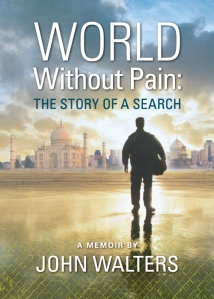
But by that time I had begun to drift away from science fiction.  I had become fascinated by the works of Jack London, Jack Kerouac, and Henry Miller and the call of the open road.  I decided that to become the writer I wanted to be, to really discover my own voice, I had to get out and live life, not just hide in an apartment and write about that which I had not really experienced firsthand.  So I cut loose and hitchhiked across the country, my duffle bag slung over my shoulder, took a cheap flight to Europe, hitched around Europe for the summer, and then hitchhiked across the Middle East to India.  This whole story is told elsewhere, primarily in my memoir “World Without Pain: The Story of a Search”.

Suffice it to say that on that trip I found my voice as a writer, but then I became involved in other things including the raising of a family and abandoned writing for a couple of decades.  When I got back to it, in the mid-90s, I started turning out some short stories and then a novel, then memoirs, more stories, another novel, and most of the fiction used science fiction or fantasy elements as literary devices, which had always been my approach to science fiction from the beginning.

I spent thirty-five years away from the States in Asia and Europe, and even if I had wanted to I would have had no opportunity to attend a science fiction convention.  Sometimes, as I perused photos of such events on the Internet, I wondered what they must be like.  I wondered if I had missed a profound piece of my life.  But then again, what could I have done?  My destiny had led in a different direction.  Howver, though the curiosity was definitely there I had no opportunity to scratch that particular itch until recently, when I moved back to the States with some of my sons and learned that San Diego’s yearly science fiction convention, ConDor, was upcoming in April.  I decided to attend, primarily to see what I had been missing.

Next:  The Convention Itself

I’m a professional writer; I make my living by my words.  I’m happy to share these essays with you, but at the same time, financial support makes the words possible.  If you’d like to become a patron of the arts and support my work, buy a few of my available books or available stories.  Thanks!

Posted in Memoir, On Writing, Travel | Tagged , , , , , , | Leave a comment

On Abandoning the Reading of United States: Essays 1952-1992 by Gore Vidal

I always like to be reading a book.  I usually alternate between fiction and nonfiction, and I usually plan my reading at least one or two books ahead so I always have something on hand.  But having finished a novel, and finding myself caught short without a nonfiction book to follow it, I traipsed on down to the public library to see what I could find.  Since the library had not yet opened, I perused the shelves of the library excess book sale set out in the bright mid-winter San Diego sunshine.  I came across this book by Gore Vidal, recognized it as a National Book Award winner and something that I had had on my reading list for some time.  Four decades of essays on the arts and literature, politics, film, and various other subjects.  What’s not to like?  It’s a massive unabridged-New-York-phone-book brick of a book 1300 pages long.  So what?  I have never shied away from big books.  I decided to give it a try.

So I read the first forty or so pages.  Then I skimmed through.  Then I skipped ahead again and read a few essays out of order, on topics I thought I would be particularly interested in.

And I’m not going to read any more.

I’m glad I only paid a buck twenty-five for the book, because it is one of those rare books that, once begun, I will not finish reading until the end.  I didn’t see it coming.

I read Vidal’s take on Faulkner, and Hemingway, and Norman Mailer, and Henry Miller, and John Barth, and Thomas Pynchon, and various other writers.  And Vidal had scarcely a good word to say about any of them.  Oh, he complemented one or the other here or there for this or that – but the problem is, he does not write from the viewpoint of an ordinary person, but from the top of some tall tower of academia.  He writes in a language that is pompous, highbrow, cynical, condescending, and elitist.  That’s the trouble with being a critic.  A critic criticizes.  I had to stop reading because I didn’t want that voice in my head telling me that nothing is first rate, nothing is innovative, nothing is praiseworthy.  This writer has this flaw; the other writer has that flaw.  That one, though acclaimed, is a hack, or a fraud, or insincere, or overrated.  All right, I admit that no writer is perfect.  No human being is perfect for that matter.  But such a negative view of – well, everything – leeches the fun, the excitement, the exuberance out of life.

This hit me particularly hard in light of the current furor in the publishing field between traditional and self-publishing.  To me Vidal and his pedantic essays represent the epitome of the traditional.  I realize he was not so in his personal life, nor was he in his own fiction.  He was bold, innovative, outspoken.  His writing ran the gamut of essays and nonfiction, novels, plays, and screenplays.  He was admired for his essays by the literati, whoever they are, and that’s just fine.  I feel, though, there is a place for the writer who has no place in academia, who grew up on the streets or on the road, who speaks uncommon things with a common voice, who puts on no pretences in pursuit of truth, though it be truth seen through the lens of fiction.  Perhaps Vidal believed the same, but if so it doesn’t come through in the essays I read.  Give me someone simple, straightforward, powerful, emotional, willing to speak from the guts and the heart without the need of a dictionary and a thesaurus and a classical library.

Therefore this book has found its way onto the very short list of the books I started and did not finish.  If you enjoyed it and you think I’m dead wrong, so what?  I can live with that, and I’d even be happy to hear your opinion on the matter.  In the meantime, I’m going to move on to something else.  C’est la vie!

*     *     *

While continuing to think about this essay this week, in contemplation of its upcoming publication, a few further thoughts came to me.

One was a word, actually.  Irrelevant.  That’s what this book is to me; it’s irrelevant.  It has nothing to do with me or my experience as a writer or as a human being.  That’s why I put it down.  If it relates to you, go ahead and enjoy it.

The other thing that came to mind, something I hadn’t thought of for many years, is from the wonderful novel “Jurgen” by James Branch Cabell.  If you’ve never read it I encourage the experience.  It’s a fantasy parable about a man who goes searching in the underworld for his wife and finds many marvelous and peculiar beings.  Anyway, Jurgen, who prides himself on his cleverness, meets a young man who reminds him of himself when he was younger.  The young man asks Jurgen something like, “But is not cleverness the main thing?”  And Jurgen sadly realizes that though he may have thought so once he now realizes that life is much more complex than that.  Resonating through the essays in “United States” is the underlying tone of the writer:  “Aren’t I clever?” and “Is not cleverness the main thing?”  I have to answer, at least for myself and in my own experience:  No, it isn’t.

Posted in Book Reviews, On Writing | Tagged , , , , | Leave a comment

Book Review: Barney’s Version by Mordecai Richler

This book was recommended to me by a friend.  Let  me somewhat amend that:  it was not exactly recommended, but she mentioned that she had started reading it.  Curious, I looked it up, perused reviews; I had heard of the movie version but not the book so, as I usually do, I wanted to know something about the book before I invested time in it.  The overview seemed interesting enough, so I decided to give it a try.

It was hard to get into at first.  Richler has a dense, detail-ridden style that can be confusing.  In addition, the book is not told chronologically.  Ostensibly it is, as there are three sections, each dealing with one of Barney Panofsky’s wives.  But it is a first-person pseudo-memoir of a man who is in the early stages of Alzheimer’s, and it is full of flashbacks, digressions, memory lapses, side stories.  Once you get used to it it’s not so hard to navigate, but you have to get your sea legs under you before you can really follow.  The three sections correspond to each of Panofsky’s three wives:  Clara, the Second Mrs. Panofsky (she is never named), and Miriam.  Clara he meets in Paris during his wild days with a gang of writers and artists; he marries her thinking she is pregnant with his child, though it turns out Clara has been sleeping around with an assortment of friends and strangers and the child is actually a black artist’s.  Soon after its stillborn nativity Clara commits suicide.  The Second Mrs. Panofsky is a mistake from the start, a Jewess from a staid, conservative family with whom Barney has little in common, and the highlight of their wedding is that Barney meets Miriam, the love of his life.  He chases Miriam out of the reception and eventually marries her.  They have three children and share a few decades of marital bliss.  Thrown into the equation is the fact that Barney may or may not have shot his best friend.

Barney is a foulmouthed alcoholic who smokes foul-smelling stogies and has few endearing qualities.  One wonders what any of his wives see in him.  In its defense the book is very well-written and laugh-out-loud funny in spots.  Once you get used to the wild, fluctuating, back-and-forth style it is manageable as well, and it’s possible to get quite connected with the story.  The main problem is this:  the book is cynical and depressing.  I mean really depressing.  It goes from bad to worse to still worse.  In the end (sorry about the spoiler) Barney is reduced to vegetable state, and on the way down his personal life is one disaster after another, all of which he brings upon himself.  This book affected me in a bad way.  Sometimes tragedy can be cathartic, but in this case, for me at least, it was just a downer.  To provide disclosure, this hasn’t been the best time in my personal life anyway, what with tearing up roots, moving to another country, leaving half my family behind, having to start fresh, being unemployed and unable to find work, keenly feeling the edge of poverty.  This book didn’t help my mood any.

It made me think of another book which was also a tragedy, “American Pastoral” by Philip Roth.  I wondered what makes me consider “American Pastoral”, despite its terribly negative ending, a masterpiece, and “Barney’s Version” not.  I think the difference is that “American Pastoral” rises above the characters it uses to make its point into a critique and exposition of an entire class of society and the way its members see themselves, whereas “Barney’s Version” is just about Barney and his slow descent into hell.

All right, I admit that my own situation and state of mind affects my interpretation and appreciation of the book.  But that’s the way it is, isn’t it?  None of us are ever completely objective.  All that said, I cannot recommend “Barney’s Version”.  It’s just too damned depressing.  If I had known how much it would bring me down I never would have read it.  As it is, what’s done is done.  Today I went to my son’s school because he had to get an inoculation and a parent’s presence was mandatory.  Perhaps reading “Barney’s Version” was in the nature of an inoculation for me.  I’ve been singing plenty of blues myself lately; reading this book helped me force myself to snap out of it.

I’m a professional writer; I make my living by my words.  I’m happy to share these essays with you, but at the same time, financial support makes the words possible.  If you’d like to become a patron of the arts and support my work, buy a few of my available books or available stories.  Thanks!

Posted in Book Reviews | Tagged , , , , | Leave a comment

Book Review: The Nebula Awards Showcase 2011 edited by Kevin J. Anderson

Being in the mood to get back into writing short fiction at the beginning of the year, I decided to read some to get in the mood.  Perusing my trusty book-buying website I came across this volume at a special price and decided to give it a try.  Though I write a lot of science fiction and fantasy I don’t really keep up with the field, but once in a while I enjoy taking a peek and seeing what’s going on.

I very much like the new format of the Nebula Awards volumes.  First all the short story nominees are presented, along with the winner, then the novelette nominees and winner, and finally the winning novella.  In addition, there are bonus stories from the Author Emeritus and new Grand Master.  All in all, it’s a good full selection of reading material.

So I started at the beginning, with the short stories.  I love well-written short stories, but I have to admit that as I read the first several I was disappointed.  They were decent enough stories, nothing wrong with them, but I expect award-nominated stories to be not only decent but exceptional, thrilling, the kind that at the end make you think, “Yeah, that’s why I read science fiction.”  Perhaps I’m spoiled because I read my first Nebula Awards volumes way back in the late sixties and early seventies, and the stories in those books were in-your-face out-and-out classics.  There were some ho-hums in that bunch too, but there were also amazing pieces by the likes of Harlan Ellison, Roger Zelazny, Jack Vance, Samuel Delaney, Robert Silverberg, and other luminaries of the field.  Perhaps I set my sights too high, but I was looking to be blown away.  The only short story that met my expectations was “Bridesicle” by Will McIntosh.  Though hampered by an inappropriate title that suggests slapstick humor, the story is in fact an unusual, heartfelt, and entertaining look at love enduring through the centuries, even beyond apparent death, due to cryogenics.

It was in the novelette section, however, where things got really interesting.  It starts off with Paolo Bacigalupi’s terrific story “The Gambler”, and moves on to first-rate stories by Michael Bishop, Richard Bowes, Ted Kosmatka, Rachel Swirsky, and Eugie Foster.  Three or four out of the six I would consider Nebula Award quality, and it must have been a tough choice for the voters.

Finally, Kage Baker’s award-winning novella “The Women of Nell Gwynne’s” is presented.  It’s a fine, absorbing look at a group of hookers in Victorian England who not only ply their trade but find out information and go on missions for a secret society.

All in all, the reading of this anthology was a very positive experience.  As I mentioned, the format is exemplary; the fact that all the nominees in the shorter categories are included is a big plus and would encourage me to seek out further volumes.  I don’t expect every story in any sort of anthology to turn me on, so I was not surprised or unduly disappointed that the short story nominees were rather weak; the superlative quality of the novelette nominees and the winning novella more than made up for it.

Apart from a boxed set of Heinlein novels and another boxed set of “The Lord of the Rings” trilogy which my maternal grandmother gave me at diverse Christmases, my introduction to the field of science fiction and fantasy was the shelf of Nebula Awards volumes at our local library.  Some had stronger stories than others, but they were all guarantees of a great reading experience.  It’s good to see that the tradition is ongoing.

Posted in Book Reviews | Tagged , , , | Leave a comment

Reflections on The Who’s Performance of Quadrophenia in San Diego, February 5th, 2013

If truth be told, I didn’t even know that The Who were coming to San Diego, and even if I had known I would not have considered going, the primary reason being that tickets to rock concerts, starting as they are at fifty dollars or so and going up into the hundreds, are way out of my price range.  However, someone affiliated with the show came to the naval base where one of my sons is stationed and passed on a number of tickets to my son’s superior officer, and so it was that my son, one of his buddies and I headed, along with about ten thousand other rock fans, to the sports arena in which the event was to be held.

The concert is part of the Quadropheia + More tour, during which The Who play the entire rock opera Quadrophenia (which came out as a double album back in 1973), along with an encore of some of their greatest hits.  Of the original members of The Who only Roger Daltrey and Pete Townshend are left, Keith Moon (the original drummer) and John Entwistle (the original bassist) having died.  The rest of the group is made up of musicians who have since been added, most of whom have played together off and on for years.

I used to listen to The Who back in the sixties; their singles played frequently on local rock radio stations, and we owned their first rock opera, “Tommy”.  I watched them in the splendid documentary of the original Woodstock Music and Arts Festival.  I didn’t really follow their musical progress, though, after the early 70s.  Especially when I got involved in my own struggles as a writer, moving to Los Angeles to attempt screenwriting, and afterwards hitchhiking around the world, I lost touch with what was happening in the contemporary music scene, with the exception of whatever I might hear by chance on public radio stations in Europe, the Middle East, and the Indian Subcontinent.  As a result, I had never heard of Quadrophenia before last night, and I knew nothing about the story behind the rock opera.  This became a problem when The Who began to play, because though the instruments were sharp and clear the vocals were indecipherable; it was impossible to understand any of the lyrics.  I suppose most of the attendees were long-time fans and knew the lyrics by heart, and so for them it was no problem, but for me it was like watching an opera in Italian or German; I could enjoy the music and instrumentals, but I could not follow the story.

Don’t get me wrong – the music was superb, and it was well worth the time (The Who played for more than two hours) to appreciate the music alone.  But reading about Quadrophenia afterwards I was struck by the depth and the nuances in the story, and I wished I could have known it before I experienced the performance.

No matter.  It was what it was, and I’m thankful I had a chance to see it.  Both Roger Daltrey and Pete Townshend, though they are almost seventy years old, can still rock.  Townshend especially is still a wizard with a guitar.  He didn’t break one on stage, though, this time, as he used to, which is probably just as well.

Now I want to say a word about these two near-septuagenarians, something that struck me even before I attended the concert.  I’ve thought of it in the past when I would hear that The Rolling Stones or Paul McCartney or another of the old rock superstars was on tour.  Some might wonder why the old farts don’t retire, but such an attitude never occurs to me.  If they retired, what would they do?  Curl up and die?  Music is their life, their talent, their calling, just as writing is mine.  I could no more conceive of not writing than they could conceive of not playing music.  It’s a part of who they are; it’s their destiny.  And it’s clear that the fans agree, as evidenced by the near-sellout crowd last night who were giving The Who one standing ovation after another.  If you have found your calling you don’t stop what you are doing ever.  It makes no difference, in fact, whether you are famous and successful or not.  You are what you are; you do what you do.  Entertainers may try to retire but it seldom works out.  It’s like what I’ve heard of the difference between an author and a writer: an author is someone who has written something; a writer is someone who writes.  Present tense, not past tense.  That’s what drives these rock stars.  That’s what drives actors and actresses who take on TV and movie gigs late in life.  It’s true not only of the entertainment industry, but applies to other facets of life as well.  Parents, for example, don’t stop being parents when their kids grow up and move away; most are still concerned from afar.

Anyway, it was a great experience to go see The Who perform.  I wish them well, and also any other artists who want to keep working until they drop.  That’s what I plan to do too.  When I’m on my deathbed, just make sure there’s a keyboard close at hand…

I’m a professional writer; I make my living by my words.  I’m happy to share these essays with you, but at the same time, financial support makes the words possible.  If you’d like to become a patron of the arts and support my work, buy a few of my available books or available stories.  Thanks!

Posted in On Writing | Tagged , , , , , | Leave a comment

California Writers: Jack London and Glen Ellen

This is an excerpt from my recently-published memoir “America Redux: Impressions of the United States After Thirty-Five Years Abroad”.

To reach our next destination we have to head north through the Bay Area and San Francisco itself, across the Golden Gate Bridge to the town of Glen Ellen.  This is the gateway to Jack London State Historic Park.

I have visited it twice, and both times it was in the nature of a pilgrimage.

The time I remember most vividly I approached it hitchhiking from the north in the early morning.  I came through a pass in the hills into a lush valley, and I wondered who lived in the meticulously-landscaped palatial mansions on the hillsides around me.  Somewhere along the way – possibly in Glen Ellen itself – I went into a grocery store and bought an apple, an orange, a pear, and a pint of milk.  The young attractive cashier remarked, “That’s a healthy breakfast,” and I smiled and agreed.  Under other circumstances I might have made small talk and met her later for some sex after she got off work; I indulged in such casual liaisons not infrequently in those days.  But I had my mind on visiting the State Park, and it was far more important to my journey as a writer than mere fleshly gratification.  I hiked up the road to the visitors center, my duffle bag slung over my shoulder.  I could walk all day like that, occasionally shifting the bag from one shoulder to the other.  The trick is not to overload it.  I had my sleeping bag, my shaving kit, my writing notebooks, possibly a change of shirt and a change of socks, no underwear, and one book only that I was reading at the time.  Sometimes, if it was warm enough, I stuffed my leather Navy flight jacket in too, but I might have been wearing it at this particular hour of the morning as it could have been still chilly.  I wandered through the museum at the House of Happy Walls, perusing the collection of first editions of Jack London’s work and the curios and souvenirs he and Charmian brought back from their world travels.  I might have checked out some of the other outbuildings and the grave site as well, but that was not what I was there for.  When I was ready I walked through the eucalyptus-smelling trees along the path that led to the ruins of Wolf House.  Both times I visited the State Park I spent hours at Wolf House.  I couldn’t pull myself away.  I would stare at the ruins and wonder what it might have looked like if it had been finished in all its glory.  I wondered what London must have felt to see his dream turn to flame and ashes so close to completion.  I wondered about my own life as a writer and what had caused me to leave everything from my old life and hit the road, why I couldn’t just fit in and conform and get a normal job and be like everyone else, why I had this inner compulsion that kept me going on an unknown path to an unknown destination, why it was far preferable to me to face loneliness and poverty and the dread of the open road than settle into a convenient rut, why I still had no answers and much of the time didn’t know what to do or where to go, why I couldn’t find anyone else who thought and felt as I did.  Yes, I did a lot of ruminating there at the stark gray stones of Wolf House, but I lingered because somehow there I felt a bit of peace.  It was like a moment out of time, a respite, a pause, a refreshment.  When I was finished, as darkness was falling and the park was closing and I made my way out, I felt stronger and better able to continue to I knew not where.

I hope I get a chance to go there again.  I love that place.

And Jack London himself?  He inspired me as few other writers ever have.  He taught me to hold to my calling and to fight for it.  He taught me to get out and live life so I’d have something to write about.  He taught me that sometimes you just have to do something about what you feel called to do and to hell with the consequences.

Despite the fact that his most famous stories are about the Klondike, sailing in the Pacific, and the South Sea Islands, he was a compleat Californian.  Born in San Francisco, he grew up in the Bay Area, and no matter where he forayed later he always returned.  Eventually he bought several local ranches and combined them into what he called the Beauty Ranch, studied ranching techniques, and attempted innovations that were ahead of their time but now are considered to have been sound ecologically.  Though one of the wealthiest writers in the world, he managed his money poorly and was always in debt.  His death came tragically early.

It is not my intention here to write a critique of Jack London’s literary output or of his life.  I have done that elsewhere.  What I want to do is impress upon you that despite his flaws he represents something that is best about America and the American dream:  the hope that despite humble origins you can rise to great heights, that if you have the grit and tenacity and courage to persevere success will follow, that if you step out and reach beyond what others expect of you and never give up you will win in the end.

Jack London taught me to keep fighting.  I still feel his influence because I have to keep fighting every day.  I am at this moment an unknown, a nobody, but I will never quit.  I will die trying to live my dream.

Posted in Memoir, On Writing, Travel | Tagged , , , , , , | 2 Comments

Book Review: Becoming Ray Bradbury by Jonathan R. Eller

I suppose I should preface this by saying that this book was not what I expected.  I found it by chance browsing at the public library in the new book section.  It intrigued me because I love the short story form and Bradbury is an acknowledged master of it.  I knew a bit of his life story already and have read a number of his books: some short story collections and the novel “Fahrenheit 451”.  I didn’t check it out right away, however.  I went home and read a few reviews online first.  Since the reactions I could find were generally positive, I decided to give it a try.  What I expected was a literary biography, but that’s not what it is.  It is a critical work, meticulously researched, that delves into Bradbury’s literary influences and thought processes as he began his career and achieved early fame in the 1940s and early 50s, up until the publication of “Fahrenheit 451”.

I wanted to like it.  I really did.  I love reading about how authors get their start, how they struggle for recognition, and how they have to overcome obstacles on their way to renown.  Yes, I wanted to like it, but it was very difficult to do so for two important reasons.  One of them was not that Bradbury isn’t one of my favorite short story writers.  I like his work, but my favorites in the short story form are James Tiptree, Jr., Robert Silverberg, Harlan Ellison, Jack London, and Jhumpa Lahiri.  That doesn’t matter.  Bradbury is an important writer in the science fiction/fantasy genre, and a good biography would be a fascinating look not only at the writer himself but at an important stage of American literature at a point when genre writers were struggling to free themselves from the ghetto in which they’d been relegated.

One reason it was hard to like this book was not the writer’s fault at all but the publisher’s.  It is printed in a tiny, almost impossible to read font.  Every time I finished a reading session my eyes would be sore, and it would take them hours to recover.  It was so bad that I almost gave up, something I almost never do once I start reading a book.  But my expectations were high, as I already mentioned, and I persevered because I hoped for a grand, unique reading experience.

Therein lies the second difficulty, which does, alas, lie upon the author.  The book is boring.  The writer is obviously a gifted researcher, but he has taken material that could have been a masterpiece and has turned it into an academic burden.  I kept waiting for it to come to life, but it never did.  I kept waiting for emotion, the emotion that the writer explains that Bradbury depended on so much for his inspiration, to manifest itself, but there was nary a sign of it.  And I know, I can feel, that there is so much emotion behind Bradbury’s story and life.  I know as a writer that every little success, every little sale, especially early on is a thrilling experience, and holding the first magazine which contains a story of yours, or your first book, is a sensation beyond words.  There is no hint of this in the book.  I had to intuit that such would be the case.  Indeed, even Bradbury’s meeting his wife-to-be, and their courtship, and marriage, and having children, is presented in a droll, ho-hum, factual manner.  I can’t believe that these experiences could be so devoid of any emotion.  I know that it is not so.  What I get from this is that the material that the author had to work with is marvelous, that Ray Bradbury’s life would make a wonderful biography which would be an inspiration to writers for generations to come, but this book is not it.

This book drowns in details, probably more detail about Bradbury’s literary and cultural influences that he was even consciously aware of.  I could be wrong about this, but I have a feeling that the author made too many assumptions and tried to connect too many dots, and in some conclusions came up with an at least partially contrived picture, a neat sewing-up of the mental processes in aftermath.  The truth, though, is that there is a lot of groping in the dark, a lot of hit and miss, a lot of sampling and struggling as a writer comes to grips with his voice and his philosophy and the way he sees the world.  This too could have been presented with more enthusiasm and verve.  I am reminded of the way Irving Stone wrote of Jack London’s self-education in “Jack London: Sailor on Horseback”, how he made it seem like a passionate, all-consuming, glorious adventure.

In conclusion, I would say that the book is interesting, but it could have been so much more.  It is not interesting enough for anyone to read who has weak eyes; it is not worth the risk of damaging them further.  I suppose that would be alleviated by tackling it on an e-reader where you can choose your font size and not in the poorly composed print book.  But as I said, most of the power of this book is in its potential, not its fulfillment.  Someday I hope someone else tackles Ray Bradbury’s life story in a more compelling way; I’ll be the first one in line for a copy of the book.

Posted in Book Reviews, On Writing | Tagged , , , , | Leave a comment

If I Could Have, I Would Have

On my evening walk I was contemplating what I would have done if I had had the publishing opportunities available in the past that are available now; that is, the internet, blogging, self-publishing, and so on.  In my mind’s eye I looked back at myself as a young writer on the road during the time I wrote of in “World Without Pain: The Story of a Search”, when I was desperate for my voice, desperate to unleash the words locked in my soul, desperate for my destiny, and I had forsaken everything else in my life to find these things.  I was hitchhiking and traveling around, eating and sleeping where and when I could, taking odd jobs only when I had to.  Since I couldn’t carry a typewriter, even a portable one, I would write in notebooks and transcribe it later, whenever I had the opportunity.  So I considered myself as I was back then and tried to imagine…

I would have started and maintained a blog, for one thing, and in it I would have put my observations on writing, on reading, on life in general, on traveling and what I was going through.  I also would have included links to anything I had published which was available for sale.

Which leads me to my next point:  I would have published what I wrote.  If I thought it appropriate to an established market I might have sent it to an editor, but if not I would have published it myself.  I would have focused my writing to organize it for publication, in electronic formats and eventually in print as well.  When I was traveling I would have had to avail myself of the internet wherever I could.  It’s possible I would still not have been able to carry a computer around, but if I could I certainly would have, at least a little mini word processor from which I could upload my prose to the web.  Since I would not have had constant access to the internet I would have had to save up my work until I could get online somewhere:  at a public library, perhaps, or at a friend’s or relative’s house.  But I would have been sure to maintain my blog and my publications periodically.

I would have kept my published work for sale on whatever channels I could, whether I sold anything or not.  It wouldn’t have hurt to have it out there, in the hope that someone somewhere would discover my words, and those words would resonate in his or her soul, and then it would happen again to another someone, and another, and another.

I would be sure to write whatever the hell I wanted, to maintain my artistic integrity.  Part of my artistic constipation when I was young was due to the fact that I tried to imitate the work of others.  When I found my own voice I wrote my own material, whatever that material was, whether it was commercial or not, whether it was the latest fad or trend or not, whether it was what everyone wanted to hear or not.  I would write what I had to write, nothing more and nothing less.

I would loathe any day job I had to take just for the money, any pursuit that would keep me from spending my time writing, publishing, studying, ruminating, and doing whatever I could to improve my talent and my craft.  I often had to take odd jobs when the poverty got too severe, when I needed a few bucks in my pocket, when I just couldn’t handle the uncertainty any more.  These jobs never lasted for long and I could never be rid of them soon enough.

I would maintain my personal integrity as well as my artistic integrity.  I realize that many very talented people throughout history have been assholes in their personal lives, but I do not believe that this is the correct way for an artist to behave.  If your calling is communication, as a writer’s always is, then it is important that you be as clean a conduit as possible, that you keep your channel cleared of bullshit.  By this I do not mean you cannot write fiction.  Fiction is not bullshit.  Fiction is a way of presenting truth to the world in metaphorical terms.  But I think it is important for a writer to be honest, courageous, and honorable.  Don’t get me wrong; nobody is perfect, and to pretend to be is nothing less than self-righteousness, which is well nigh intolerable.  But writers should always strive for improvement in their work and in their personal lives.

Finally, I would keep in touch with friends and family.  This is something I did not do when I traveled when I was young.  I would write the occasional aerogram to let them know I was still alive, but weeks would go by between communications.  There was no internet, no e-mail, and long distance phone calls were prohibitively expensive.  The only thing I could do was estimate where I would be next, let my loved ones know, and hope that they wrote in time for me to receive a letter at post restante, or general delivery, before I moved on.  With e-mail I would keep in touch.

In looking back, I realize that I am not so far removed from that young man of sincerity who set out on the road so long ago on the adventure of becoming a writer.  As a matter of fact, as I wrote this I felt I was looking at a younger version of myself in a mirror.  I am still doing the same things I would have done back then had I the opportunity.  I have a blog, I send out or publish my material, I keep it up for sale, I write whatever the hell I want, I loathe any job I have to take just for money (the one exception in my life being when I taught English as a second language in Greece and I could see I was genuinely helping my students), I maintain my personal integrity the best I can, and I keep in touch with my friends and family.  What this hypothetical journey back in time has shown me is that I am an older, more developed version of the young man I was back then.  I am still growing and developing as a writer.  It is my calling, my life’s work.  I do all those things now, and it is all I can do as an artist.  I can’t make myself famous or wealthy; that is outside my hands.  But I am successful in that I try every day to create the best work I can and offer it to the world.  Whether the world accepts or rejects it is not something over which I have any control.

And so I will continue along the path that young writer embarked upon, and try to fulfill the destiny he set out to seek so many years ago.  Day by day, step by step, word by word, until…

Posted in Memoir, On Writing, Travel | Tagged , , , | Leave a comment

California Writers: John Steinbeck and Monterey

This is an excerpt from my recently-published memoir “America Redux: Impressions of the United States After Thirty-Five Years Abroad”.

John Steinbeck was my first literary love, the first writer I became so enthralled with that I wanted to read everything he wrote.  It began, as I recall, with his novella “The Pearl”, which I was required to read in school.  A simple, elegant fable, it impressed me with its plain yet poetic style and the vividness of its imagery.  Afterwards I devoured “The Grapes of Wrath”, “East of Eden”, “Of Mice and Men”, and other works.  I avoided “Cup of Gold”, figuring it wasn’t representative; and “Tortilla Flat” didn’t leave much of an impression.  But the books that were my favorites were “Cannery Row” and “Sweet Thursday”.  Both were set in the Monterey area and both dealt with the same characters:  the marine biologist Doc, an assortment of indigents hanging out around the fish warehouses, and the inhabitants of the local whorehouse.  These characters were so finely drawn you could not only picture them but become totally immersed in their world, the beautiful brilliant world of the California coast.  It made me fall in love with the area before I had ever been there.  “Sweet Thursday” especially, schmaltzy love story and all, was one of my favorite books for years.  I read it over and over, and the part at the end where Doc and Suzy the hooker get together and head off to the tide pools to hunt for octopuses always brought tears to my eyes.

Because I was so young when I became enthralled with Steinbeck, some of his books had less appeal to me.  I tried to read “The Winter of Our Discontent” but I don’t think I ever finished it.  To me Steinbeck represented California, and especially the California coast around Monterey, and I felt that when he wrote about other places he was out of his element.

Later in life Steinbeck made a journey around the United States in a camper with a French poodle named Charlie and called it, appropriately enough, “Travels With Charlie”.  I know I read it but I have to admit I remember none of it except for one distinct scene which is somehow burned in my memory.  I recall this from the first and only time I read the book, which was over forty years ago, so I may not have all the details right.  He’s sitting in a bar in, I’m not sure, Monterey perhaps, anyway somewhere on the coast there, and an old acquaintance is asking him why he left California, and likening it to some sort of betrayal.  Steinbeck tries to explain that it was time to move on and so he moved on, but the local is having none of it.  He is hurt, offended by the fact that Steinbeck left his old haunts and old friends and moved East, as if East were Mars or Saturn and Steinbeck is somehow no longer as human as he used to be.  This struck me, even back then when I was naive and knew very little about the ways of the world, eminently unfair.  Such regionalism seemed to me then and still seems to me petty, short-sighted, unworthy and unfair.  So what if he had moved on?  Life, if one continues to grow, is a series of such moves.  Stagnation breeds decay.  I have no idea what prompted Steinbeck to make that move; my interest drifted to other writers before I became so absorbed that I read biographies and delved into the details of his personal life.  But I am sure he had his reasons.

This brings me back to my own odyssey.  In a physical sense I have probably moved from one part of the world to another more than most:  from Seattle to California to Mexico and Guatemala and back to Seattle and California again to Europe to India and Sri Lanka and Nepal back overland to Europe and back to the States and back to Europe and India and…  You get the point.  That’s just the beginning, before I got married.  I could go on and on.  That’s not the goal of it all, though.  One can drift from one place to another and never get anywhere that really matters.  Thoreau said, “If you would learn to speak all tongues and conform to the customs of all nations, if you would travel farther than all travelers, be naturalized in all climes, and cause the Sphinx to dash her head against a stone, even obey the precept of the old philosopher, and explore thyself.  Herein are demanded the eye and the nerve.”  It’s not how far you go physically that counts; it’s how far you step outside your comfort zone, sail forth into new waters, brave new metaphysical territory, explore uncharted thoughts and concepts, cleanse yourself of old ruts and habits, leap into the void trusting that you have wings.  Timidity never aided the discovery of new lands.  Courage involves risk.  Courage involves venturing into the unknown.

And so we carry on our imaginary journey northward up into the Bay Area.  We will pass quickly by Santa Clara University, where I stayed for one year and spent some of the darkest of the dark nights of my soul.  By then I no longer read Steinbeck.  Instead I was absorbed in “The Lord of the Rings”, and the hallucinatory meanderings of Carlos Castaneda, and the beginnings of my fascination with science fiction.  I cannot, however, entirely discount my time in Santa Clara, as it is there, as I was taking a course in science fiction literature, that I realized my calling as a writer.  It is one of my life’s most profound experiences, and makes all the rest of my stay there tolerable.  If I had to descend into that deep, dark, terrifying hell only for that realization it was worth it all.  I probably would have come around to it anyway in time, but in the midst of my soul’s degradation and despair is how it transpired, and I don’t believe that anything so significant happens by accident.

Posted in Memoir, On Writing, Travel | Tagged , , , , , , | Leave a comment

Book Review: Plexus by Henry Miller

“Plexus” is the second book of Miller’s “The Rosy Crucifixion”, a trilogy which is comprised of “Sexus”, “Plexus”, and “Nexus”.  A few years ago, when I decided to re-read some of Henry Miller’s works, I started with “Tropic of Cancer”, his first and by far his best book, one that burst upon my consciousness like a beacon back in the days when I wandered about lost and confused, having no idea of how to come to terms with the wonderful idea of being a writer.  And here it was, so simple and direct, like a mortar shell in the living room:  live life and write about it.  That’s all there was to it.  Such a simple formula.  My naiveté was so great that at the time exactly what that meant didn’t sink in.  The depths of depravity to which Miller was exposed as he came out into the literary light are detailed in the book, but the prose is so magical that I was oblivious to it.  I didn’t grasp that it meant you had to go to hell and then describe in minute detail what the experience was like, even though the words were right there in front of me.  Henry Miller minces no words when it comes to describing hell, and the obliteration and rebirth of the self, or rather I should say the obliteration of the old self and birth of a new.  Paris, for him, was the place at which he hit rock bottom.  For me it was India, and I describe it in my book “World Without Pain: The Story of a Search”.

But I was talking about re-reading Miller.  Next I re-read “Tropic of Capricorn”, a wild roller coaster ride of a book that delves into his roots, especially his days as a personnel manager for a large telegram company.  Another of the levels of hell, but even more hellish because he is completely lost in the chaos, thrown about by every wind of circumstance.  It’s a crazy symphony of a book, if symphonies can be insanely discordant and possessed of their own erratic rhythm of death and decay.  Then I re-read “Black Spring”, which is a mixed bag of short pieces; I liked some and disliked others upon reappraisal.

For this discussion I discount his nonfiction books of travel and reflection upon particular places such as “The Colossus of Maroussi” and “Big Sur and the Oranges of Hieronymus Bosch”.  Though they are among my favorites of his works, they are completely different in tone, not written ostensibly as novels as the other books are, but as out-and-out memoirs.

From “Black Spring” I moved on to “Sexus”.  The title gives this one away.  Each of the volumes of “The Rosy Crucifixion” are thick, heavy tomes, and this one is full of graphic descriptions of sexual escapades during his early days in New York, one after another, some of them uproariously funny.  It doesn’t rise to the level of literary excellence of “Tropic of Cancer” or “Tropic of Capricorn”, but I enjoyed it so much I ordered a copy of the next volume, “Plexus”.

In “The Rosy Crucifixion” Miller attempts to chronicle the years in New York leading up to his departure to Europe and his profound change of life and of soul, of the finding of his voice as a writer.  It’s got a wealth of characters, details, and minutia.  And herein lies the problem.  Miller obviously wanted to include everything, leave nothing out, and it’s a case of too much, one thing piled upon another until he commits the one sin of which writers should never be guilty:  in some places it is boring.

Don’t get me wrong.  “Plexus” is full of great passages.  There’s almost none of the graphic sexuality of the previous volume; it’s one that you can leave out in sight for the perusal of the kiddies.  The part at the beginning where he talks about trying to find himself as a writer but not knowing how to proceed, what to do, what to write about, is one that many aspiring writers can relate to,  and there are some very funny stories of his down-and-out times as he and his wife drift from one apartment to another, open a speakeasy, even hitchhike on the road to South Carolina.  But there are other sections in which Miller goes on and on, page after page, describing night dreams or daydreams which in the end have no point.  The book could have benefited from some serious editing; the excising of the slow parts would have made the rest of it a delicious romp through the trials and tribulations of a writer-to-be.  As it is, surprisingly even to myself, I got fed up and almost put it down.  I persevered because I always hate not to finish a book I start, even if I have read it before, and I was glad I saw it through because brilliance is scattered throughout, and I would have missed some of the best bits if I had not read it to the end.

The curious thing is that though I bought “Plexus” right after I finished “Sexus” it was years before I got around to re-reading it.  I’m always looking ahead when it comes to books.  It has to be the right time for something.  I know that I am so impressionable that what I am reading affects my daily life and what I am writing.  I figured the time was finally right, and I suppose it was.  It showed me one thing I hadn’t realized before:  as writers we eventually outgrow our mentors.  By that I don’t necessarily mean that we become better than they are.  We simply expand our horizons, go our own ways, so that we don’t have to swallow everything another writer says or does complete and whole without any kind of discernment or screening process, as we might do at the beginning when we are in the first thralls of literary love.  We can eventually pick and choose according to our own dictates, according to what our muse reveals to us personally.  When I first read “The Rosy Crucifixion”, therefore, I was utterly entranced, utterly enthralled at what Miller was doing, the pouring out of his life in a great overwhelming flood of words.  Observing and understanding what he was doing helped me learn to pour forth, to find my own voice as a writer.  But times change.  I found my voice long ago, and I can pick and choose now, be more discerning, more selective.  Even back then, the first time I read it, I realized that “The Rosy Crucifixion” was too rambling and did not rise up to the brilliance of the “Tropic” books; nevertheless I have to say that it is worth reading, especially for new writers just starting out, to get a feel for what it’s like to be able to convert a confusion of experience, in retrospect, into a rambunctious tale of coming-of-age.

Posted in Book Reviews, On Writing | Tagged , , , , , | Leave a comment