When I read books on writing, I don’t expect to agree with everything the author says. There are as many theories on writing as there are writers, and that’s as it should be. Still, the opinions and advice of others can help me sharpen my own tools of the trade. Robert McKee is renowned as a writing teacher, especially of screenwriting. I read his book Story: Substance, Structure, Style, and the Principles of Screenwriting years ago, and though I have never attempted to write a script, I found it valuable in planning the structure of some of my novels. This new book, Dialogue, takes a wider approach than Story, and encompasses not only writing dialogue for the screen, but also for plays and novels.
As I was reading the book, I came across a discussion of it on a blog focusing on indie writing that I frequently peruse. Those who contribute to the discussion boards have a tendency to be very opinionated, and this thread was no exception. There was a lot of criticism of McKee’s ideas, which is fine, but I think that some of the commentators missed the point. They are under no obligation, when they read a work like this, to take or leave the entire work as a whole. Some parts of it may be relevant or useful to them, while other parts may not. For me, McKee’s credentials and opinions are solid enough for me to at least listen to what he has to say.
The book starts slowly, with explanations of the basics of what constitutes dialog and what its functions are. Because I am so familiar with the concepts McKee presents in these chapters, I almost lost interest. I persisted, however, and was rewarded in later chapters when McKee analyzes specific scripts, plays, and novels to illustrate the principles he propounds.
There’s no harm in having a keener appreciation and understanding of the tools that a writer uses to bring about desired effects in his work. The danger comes in over-analysis of technique to the detriment of creativity. Dean Wesley Smith differentiates the creative side of a writer with the critical side, and stresses that if you overemphasize the critical, you can stifle the creative. He has a good point, of course, but there is a difference between over-analyzing your work so that it becomes a mass of disparate parts rather than a coherent whole, and being familiar with the tools of the trade with which you work.
In my opinion, McKee does fall into the trap of over-analyzing. He acknowledges that there is a difference between the creation of a work and analyzing it in aftermath. For writers, the best way to approach a book like this is to consider it a sharpening and fine-tuning of some of the tools that they use, and if there is any advice with which they disagree, they should feel free to completely ignore it. This book considers many nuances of dialogue, and it may be that after you have read it, you may be able to use some of its principles to bring the dialogue that you give the characters in your own works into sharper focus.
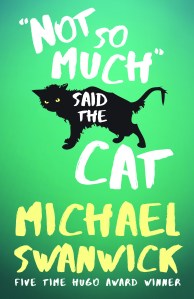 Multiple Hugo and Nebula winner Michael Swanwick writes both novels and shorter works, but it is in short stories that he truly shines. He’s one of those writers that is at home in the shorter length; others that I can think of right off include Harlan Ellison, James Tiptree, Jr., Jorge Luis Borges, and R.A. Lafferty. Some of the stories in this collection, in fact, remind me of Lafferty’s stories: spare, precise, poetic, and with just a few subtle tweaks of reality to spin the reader off into an alternate dimension or situation. Like Lafferty’s too, not all of these stories make any sense or have any internal logic, but they are not meant to have these qualities. Instead, the author puts you into a situation that may be only slightly different from so-called reality, gives you a shove, and propels you farther and farther into an abyss or a labyrinth or a rabbit hole until you end up at some surreal, strange, and absurdly other sort of location and wonder how you got there.