Book Review:  Short Nights of the Shadow Catcher: The Epic Life and Immortal Photographs of Edward Curtis by Timothy Egan

This fascinating biography tells the story of Edward Curtis, a photographer who devoted his life to traveling around North America to capture images, stories, music, and languages of the indigenous population before traditional ways of life had completely disappeared. He began his quest in the late nineteenth century and persevered until the economic crash of 1929. His magnum opus became an elaborate twenty volume set of books called The North American Indian. Although he died in obscurity, for a time he was the most famous photographer in the United States. President Theodore Roosevelt wrote a glowing introduction to his works, and H.P. Morgan, at that time one of the world’s richest men, partially financed Curtis’s field trips.

Curtis was originally based out of Seattle, and his first subject was Princess Angeline, the only surviving child of Chief Seattle, the Native American leader from whom the city got its name. Curtis’s vision grew until he resolved to photograph and document all the Indian tribes whose people still clung to their traditional lifestyles. It was a race against time, not only because so many Native Americans had already been killed off through warfare and decimating diseases, but also because those that remained were being forcibly assimilated into mainstream American culture by missionaries and government agents. To accomplish his task, Curtis lived for long periods of time with Indian peoples throughout the western and central United States and as far north as the Arctic Circle in the then-territory of Alaska. His initial estimate to Morgan was that the twenty volumes would take him five years to complete, but it actually took thirty. In the early years his work was lauded, but as time passed he became more and more forgotten after his benefactors Morgan and Roosevelt died. Still, he persevered until his task was accomplished, despite living under the roughest of conditions and going deep into debt.

There is a profound lesson to be learned here about the life of an artist. A true artist relishes the work and accomplishes it for its own sake, fame or no fame and wealth or no wealth. I can relate to that as the author of numerous books, none of which have been read by many people. I keep writing because I can’t not write. As for Curtis, he gave everything he had until there was nothing left and then collapsed across the finish line, broken in body and spirit.

As I read Curtis’s story, I wondered what my friend and Clarion West classmate Russell Bates, a Kiowa Indian, would have made of it. I think he would have approved. Russ died several years ago, but when he was still alive he was my go-to person for all queries related to Native Americans. One issue was the name. He was so-so on the word “Indian” and he didn’t mind “Native American”; however, he had come up with his own nomenclature for how the indigenous peoples of the North American continent should be called. It wasn’t “Amer-Indian,” which he had considered; it was something else. I’ve been trying to remember it but so far it doesn’t come to mind. Anyway, once when I was living in Greece I wrote Russ and asked him for some recommendations of books on Native Americans, and he sent me a fairly extensive list of both fiction and nonfiction. I think that Short Nights of the Shadow Catcher, had it existed at the time, might have made that list. It is well-written and sympathetic to the people who were first on the land we now call home but were ruthlessly trodden under foot by the American government and land-hungry settlers.

The book contains numerous examples of Curtis’s photos, and they are stunning. Curtis was a true artist with a camera, a genius at capturing the essence of his subjects and their stories. I recognized some of the photos, and I’m sure I’ve heard Curtis’s name in the past, but not until I read this excellent book did I realize the value of his work.

*     *     *

As an addendum to my appreciation of Edward Curtis’s life and works, I found a large and heavy coffee table book at the library called One Hundred Masterworks by Edward Curtis edited by Christopher Cardozo. Some of Curtis’s photos appear in Short Nights of the Shadow Catcher, but it is worthwhile viewing them in this larger, sharper format. As I perused the volume, I was in awe of the abiding excellence in all of his pictures, especially the ones that focus on individual likenesses. As Native American author Louise Erdrich points out in One Hundred Masterworks about his photos of women: “Curtis mastered the art of making his subject so dimensional, so present, so complete, that it is to me as though I am looking at the women through a window, as though they are really there in the print and in the paper, looking back at me.” I feel the same about Curtis’s portraitures of men, women, and children. He captures a lifelike intensity that makes you feel like at any moment they might come alive and speak to you.

Posted in Book Reviews | Tagged , , , , , | Leave a comment

The Library Blues

Don’t let the title of this essay mislead you: I am profoundly thankful for the local public library system. Its online search capabilities are excellent; I can reserve a book and it will be transported free of charge from any of the numerous branches around the city. Because I continually need books, however, I don’t always have time to reserve them and wait for them to arrive. Rather than browse the physical shelves, to save time I often search the digital catalog for what is available at the closest branch the night before, and then I go soon after the library is open to pick up what I’ve found. And so I had arranged to do today. I had done my search and listed some titles, and shortly before ten I took a long walk so I would arrive just at the right time. It was not until I was inside that I realized to my dismay that I had left the list of books at home. I tried to remember the titles, or at least the authors, but I had chosen books that were previously unfamiliar to me and I had recorded their particulars in haste. I had no time to walk almost a mile back home, a mile to the library again, and then return home. The situation was made worse by the realization that I would finish the book I had been reading that afternoon and I might not have something with which to immediately replace it. Frustration! The best laid plans, and so on…

This was a minor inconvenience, though, compared to the library withdrawal I experienced when COVID-19 restrictions hit full force at the beginning of the pandemic. The library completely shut down for several months. I reread books off my shelves, and I bought some books online – but I couldn’t afford to keep that up for long. When the library reopened, at first patrons were not allowed inside. We had to reserve books online and then form lines outside, isolated from one another by distancing protocols, and enter the vestibule of the library in small groups to claim the books we had ordered. Those months of limited access to the library affect me even now. If I find discount books I’m interested in at used bookstores and bring them home, I won’t read them. Instead, I will set them aside – for the next pandemic – and continue to rely on the library for current needs. It reminds me of a story a sibling once told me about a relative who would hoard excessive amounts of household items; she’d lived through lean economic times and never wanted to be without the necessities. That’s how I feel about the books.

Thank God for the Seattle Public Library system! It is well-organized and works effectively. Most of the troubles I have with it are of my own making. To make sure I always have something with which to satiate my literary hunger, when I need one book I usually check out at least two or three – so that if the book I was planning on reading disappoints, I have backups. So it goes in the life of a confirmed book addict.

Posted in Reading | Tagged , , , | Leave a comment

Book Review:  The Underworld: Journeys to the Depths of the Ocean by Susan Casey

The Underworld has many positive attributes: it is fascinating, it is well researched, and it is very well-written. However, what shines through and illuminates it more than any of these is this: the author is clearly in love with her subject. Susan Casey loves the ocean, and when she writes about it her love is manifest. The thrills she feels as she roams the seas, explores the deep, views sea creatures she has never seen before, and shares stories of the lives of others who are as enthralled with the sea as she is are palpable. There is much joy and an overwhelming sense of wonder in this book.

Thus as I read on I was overcome with a sense of grief at an opportunity lost. You see, a few weeks before I began reading this book I found out that Casey was going to appear at a bookstore here in Seattle for an author’s event. The book was already on my radar, and reading the book soon was in my plans, so I marked the day on my calendar. However, when the day of the event came I was especially tired; it was scheduled for fairly late in the evening, and because I don’t own a car I would have had to spend considerable time taking a bus and the light rail. My exhaustion caused me to back out. But then soon afterwards I started reading the book, encountered Casey’s enthusiasm and fervor for the sea and its mysteries, and I realized – alas, too late – that I had missed a profound experience. I would have liked to have heard her expound on her adventures and maybe I would have even asked her a few questions.

At least, though, we all have the book, and ultimately the book is enough. Many of us are enraptured by the thought of space travel, and yet, as Casey points out, we have here with us on Earth the vast environment of the ocean that is for the most part still unexplored. It is full of marvelous landscapes, hidden treasures, and bizarre alien creatures, and the discoveries to be made in its depths are virtually limitless.

Casey takes us on a literary journey back in time to the first attempts to explore under the sea, and then tells of contemporary efforts, some of which she witnesses firsthand, to descend to the lowest depths. She writes of teams who locate and study shipwrecks and of commercial companies that seek to despoil the seafloor and lay waste to its ecology for profit. She also has a few opportunities to personally accompany submersible pilots to the deep parts of the ocean, and when she writes of these experiences she refers to them as some of the highlights of her life. Her ecstasy during these deep-sea voyages is infectious. Once, when I was a child, I too had that sense of wonder, and I briefly considered oceanography as a career. Reading Casey’s book brought back that enthusiasm to discover the ocean’s secrets. If I had multiple lifetimes, I’d want to explore the ocean in at least one of them. Since I have chosen another path in this one, though, I am profoundly appreciative to Casey for allowing me, at least for a time, to share her world.

Posted in Book Reviews | Tagged , , , | 1 Comment

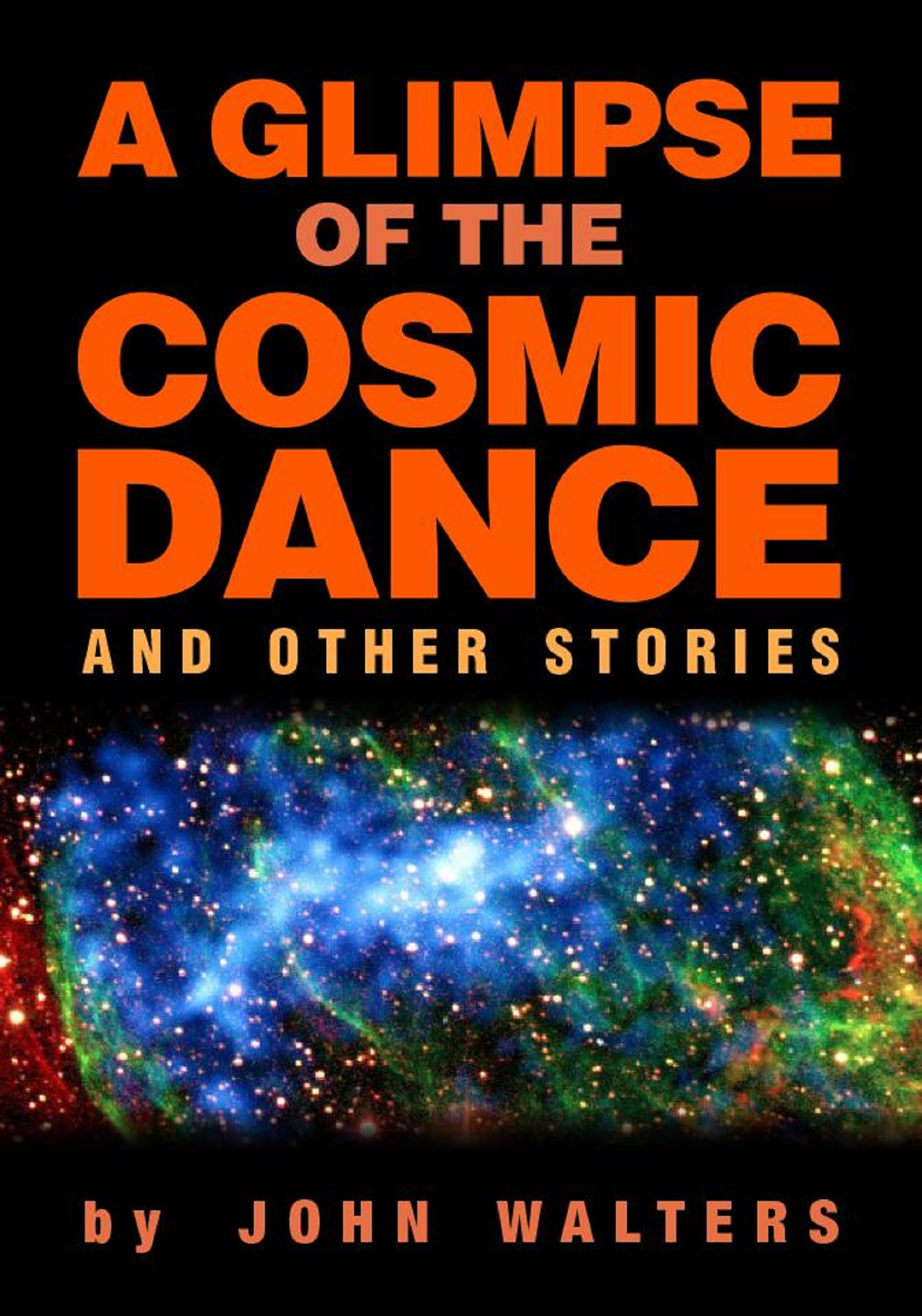
A Glimpse of the Cosmic Dance and Other Stories Is Now Available!

My 35th book and 12th short story collection, A Glimpse of the Cosmic Dance and Other Stories, is now available as a paperback and as an ebook at various online outlets. Links to these are below.

In a world whose inhabitants routinely visit famous historical events, two jaded road-weary tourists take a holiday in an isolated retrograde enclave where time travel is forbidden.

Humankind is plunged into chaos as the recently deceased reappear and take up residency in their former homes.

As the result of an expensive technique that restores their youthful vigor, wealthy old people gallivant from place to place adventure-seeking and partying. However, their newfound energy comes at a terrible cost.

In these and other tales you’ll find heart-pounding excitement, deadly perils, baffling perplexities, complex conundrums, dread mysteries, deceptive hallucinations, fantasy landscapes, far planets, distant futures, evil menaces, and unlikely heroes.

Trade Paperback

Amazon Kindle

Barnes & Noble

Kobo

Apple iBooks

Smashwords

Posted in Uncategorized | Tagged , , , , , | Leave a comment

Book Review:  Babel; or, The Necessity of Violence: An Arcane History of the Oxford Translators’ Revolution by R. F. Kuang

I had never heard of this book until it won this year’s Nebula Award for best novel from the Science Fiction and Fantasy Writers Association. Since then it has won several other awards, and since awards season is not over, there will probably be more. It is a terrific book; it well deserves the accolades. Seldom have I read a fantasy so intelligent, complex, absorbing, character-driven, nuanced, surprising, and yet despite its fantastical elements so grounded in the world in which we actually live.

Babel is an alternate history novel set in the 1800s at the height of the British Empire. In it, the crown jewel of Oxford University is a literal tower of Babel, a linguistics center that creates the magic that runs the empire. The magic is based on the use of the element of silver combined with codes matching words from two or more different languages. To create the effect that powers the magic, silver workers must be able to know the languages they use so well that they can think in them. Since they require this level of expertise in diverse languages, magical silver workers are scarce; professors from Babel search the world for suitable candidates.

The main protagonist, Robin Swift, is a half-Chinese and half-British young man born in Canton, China. His mentor, who turns out to be also his father, Professor Lovell, transports Robin from Canton to England and arranges for tutors for him so that he can qualify for the language school at Babel. Once he begins, he becomes close to the other first-year students: Ramy, from Calcutta, India; Letitia, or Letty, from an aristocratic English family; and Victoire, from Haiti. Reading about these four teens learning to interact and trust one another in the midst of their studies and discoveries at Babel, I was reminded of the group of kids who get together in the Harry Potter series (which, I must admit, I have watched in films but never read). However, in Harry Potter the magic is presented simply and straightforwardly, while in Babel the approach is much more complex, being dependent on principles of linguistics. It turns out that when they arrive, European languages are becoming less effective in bonding with English to create magic; this is the reason for recruiting Robin and Ramy and Victoire from the more distant reaches of the empire.

Speaking of the empire, though, the students eventually find out that there are more sinister reasons for their recruitment than the mere making of magic. Babel’s true purpose, besides self-enrichment, involves strengthening Britain’s oppressive hold on its colonies so that aristocrats and capitalists can get rich at the expense of everyone else. When Robin’s cohort accompanies Lovell on an excursion to China, they discover that Babel is intent on assisting the empire in making war on China to ensure that the lucrative Chinese market for the debilitating drug opium remains open. This, of course, causes Robin and his friends to question their roles as Babel linguists.

I am only skimming over a few highlights. The story is meticulously researched both in history and in linguistics. Kuang obviously knows her languages. When she references a Chinese word, for instance, she not only gives the phonetic pronunciation but also the character in Chinese. These details are often included in footnotes, which give the story additional verisimilitude. While reading the novel I was often amazed at the depth of research and scholarship the writer must have gone through to get it all right.

Concerning the evil of empire and the negative effect that conquering nations have on their colonies, I was reminded of another book I have read recently: Power and Progress: Our Thousand-Year Struggle over Technology and Prosperity by Daron Acemoglu and Simon Johnson. The authors point out that over the last thousand years of history technology has invariably been used not to benefit all of humankind, but rather to enrich very few at the expense of the multitudes. Kuang uses the highly profitable silver-working magic in her novel as a devastatingly effective metaphor of this principle.

All in all, it has been years, perhaps decades, since I have so thoroughly enjoyed a fantasy novel. Don’t miss this one. It’s a sure classic.

Posted in Book Reviews | Tagged , , , | Leave a comment

Book Review:  Chasing the Light: Writing, Directing, and Surviving Platoon, Midnight Express, Scarface, Salvador, and the Movie Game by Oliver Stone

With its subtitle in place, this book has a long, long title. I’ve found that most nonfiction books have subtitles; publishers probably figure that buyers browsing in bookstores won’t pick up a book unless a bombastic title spells out the details for them. Personally, I would have preferred something simple like Chasing the Light: A Memoir; I would have assumed, of course, that everyone would already know who Oliver Stone is and be familiar with at least some of his work. Then again, maybe not – who knows?

For those unfamiliar with his work, Oliver Stone has been writing, directing, and/or producing movies since the 1970s. Besides those the subtitle mentions, they include such iconic works as JFK, Born on the Fourth of July, Wall Street, The Doors, and many, many more. This memoir begins in his childhood and takes us up to the evening when he wins the Best Director and Best Picture Oscars for Platoon. His reminiscences of his early years are not extraneous, though; the background is crucial in understanding his intensity and what motivated him to focus on the subject matter that he did. His dad was an American GI who was stationed in France at the end of World War II, and his mother was a young French woman. When Stone was away at a boarding school during his high school years, they got divorced, and the trauma and confusion following their neglect of him during this time caused Stone to volunteer for the army and get promptly sent off to Vietnam. More severe trauma followed, of course, and this became inspiration for the screenplay of Platoon.

Stone is an excellent writer, although sometimes given to hyperbole. At the heart of the book are the accounts of how he managed to create Midnight Express, Scarface, Salvador, Platoon, and other works, usually when faced with great opposition. He tells of his struggles with drugs, obstinate actors and film crews, foreign locations, producers, and financers. This is all fascinating, of course, but even more important to me are his insights into the creative experience. For instance, one of his teachers at NYU film school, a young Martin Scorsese, praised one of Stone’s early short efforts by exclaiming: “This is a filmmaker. Why? Because it’s personal. You feel like the person who’s making it is living it.” Whether Stone, in his creative efforts, flew or fell flat on his face, he always remained emotionally intense and personal. He also persevered against seemingly insurmountable obstacles. Of the arduous filming of Platoon in the Philippines despite multitudes of difficulties, he writes: “I had to keep going now… Self-pity is not possible. You must be stronger than your captors – or your critics.” In referring to captors, he meant the POWs and their efforts to stay sane when they had to endure horrific confinement during the Vietnam War; he mentioned critics because at the same time he was off in the jungle filming Platoon on an excruciatingly tight schedule and budget, the film he had just completed, Salvador, was premiering in the States to mixed reviews.

The answer, according to Stone, is to persist in spite of everything. His early career was like a roller coaster: extreme highs followed by extreme lows. One moment he’d be winning an Oscar for the screenplay of Midnight Express, and soon afterwards he would be involved in several flops in a row. As Stone makes clear, the point is to remain resolute, or in the words of Kipling in the immortal poem “If”: “If you can meet with Triumph and Disaster and treat those two imposters just the same…”

As I mentioned, the book ends on a high note, with the triumph of Platoon at the Oscars in 1987. For Oliver Stone, there would be many more triumphs and disasters yet to come. This book is so absorbing and well-written that I hope he carries on the story in another volume.

Posted in Book Reviews | Tagged , , , , , , , | 1 Comment

Book Review:  Elevation by Stephen King

The cover of this recent book by Stephen King says: Elevation: A Novel. In fact, though, it’s not a novel; it’s a novella, and a short one at that. We are all accustomed to King’s books being thousand-plus page brick-heavy tomes, so this small, slim volume might be quite a surprise to those familiar with his work. Don’t let that put you off, though. One of the things I like about this book is that it is not such a formidable read. It is told in succinct and simple prose that is nonetheless effective for the story it tells.

In fact, one of the things that puts me off from reading more of King’s work is its length. You have to commit to a significant amount of time and effort to tackle most of his novels. That’s not to say that the effort is not rewarded. I greatly enjoyed his time travel epic 11/22/63, about a man who attempts to thwart the assassination of JFK, even though the hardcover version I read was well over one thousand pages. Elevation, on the other hand, you can easily read in one sitting if you are so inclined.

Besides length, the other thing that causes me to hesitate before opening a King novel is the genre he usually writes in. His name is associated with horror, and for good reason. Horror, however, is simply not my thing. It generally frightens me in a bad way and not a good way. The good news, for me at least, is that Elevation is not a horror story. It has a fantasy element at the heart of the plot, but it is not dark fantasy; instead, King assiduously avoids taking it in that direction.

In short – and I’ll keep the synopsis brief because I don’t want to give too much away – a middle-aged man discovers he is losing weight while at the same time retaining his heavyset bodily appearance. It is an anomaly that his friend, an elderly doctor, is unable to explain. At the same time, he becomes involved in the lives of his neighbors, a lesbian couple, who have just opened a restaurant in a small conservative town in Maine. As his malady progresses, so does local ostracism of his neighbors. Using his signature straightforward writing style, King builds this situation up to an exceedingly satisfying conclusion.

Until now, my favorite book by Stephen King has been his memoir On Writing, in which he tells an abbreviated story of his life and offers this immortal advice to aspiring writers: “If you want to be a writer, you must do two things above all others: read a lot and write a lot.” It is possible, though, that Elevation might supplant On Writing as my favorite King book. In fact, I wish that Stephen King would write more sweet, inspiring stories like this. I think that it might have been published separately instead of in one of King’s short story collections because it is so different from the rest of King’s work. It demonstrates, though, the range of King’s talent, and I hope that in the future he ventures into this unfamiliar territory again.

Posted in Book Reviews | Tagged , | 1 Comment

Book Review:  Power and Progress: Our Thousand-Year Struggle over Technology and Prosperity by Daron Acemoglu and Simon Johnson

This brilliant book is not an easy read, but it is definitely a rewarding one. The authors (both professors at MIT) delve deep into history and economics to explain why in our present era the very few elite prosper while the rest of humankind gradually becomes poorer. It has to do with technological innovation and how those who control it decide to use it. As the authors explain, it is not inevitable that people lose jobs due to automation; in fact, in some countries this has not happened. However, those in power typically look out for themselves at the expense of everyone else.

Technological progress is supposed to make everyone’s lives better; at least that’s what corporate propaganda would have us believe, but at crucial historical moments this has not been true – nor is it true today. The authors prove this point through examples such as England at the beginning of the industrial revolution, the Deep South in the United States when machinery like the cotton gin enriched plantation owners and made the lives of multitudes of slaves miserable, and the rise of factories and communal farms in Soviet Russia. In each of these situations, only the elite prospered while most people endured worse conditions than before. The evolution of economic history the authors present clarify what most of us are aware of even now: that progress favors the few, while the rest of us see no gain or even a diminution of our quality of life.

Certainly modern tech companies are set up like this. Instead of using the amazing recent technological innovations to benefit us all (and the authors make it clear that this could have been an option), the biggest digital businesses are set up for exploitation of the masses, for surveillance and personal data collection that makes the very rich richer. This was not inevitable. Instead of focusing on automation that replaces humans, innovators could have opted for machine usefulness – in other words, machines complementing and assisting humans. The present social media algorithms, contrary to what is touted in slogans and advertisements, are not set up to increase communication and socialization. They are set up to sell advertisements. For this reason, they foster hatred, division, and misinformation. They want you to be enraged and upset (regardless of the truth or falsehood of what you read or see) because these emotions increase platform engagement and help them sell more ads. They honestly don’t give a damn about you.

The new trends in artificial intelligence platforms are also set up for similar reasons: to enrich a few innovators at the expense of everyone else. They scrape data from everywhere with complete disregard for privacy, let alone copyrights. And what AI is theoretically capable of (although at present it can do it only poorly) could put many, many more people out of work. This has happened to me personally recently. For years I have been ghostwriting articles and blog posts as a primary source of income, but in the last several months these income streams dried up. The reason? The companies that were paying me and many others to write for them decided it was cheaper to have AI write their articles (they even outright announced this), even though there is a significant drop in quality and basically all the AIs are doing is copying what they have scraped without permission from other sites.

In the final chapter, the authors of Power and Progress offer a number of possible solutions, none of which are easy but most of which are necessary. I won’t spoil the book by giving away the ending, though. Read it yourself if you want to know what’s really happening and not just what those in power tell us.

Posted in Book Reviews | Tagged , , , , , | 1 Comment

Book Review:  At the Center of All Beauty: Solitude and the Creative Life by Fenton Johnson

A while back I became aware that there was no quick cure for my living alone and being alone much of the time. To mitigate the loneliness, I looked for some books that might give some insight on turning the negative state of loneliness into the more profound positive state of solitude. Back then I didn’t really find what I was looking for, but now I have come across this book, which though flawed (by flawed I mean that I don’t agree with everything the author says) is close to what I was looking for.

Johnson makes a compelling case for the solitary lifestyle; in fact, he gives the name solitaries to the individualistic people he profiles. Besides telling of his own life lived in solitude, in separate chapters he writes about Henry David Thoreau, the painter Paul Cezanne, poets Walt Whitman and Emily Dickenson, the novelist Henry James, Eudora Welty, Nobel Prize-winning Bengali author Rabindranath Tagore, Black writer Zora Neale Hurston, Rod McKuen and Nina Simone, and photographer Bill Cunningham. I am most familiar with the work of Thoreau, Whitman, Dickenson, and Tagore, but all of Johnson’s profiles and explanations shed light on the role of solitude in the life of artists. Johnson also often mentions Thomas Merton, the author and Trappist monk; the abbey Merton lived at was near Johnson’s family home in Kentucky, and the monks, including Merton, knew the family personally.

After a chapter about his own background, Johnson starts off with a study of Thoreau, claiming that though Thoreau was not a cloistered monk he lived a life of poverty, chastity, and obedience (to his conscience) without the trappings of ordinary religion. For me as a young writer making a decision to head off on the road seeking my own unique voice, Thoreau’s Walden was certainly of extreme importance. And Whitman’s “Song of the Open Road” is one of my all-time favorite poems. About Whitman Johnson writes that he “came gradually to understand, the solitary’s challenge is the conversion of loneliness into solitude.” In his explanation of Whitman’s and Dickenson’s distain of conventional marriage, Johnson says that they instead embraced “a literary polygamy as vast as their readerships.”

This brings up one of my disagreements with a conclusion that Johnson repeatedly expresses: that conventional marriage is a hindrance to wholeness and creativity. I was married for twenty-five years and wrote some of my best and most heartfelt books during those years. I can think of countless artists who were married but still managed to find time for solitude and the creation of great work. I think too that Johnson sometimes tries to over-explain the reasons for artists choosing solitude: their sexual predilections, for instance, or their racial or cultural backgrounds. Sexual orientation is incidental to creative solitude, as is, ultimately, race, nationality, gender and other such considerations. The fact is, in my opinion, artists seek out solitude to clear their minds for creative endeavors regardless of their backgrounds. I also believe that Johnson puts too much emphasis on celibacy. He writes that “the solitary foregoes openness to one for openness to all.” For me, though, and I think for many creative people, the patches of temporary celibacy in my life were always involuntary; I have derived intense creative energy from sexual relationships – whether long-term or short.

Still, Johnson is much more often right than wrong in his expostulations. Consider this gem: “Capitalism tells me I will find myself in things – I will locate myself, literally and psychologically, in and with my phone – when what my solitaries have taught me, again and again in their different ways, is that if I want to find the self, give it away, again and again, until there is no more left.” Or this, concerning Van Gogh’s mindset: “One understands being an artist as not about making product for a market but as a way of life.”

In the final chapter, Johnson sums up his ideas with great skill, making a strong case for what he refers to as secular monasticism. Did this book help to assuage the pain of my loneliness? Maybe not. However, it brings my solitude into clearer focus as a thing of value to be treasured and not despised. In time, perhaps, I will be able to better see it in that light.

Posted in Book Reviews, On Writing | Tagged , , , , , , | Leave a comment

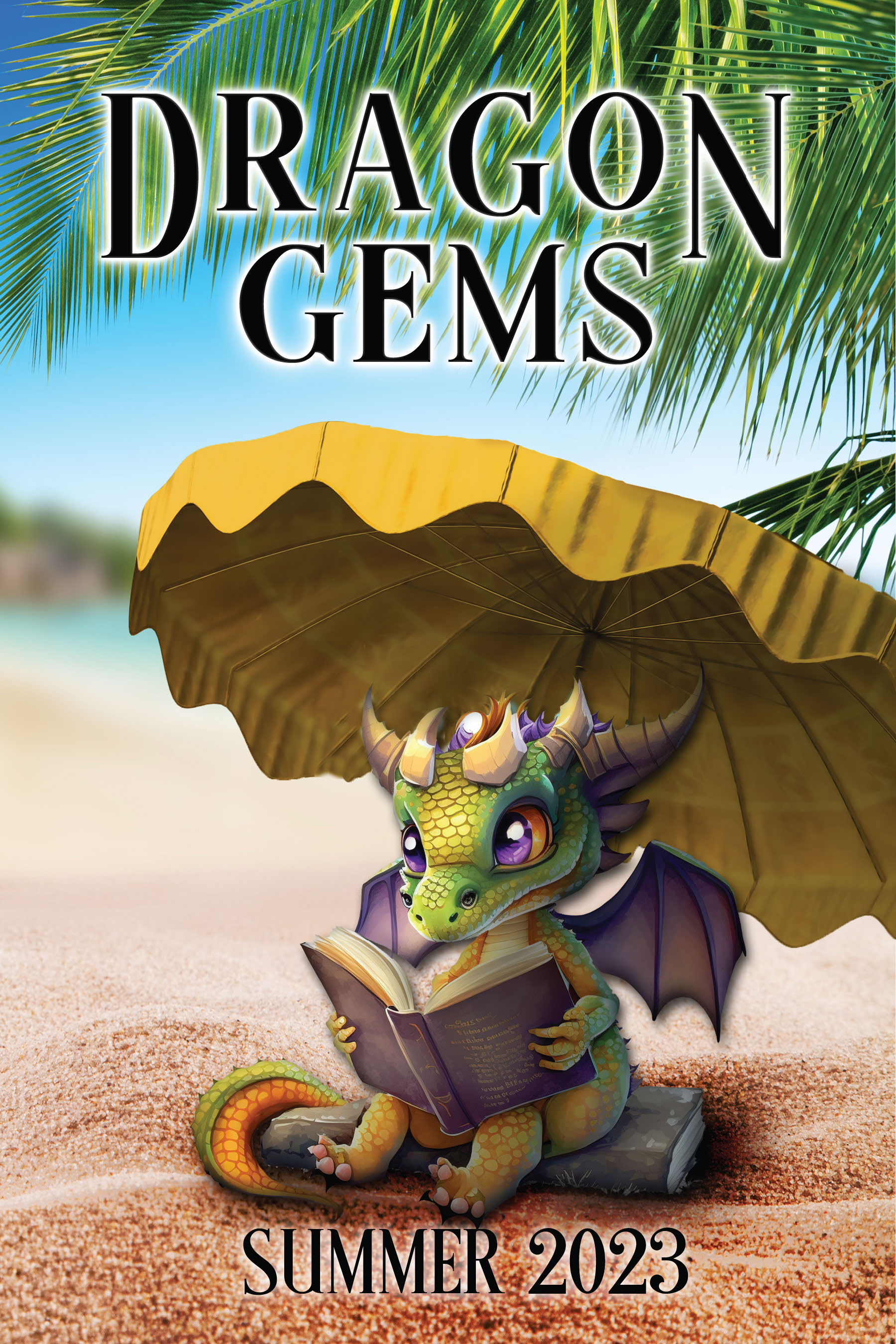
My Story “Dark Mirrors” Has Just Been Published in the Summer 2023 Dragon Gems Anthology

The Dragon Gems anthology for summer 2023, published by Water Dragon Publishing, has just been released, and it includes my short story “Dark Mirrors.”

About “Dark Mirrors”:

The people of Earth are losing a war with aliens that they themselves provoked. Every able-bodied person is being called up to fight, even prisoners; those who refuse are threatened with dismemberment to provide spare parts for wounded soldiers. A battle-hardened general enters a prison to recruit a woman who refuses to fight, but who may have a most unusual special ability that can turn the tide of the war.

You can find links to sales outlets on the Water Dragon Publishing website.

Posted in Uncategorized | Tagged , , , | Leave a comment