On Rereading The Best of the Nebulas Edited by Ben Bova; Part One

Having a strong urge to get back to my literary roots, I picked up the weighty tome The Best of the Nebulas and began to read. As Bova, the editor, explains in the introduction, these stories were selected by members of the Science Fiction Writers of America (as the Science Fiction and Fantasy Writers Association was then known) from the stories that had won the organization’s Nebula Awards from 1965 through 1985. In other words, these stories were considered the best of the best. And wonderful stories they are, too – every one of them. I wondered, in fact, as I have wondered in the past, why there has not been a follow-up volume in the decades since this one.

Be that as it may, the stories in this anthology are representative of some of my earliest encounters with so-called new wave science fiction writers; Harlan Ellison has three stories herein, and Roger Zelazny and Samuel Delaney have two each. I remember searching for science fiction at the local library in Seattle shortly after resolving to become a writer (during my one year of college in California) and coming across a shelf with several Nebula Awards volumes. I devoured them, of course, and craved more, eagerly pouncing upon each new edition as it came out.

The first year of the Nebulas, 1965, was a very fine year for short fiction; three stories from that year made the cut. The book starts out with Roger Zelazny’s novelette “The Doors of His Face, the Lamps of His Mouth.” It is incomparable as a lean yet poetic action-adventure story set on a fantasy Venus. A team sets out on Venus’s ocean on a huge special fishing rig to try to bring in a gigantic sea creature. The title is from the Book of Job in the Bible. In Chapter 41 God is describing the monstrous leviathan to Job: “Who can open the doors of his face? His teeth are terrible round about.” And: “Out of his mouth go burning lamps, and sparks of fire leap out.” The story would already be amazing as a mere adventure, but Zelazny also populates it with well-rounded complex characters and tells it in a unique minimalist style that somehow still allows for intricate world-building.

Following this is Harlan Ellison’s classic tale of civil disobedience in an ultra-efficient, well-organized, intensely scheduled future: “‘Repent, Harlequin,’ Said the Tiktokman,” which manages to be humorous and tragic all at the same time.

In the novella “He Who Shapes,” Roger Zelazny is more elaborate and less Hemingwayesque. Several times he allows the protagonist, Render, to digress into lengthy discourses on psychology in the guise of speaking into a microphone preparing for a lecture. The story posits a near future in which elite psychiatrists called Shapers enter the dreams of their patients and manipulate them in ways that will help cure their patients of their psychoses. A woman blind from birth approaches Render and requests that he familiarize her with the sense of sight, but she is strong-willed and Render has difficulty maintaining control. I have read this story several times since first encountering it in the sixties, and I have had more difficulty with it than with my favorite Zelazny tales such as “The Doors of His Face, the Lamps of His Mouth,” “A Rose for Ecclesiastes,” and of course the classic novels This Immortal and Lord of Light. Nevertheless it is a fine story and worthy of its award.

Then follow two stories with sexual themes: “Aye, and Gomorrah…” by Samuel R. Delaney and “Passengers” by Robert Silverberg. In “Aye, and Gomorrah…” it has been discovered that radiation in space can intensely damage the sexual organs; as a result, before candidates can become Spacers they are neutered. This leads to the rise of a class of deviants known as frelks who are sexually attracted to the neutered Spacers. In “Passengers,” disembodied aliens have invaded Earth, and at random moments they possess Earth people and then engage in sexual and other self-destructive practices. Both stories are emblematic of the so-called new wave of stories dealing with significant social issues that were erupting at the time, and both are well-written, succinct, and devastating.

I have mixed feelings about the next story, the novella “Behold the Man” by Michael Moorcock. It is also a new wave story; it never would have been published in the fifties or even the early sixties. In it, a man time-travels from (then) present day England back to Palestine about a year before Jesus was to be crucified. There’s no explanation about how the time machine could not only pinpoint the era so accurately but also somehow get the man from England to the Middle East. Be that as it may, as Moorcock in the introduction states: “I was interested in the social and psychological processes which turn people into demagogues and/or myths. I’ve no religious background and no particular religious or anti-religious axe to grind.” The time traveler finds the family of Jesus but discovers that the adult Jesus has severe birth defects and the mind of a child. He resolves to take Jesus’ place in his ministry and eventually dies on the cross in his stead. As the protagonist gradually shifts from time traveler to prophet, Moorcock disperses here and there quotes from the King James Version of the gospels; however, the Biblical passages are, of course, not comprehensive, and only a select few are chosen that ostensibly confirm Moorcock’s version of the events. Fair enough, but there are enough gaps in the internal logic that make it somewhat difficult for me to suspend disbelief, as one must do when one reads science fiction or fantasy. Still, the story is an audacious and interesting attempt to deal with a complex and difficult subject.

The story “When It Changed” by Joanna Russ was cutting-edge when it first appeared in Harlan Ellison’s groundbreaking anthology Again Dangerous Visions, and it still packs a powerful punch. Many generations ago on a far planet called Whileaway, a plague killed off all the men, leaving the women to survive and create a society for themselves. Now after hundreds of years men from Earth have returned, and instead of appreciating how well the women have adapted and thrived, they are condescending and paternalistic. The women realize that their world will inevitably change. Although the men repeatedly say that sexual equality has been re-established on Earth, the women doubt that this is so, and there is a strong sense of grief at the story’s ending.

(To be continued.)

Posted in Book Reviews | Tagged , , , , , , , | Leave a comment

The Genesis of The Dragon Ticket and Other Stories

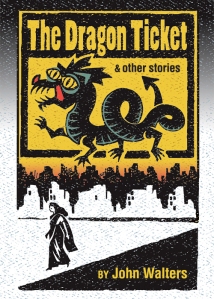
The Dragon Ticket and Other Stories is the first of my thirty-five books. Although most of the stories in it take place on the Indian Subcontinent, I was living in Greece when I wrote them. I had lived in South Asia for about ten years, though, and my experiences in those enigmatic lands still filled my thoughts. Several of my first stories published in magazines and anthologies were set in Nepal, Kolkata, Mumbai, Kodaikanal, and Dhaka.

In Greece I faced numerous challenges in the path to publication. In the days before periodicals accepted electronic submissions, I had to print out stories and send them with a self-addressed envelope to the markets in the United States, Canada, England, and Australia. Since I couldn’t buy the relevant stamps in Thessaloniki, I had to find post offices that sold international reply coupons. These were few and far between, and by the time paper submissions became redundant, I had pretty much cleaned out those reply coupons from almost every post office in town.

In the late 2000s I became enthralled with the fledgling trend in self-publishing. I studied blogs such as those of Kristine Kathryn Rusch and Dean Wesley Smith as well as comprehensive layout and publishing guides on sites like Smashwords to figure out how to do it right. During the school year I taught English as a foreign language, but in the summers I was free, and I took the time to learn to properly format my writing for both digital and print editions. However, when it came to the cover I got some help from 2Pollard Design, a graphics arts business owned by relatives. They produced a vibrant, evocative, and colorful picture and design that is perfect for the subject matter of the stories.

I was cautious when selecting which stories should appear in my first collection; by this I mean that I included mostly previously published tales. In fact, seven of the eight stories appeared in magazines first. In my later collections, after I became familiar with self-publishing, I added more original stories to the mix.

The blurb on the back states:

High in the Himalayas a young woman receives an extraordinary gift. Beneath the streets of Calcutta a man discovers a terrifying presence. In a palace full of sybaritic pleasures a demigod incurs terrible retribution. On a far desert planet teeming with venomous creatures a woman searches for ultimate truth.

In these and other strange and wondrous tales John Walters explores the ramifications of human/alien encounter.

As I explain, though, in the book’s afterword:

The stories are not really about human-alien encounters but about the human condition. Science fiction and fantasy for me have always been literary devices to use to unashamedly produce metaphors, parables, fables – whatever the imagination can conceive. When it comes down to it, there may or may not be aliens out there, but right now it’s all about us, folks.

What a thrill it was to hold it for the first time – a thrill that repeats, of course, with each new publication, but there’s nothing quite like that first book.

Click to buy from these distributors:

Trade Paperback

Amazon Kindle

Barnes and Noble

Kobo

Posted in On Writing | Tagged , , , | Leave a comment

Book Review:  Tolstoy by A. N. Wilson; Part Two: The Spiritual Seeker

After writing Anna Karenina, Tolstoy went through profound spiritual changes. He did not abandon literature, but the tone of his writings changed, reflecting his inner metamorphosis. Scorning the Orthodox church, he adopted a personal faith that included extreme pacifism, renunciation of material possessions, and Christian anarchism based on his interpretation of the New Testament (which he learned to read in the original Greek). His fervent moral stand stirred up controversy in Russia and around the world. Eventually the Orthodox Church, which was integrally linked to the official Russian autocracy, excommunicated him, but this caused Tolstoy’s popularity in his homeland to increase, not decline.

Internationally, Tolstoy’s views, which he expressed in numerous works such as The Kingdom of God Is Within You, profoundly influenced Mahatma Gandhi and other political activists. Both Tolstoy and Gandhi drew inspiration from Henry David Thoreau’s essay “On the Duty of Civil Disobedience.” As Wilson points out, “By the time his distinctive creed was formed, Tolstoy made no bones about believing that Christ advocated a consistent anarchism, a policy of civil disobedience.” These ideas would surface later, of course, in Dr. Martin Luther King’s civil rights campaigns.

As an aristocrat responsible for a large family, numerous servants, and, as his ideas became popular, a legion of disciples and other hangers-on, Tolstoy had difficulty in putting some of his more extreme convictions into practice. This led to discord in the household and, as mentioned, with the church and the government. In other words, he was imperfect in the application of the principles in which he believed. However, his sincerity is without question.

One of the weaknesses of Wilson’s approach to Tolstoy’s spiritual journey is his almost mocking attitude toward Tolstoy’s convictions. As a biographer, it would have been better for him to have stuck to the facts and let readers draw conclusions for themselves. Wilson’s shortsightedness in this lacks Tolstoy’s own clarity. At one point Wilson posits: “With no fiction to write, he was busy making a fictitious character out of himself,” as if Wilson cannot bring himself to believe that for Tolstoy this was a period of inner growth, not an artistic decline.

Wilson comes closer to reality when he writes: “The gap between Tolstoy’s ideals and his actual behavior has made those who do not want to understand him dub him a hypocrite. But a hypocrite is a man who pretends that such gaps do not exist. In Tolstoy there was no such pretence.” And I might add that at least Tolstoy tried to do the right thing. Most people do not try to follow their consciences, at least not to such extremes. Much later, just a few years before his death, when one of his acolytes was arrested and spent a few months in jail, Tolstoy commented: “How I wish they would put me in jail, into a real stinking one. Evidently I have not yet deserved this honor.” This echoes Thoreau, who describes his experience with jail in “Civil Disobedience,” and presages the future prison forays of Gandhi, King, Mandela, and others.

In conclusion, despite its flaws, this book is a thought-provoking read about a man who was not only a literary genius, but also a heroic example for other historical figures who attempted to improve the lives of their fellow humans through pacifism and nonviolent civil disobedience.

Posted in Book Reviews | Tagged , , , , | Leave a comment

Book Review:  Tolstoy by A. N. Wilson; Part One: The Writer

This is a complex, opinionated biography of a literary genius. It is at its weakest when Wilson attempts to introduce his personal observations and impressions of Tolstoy’s life and thoughts as if they were the only possible interpretation, and at its strongest when he sticks to facts about Tolstoy and the historical background. The book is broken roughly into two parts: the first deals with Tolstoy’s growth and maturation as a writer, and the second concerns his dedication to spiritual matters in the latter part of his life.

Wilson makes it clear from the outset that Tolstoy was enabled by his circumstances. He was born into a noble family, and it was this that gave him the freedom to pursue the creation of literature in a country in which the vast majority of its population was enslaved to landlords. In fact, when a piece of land was sold, the peasants living on the land were sold along with it. As I read about this sordid arrangement, I wondered how many people might have had the desire and capability of creating art if they had been as free as Tolstoy. I also thought of Rabindranath Tagore, another wealthy member of a privileged minority who went on to become internationally renowned as a writer.

The young Tolstoy is presented as a flawed individual, a typical member of the aristocracy: selfish, profligate, and deeply addicted to gambling, which almost ruined him. At one point it seems he is helpless to prevent himself from destroying his life and the lives of others through card-playing and resultant debt. He drifts about, dabbles in education, and finally enters the military. Ultimately he finds salvation in two things: his writing, and his marriage (at least in the early years).

The narrative sometimes gets a bit muddled when Wilson attempts to analyze Tolstoy’s motives and thought processes while writing particular works. It is also disconcerting when he takes for granted that readers are familiar with obscure Russian and European writers of the era, who he sometimes discusses at length. On the other hand, often Wilson offers genuine insight concerning various phases of Tolstoy’s career, such as this observation of the time after the publication of his first important work, Childhood: “From now onwards, Tolstoy was a writer: that is, a man whose life is defined by what he is or is not writing.” Further on Wilson offers this clarification of the years when the masterpiece War and Peace was in the beginning stages: “Though there were periods of great idleness even during these, the most creative years of his life, such idleness should not be mistaken for literary indifference. A writer is not just at work when he holds a pen in his hand. He needs to allow the work to gestate; and when the work is of the proportions of War and Peace, the gestation will often be long and apparently idle indeed.”

Tolstoy’s marriage helped to stabilize him. He quit gambling and became concerned not only with the education of his own children, but also of the children of the serfs who lived on his land. In addition, his wife became his amanuensis, faithfully copying numerous versions of his works. Still, he was an often unhappy, deeply conflicted individual, and proof that though a person may have been a literary genius, it doesn’t mean that his personal life was enviable. Tolstoy recognized this himself, and after writing Anna Karenina he embarked upon a spiritual journey in which he embraced abnegation and pacifism. We will deal with this aspect of his life in the second part of this review.

Posted in Book Reviews | Tagged , , , , , | Leave a comment

Life in a Storage Unit; or, How to Declutter Without Losing Your Sanity

This all began with my desire to do a deep cleaning of the apartment. As I contemplated the task, I began to realize how difficult it was due to the overwhelming presence of – stuff. All kinds of stuff that had accumulated over the years since I moved from Greece back to the United States.

It began with the best of intentions. I needed to create a home for my sons on a severely limited budget. Relatives came to the rescue, first with a vanload of items to help clothe us and furnish our unfurnished house in San Diego, and again with more donated items when we moved from San Diego to Yakima, Washington. We sorely needed the assistance and made use of almost everything we were given. Later, when we finally made the leap to Seattle, my sons came and went as their destinies called them, but when they left they usually left some of their stuff behind. I personally too, as a result of relentless poverty, had a tendency to hang onto things long after their usefulness had passed. After the last son moved out, I downsized from a two-bedroom to a one-bedroom apartment, but due to a lack of time, I had to bring most of the accumulated things with me and somehow cram them into the smaller space. It was a complex jigsaw puzzle of a task, and I supposed that when I had finished I had done the best I could.

But I hadn’t. What I should have done was get rid of as much as I could. Instead, the clutter seemed to grow. Until recently, as I said, when I realized I’d had enough. By this time I had three desks and two dressers, and I only used one of each. I also had six bookshelves bursting with books, DVDs, and games. I had to do something.

I started with the books, and over the course of a few days I gathered three large bags full of volumes I knew I’d never read or refer to again. I managed to sell most of these to a used bookstore, and the others I distributed in the neighborhood little free libraries.

To inspire me, I began reading a copy of The Life-Changing Magic of Tidying Up: The Japanese Art of Decluttering and Organizing by Marie Kondo that one of the boys had left behind on a shelf. I don’t agree with everything the author proposes; for instance, she anthropomorphizes her belongings, takes the perspective of the affluent, and goes to extremes about what should be kept or tossed. Still, I agreed with her that purging and organizing belongings is good for the spirit, and I realized that I would feel better if I attacked the mountainous clutter threatening to overwhelm my small apartment. After the books will come the papers, the clothes, the broken or outdated electronics, and the odds and ends. I’ve even arranged with one of my sons to rent a U-Haul while he’s here for Christmas and get rid of the unneeded furniture. (It turned out that weeks before Christmas one of my brothers came by with his pickup and helped me get rid of the excess furniture.)

What is the goal of all this? For one thing, it will make cleaning the apartment much, much easier. For another, as I clear my living and working spaces, I am confident (or at least hopeful) that my thoughts will become clearer as well.

I’ve never owned much. Even now I own much less than most of my contemporaries. After decades of traveling and living abroad, and also moving from one place to the other in the States, I realize that it is not the quantity of possessions that is important. Some people need or crave more than others. That’s fine by me. The important thing I need to attend to, though, is whether I personally have exceeded my limit. If I have, these extra things will only weigh me down and make me miserable. And so: out with them! I’ve made mistakes, sure; only today I threw out something I afterwards deeply regretted discarding – but I couldn’t get it back. To put it in perspective, though, we’re talking about things. Just stuff. Nothing that can’t be replaced. Or abandoned. Or forgotten.

Posted in Memoir | Tagged , , , , | Leave a comment

On Rereading Jurgen by James Branch Cabell (again)

Due to my ongoing need for literary comfort food, I turn once again to the brilliantly written fantasy Jurgen (subtitled in the original, though not in the edition I own, A Comedy of Justice). I think I was still a teen when I first encountered Jurgen, and I have read it several times since. Shortly after its publication in 1919 the author and publisher were prosecuted for obscenity, although no sexual activity is described explicitly. Instead, Cabell makes inferences and liberally uses double entendres to make his points.

The story follows Jurgen on a journey through various fantasy lands to recover his lost wife, who has been abducted by Koshchei the Deathless “who made things as they are.” As he travels, he meets, woos, and sometimes marries a variety of beautiful women, including Guinevere, Helen of Troy, a tree nymph, a vampire in hell, and others. Proclaiming himself “a monstrous clever fellow,” he promotes himself to be a duke, a prince, an emperor, and even a pope as he ascends for a brief time to heaven to meet the God of his grandmother. As he sojourns in each land he conforms to its customs and has many strange and unique adventures. However, despite his heroics and his numerous affairs, he doesn’t find peace, and eventually he recovers his middle-aged wife and goes back to his life as a respectable pawnbroker. During much of the book, a spell has given him his lost youth, yet in the end he relinquishes even this, as he realizes that his youthful body does not match his more mature mind.

When I first read Jurgen, so many years ago, I identified with his youthful incarnation who reveled in new adventures and experiences. As I read it now, though, as an older man, I find myself in sympathy with the middle-aged person who can not quite reconcile his audacity and profligacy with the “respectable” life he has settled into with his wife. He has grown comfortable in his marriage and comes to appreciate his wife’s faithfulness and companionship.

It’s all in great fun, of course; Cabell is not particularly attempting to moralize, but rather to tell a tall tale with a multitude of unexpected twists and turns. The language he uses is a feast for the inner ear, and the outlandish places Jurgen’s destiny takes him are described in intricate and outrageous detail.

If you are looking for deep lessons and social and political relevance, you might have to look elsewhere, but if you want to enjoy a magnificent and humorous fantasy told in exquisite prose, you couldn’t do better than to read Jurgen. For a time, especially after the obscenity trial, Cabell was internationally famous and well-regarded by his literary contemporaries. He is less known now, although still revered by connoisseurs of fine fantasy. Among Cabell’s admirers were writers such as Mark Twain, Sinclair Lewis, Robert Heinlein, Neil Gaiman, and many others. If you’re a fan of humorous fantastic adventures and adroit wordplay, give Jurgen a try. You won’t be disappointed.

Posted in Book Reviews | Tagged , , | Leave a comment

Living Alone: An Anti-Primer

Let’s clarify this from the outset: I like being alone, but I dislike living alone. It’s an ideal situation for me when I can close myself up in a room and do my work, but when I open the door again I want people there to hang out with, to eat with, to watch TV and movies with, to go shopping with, to go on excursions with. After once living in a household of seven, my wife and my five kids and me, the long periods of isolation are excruciatingly difficult. I thought perhaps I could get used to it, but so far I have not been able to feel serenity about the situation – except for brief intervals when I manage to “look on the bright side” so to speak, and contemplate the positive aspects of my existence. It is almost a form of self-hypnosis that I engage in. And I know that I am not the only one to feel this. Loneliness, especially with older people living alone, is a national epidemic, it seems.

For me, however, this gut-wrenching sensation of loneliness is not directly related to age. I have always hated living alone. Traveling alone, even for long periods of time, is different, because the constantly changing environments and transient companions are distracting. I’m talking about prolonged sessions of being alone in one location. I rented my first apartment in the University District of Seattle, a scant couple of miles from the home of my parents and my eight brothers and sisters, just so I could get away from everybody, become independent, and make my own decisions. It was a fiasco. I was totally unprepared for a solitary lifestyle, and it didn’t last long. Other solo apartment adventures were scant improvements. In another apartment in the University District, when I was older, I had a string of girlfriends coming and going, but there were still times when it was only me and that was one of the things that ultimately drove me out on the road. When I rented an apartment in Los Angeles it was with the motivation of breaking into screenplay writing, yet still there were times when the solitude was overwhelming. I remember once when I was feeling really down I looked out the window and thought I saw the moon. “At least,” thought I, “the moon is rising; eternal beauties continue.” As I continued to watch it, though, it seemed to never move. Finally I went outside to check and discovered that I had been staring at a street lamp.

I attempted to mitigate my loneliness by renting houses or duplexes with friends. This was better, although it seemed that me and my roommates could rarely decide who should do the dishes. But roommates come and go. Once I rented a two-bedroom duplex with my best friend, and then he took off for Europe and left me on my own. My feelings in this situation were epitomized when Seattle was hit with a brutally cold winter. Outside, snow was deep on the ground, and inside, I couldn’t afford to keep the whole place heated so I had to spend all my time in my bedroom where I had a space heater.

As I thought back, these examples reminded me that what I am experiencing now is not an anomaly. This is how I always react to loneliness. To clarify, hitchhiking alone across the United States, Europe, and the Middle East or hiking alone in the Himalayan Mountains, all of which I have done, do not provoke the same gut-wrenching negative emotions. Those were glorious adventures, and I was fully aware that I might not have ever had them if I had waited around for someone willing to go with me. No doubt there are times when one needs to step out on one’s own. What I feel now alone in my apartment after my last child has grown and gone away is different.

Often when I write essays like this I conclude with a lesson. I give my thoughts a twist so that they come out positive in the end. This time I’m not so sure I can do that. I suppose all I can suggest, if you are in a similar situation, is to hang in there. I have been rereading James Branch Cabell’s masterpiece, the fantasy novel Jurgen. When the hero meets people who have difficulties or defects that cannot be helped, he says, “God speed to you, for many others are in your plight.” This is the only solace he can offer, and it doesn’t really cure the difficulty at all. That’s all I can say now too. In our modern era loneliness is epidemic. Would that there were a vaccine for it.

Posted in Memoir | Tagged , , , | 1 Comment

Book Review:  Lion (original title A Long Way Home) by Saroo Brierly

In my view, this book has two strikes against it before I even initiate the reading, which makes it unusual that I would have picked it up at a used bookstore and read it all the way through. First of all, it is a movie tie-in edition. Instead of having the author on the cover, as in the original, it has a photo of the actor who plays the author in the film. This, to me, is a diminishment of the author’s accomplishments. I would much rather see a photo of the man who underwent all of these amazing experiences than the thespian who had pretended to do so. I also objected to the changing of the book’s name. A Long Way Home is a precise summarization of what the author went through, while Lion makes no sense in the context of the story, until we learn near the end of the book that the author’s given name of Sheru (which he had remembered as Saroo after he had got lost as a child) means Lion in Hindi.

The second strike I discovered while researching details of the book on Wikipedia: it is ghostwritten. The actual author is an Australian writer named Larry Buttrose. I have read and enjoyed ghostwritten memoirs in the past (Life by Keith Richards, for instance) but normally I avoid them. If someone feels that their life (or an aspect of their life) is important enough to write a memoir about it, I would prefer the account to be in the participant’s own words.

For A Long Way Home, though, I am willing to waive my objections to these defects – because the fact is that it tells a truly unique, absorbing, exciting, and awesome true story.

Saroo is raised in a poor neighborhood of a town in central India along with his two brothers and sister by his mother, who has been abandoned for a new wife by her Muslim husband. The family, living in abject poverty, barely manages to survive; nevertheless, the various adversities they endure keep them close as a unit. One night when five-year-old Saroo is visiting a nearby train station with his brother, he boards a train, gets locked into an empty carriage, and makes the long journey alone to Kolkata (at the time known as Calcutta). He somehow survives on the streets until he is taken in by an orphanage. Through an adoption program he is matched with new parents from Tasmania in Australia.

It takes him time to adapt to a new language and culture, of course, but Saroo manages to prosper while growing up as an Australian. When he is an adult, he initiates a search for his hometown and family through the Google Earth program. For three years he virtually follows rail lines from Calcutta’s Howrah Station westward into India’s interior until he miraculously manages to locate his former home. He travels to India, finds his birth family, and reunites with them.

It is an extraordinary story that drew much international attention when it was first made known. The movie, too, was popular and acclaimed, earning six Oscar nominations. I have traveled extensively in India and have visited Calcutta and Howrah Station on numerous occasions, and I can testify that Saroo’s story is nothing short of astonishing. For every orphaned or abandoned Indian child who finds a home either in India or abroad, there are countless others who remain lost. Despite the drawbacks I delineated at the beginning of this essay, I recommend this book. It is rare to find a true tale with such excitement and depth.

Posted in Book Reviews | Tagged , , , | Leave a comment

Unintended but Vivid Flashbacks

Recently my sister gave me an envelope full of memorabilia saved by my mother, who died decades ago while I was living in South Asia. Evidently she was quite a hoarder. As I perused the material, I came across class pictures from elementary school (I recognized all the faces and was surprised how many names I could remember), report cards from kindergarten through eighth grade (the one that struck me most was the sixth grade report – the teacher had given me almost straight A’s and a 1st honors ribbon, but in the box asking whether I had put forth sufficient effort she wrote “no” for every term), and certificates of accomplishment for high school debate, sophomore high school football, and junior varsity basketball. The items that impressed me most, though, were letters I wrote home after I had moved out of the homestead into the wide world.

Several letters, for instance, were from the University of Santa Clara, where I went for one year of college and got thoroughly messed up by using too much cannabis and hallucinogens. My tone to my parents, however, was always upbeat and informative. I told them about my Shakespeare class (fun), New Testament class (boring), and math class (difficult – I eventually dropped it). I have no idea why I took that class on the New Testament – by that time I had become fed up with organized religion. I remember that for the final paper I wrote an anti-war political treatise instead of the theological paper the priest teaching the class had requested; he still passed me, but with a low grade. My ultimate academic audacity, though, was perpetrated in an English composition class; after a couple of sessions I stopped going because the teacher, in my opinion, was so mind-numbingly uninteresting. Instead, I wrote a fantasy story roughly in the tone of The Lord of the Rings, turned it in to the teacher at the end of term, and told him I deserved an A because I already knew how to write. He probably should have been outraged, but he wasn’t; he gave me an A minus and said my skipping class was “no great matter.”

In one letter I describe an outing with some friends. We “went up into the hills and hiked around. We found an old shack with a fireplace in it. Nobody lived there so we decided to spend the night, since it was a hard hike out of the valley where we were. So we stayed and it rained Thursday night and the roof leaked and it was really cold. We had to keep the fire going all the time, so we could only sleep for an hour or so at a time. Thrills.” What I neglected to mention was that throughout this experience we were all blasted out of our heads on acid.

The best thing that came out of my University of Santa Clara experience was the realization, while taking a course in science fiction as literature, that I wanted to be a writer. To this end, I attended the Clarion West writing workshop in Seattle, but since I was still struggling to come up with ideas, I decided to get out on the road and find out what life was all about. My first trip was from Seattle to Los Angeles and from there to Mexico and Guatemala and back. I was pleased to find in this envelope from my mother several postcards I’d written from Mexico and Guatemala. These included details that I’d long since forgotten, such as, for example, that I saw Pele play in Guadalajara stadium and that the route back from Guatemala took me through Belize (one more country to add to the total I’ve visited).

After my trip to Central America I decided to move down to Los Angeles and, with the help of some friends from Clarion West, try my hand at scriptwriting. I was pleased to find in the envelope a long letter I wrote from my apartment in the San Fernando Valley. Again there were details I had forgotten, such as watching my Clarion West mentor Harlan Ellison composing a story in the storefront window of the Change of Hobbit bookstore, or attending a meeting of the Los Angeles Science Fantasy Society with my Clarion West buddy Paul Bond, or attending a party at another bookstore where the guest of honor was Ray Bradbury, or studying a pile of scripts that my Clarion West buddy Russell Bates gave me, or getting a late night visit from a woman who drove me from Seattle to L.A. on her way to Arizona. She drove all the way back from Arizona to visit me; I am surprised that I have no recollection of her.

Anyway, all this to say that this particular trip down memory lane was profoundly satisfying and worthwhile. It made me wonder what other important snippets of life get erased by time as we journey through life. I suppose that’s the value of memorabilia: to serve as mnemonic devices to bring back details of times forgotten.

Posted in Memoir | Tagged , , , , , , , | Leave a comment

Book Review:  Being Gardner Dozois: An Interview with Michael Swanwick

Not long ago I read and reviewed a recently published book called Being Michael Swanwick by Alvaro Zinos-Amaro. It consists of a series of interviews of author Swanwick that delve into the creative process of how he came to write his published short fiction. This book was inspired by an earlier book, Being Gardner Dozois, in which Swanwick interviews Dozois about his short fiction. The late Gardner Dozois was a powerful presence in the science fiction field, not only as a writer but even more as an editor, and so I was eager to read the earlier volume as well.

I received Being Gardner Dozois as a Christmas present and set about reading it almost at once. Something mystified me, though, about the publication date. The ReAnimus Press edition marks the copyright and publication dates as 2018, but the last story that Dozois and Swanwick discuss was published in 1999. Could it be that Swanwick was unable to find a publisher for it for two decades? That didn’t seem likely. A modicum of research, mainly on Wikipedia but also on publisher websites, revealed that the book was first published in 2001 by Old Earth Books. At that time it was a finalist for the Hugo Award and won the Locus Award for non-fiction. The Old Earth Books website has not been updated since 2012, so we can presume it is defunct. According to its website, one of the aims of ReAnimus Press is to help authors to “get their out-of-print books and short works back into readers’ hands.” To accomplish this, it uses ebooks and Amazon’s print on demand services.

Being Gardner Dozois covers all of Dozois’s published stories beginning with those he wrote as a teenager through, as I mentioned, 1999. Besides being a writer, from 1986 to 2004 Dozois was also editor of Asimov’s Science Fiction magazine, and he won the Hugo award fifteen times as an editor. I would have liked Swanwick’s interviews to delve into Dozois’s editorial process, but he focuses only on Dozois as a writer. And Dozois was an excellent writer. Two of his short stories won Nebula Awards, and many more were nominated. Dozois had a singular style that might be described as literary, and not many of his stories appeared in the genre digest magazines. Instead, he sold his stories to top-class cutting-edge anthologies such as Damon Knight’s Orbit series and Robert Silverberg’s New Dimensions series. Later he also sold numerous stories to slick magazines such as Omni, Playboy, and Penthouse.

Since I have read both Being Michael Swanwick and Being Gardner Dozois fairly recently, it is interesting to compare the interview styles and the voices of the authors. Being Michael Swanwick is a bit more formally presented, whereas Being Gardner Dozois is presented more as a lark, as a fun project involving two close friends. Near the end, Dozois jokingly mentions: “You realize that you have just pulled off one of those completely useless but impressive accomplishments, like making a replica of the Titanic out of marzipan, or building the Eiffel Tower life-sized out of old used Q-tips. I figure there’s about five people in the world who are going to want to read this book. Maybe that’s overestimating it.” Dozois turned out to be wrong in this instance, as evidenced by the awards the book received, and I’m sure he knew he was wrong when he said it or he wouldn’t have spent so much time with Swanwick compiling the book. It’s true that a book like this could become tedious if the interview subject was a mediocre writer, but that’s certainly not true of Dozois or of his interviewer Swanwick. They are both among the finest writers the science fiction and fantasy field has ever produced, and this book is of great value to both aspiring and veteran writers – and, for that matter, anyone interested in how superlative literature comes into existence.

Posted in Book Reviews, On Writing | Tagged , , , , | Leave a comment