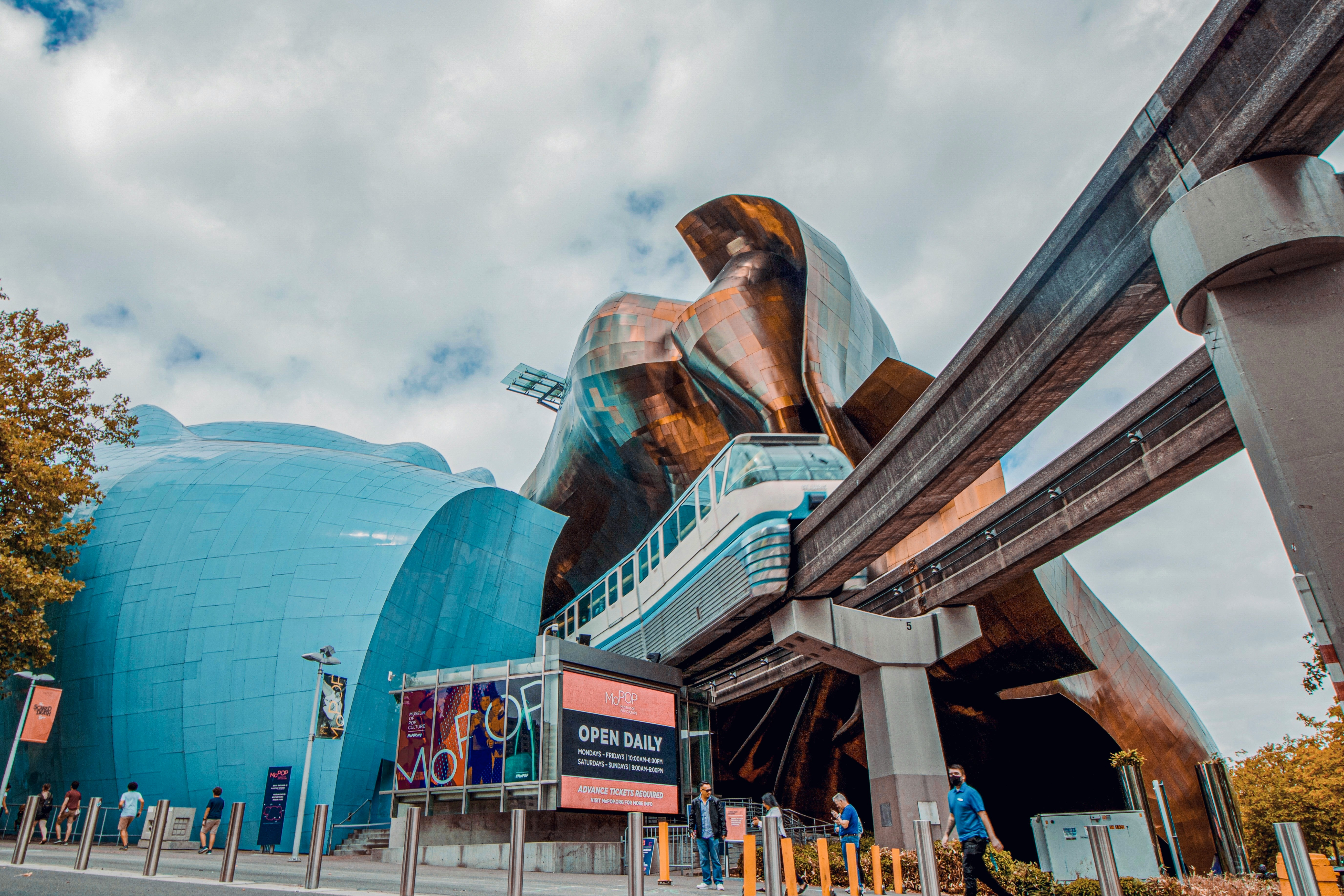
I decided to take a bus to the Seattle Center, the former site of the 1962 Seattle World’s Fair, to visit the Museum of Pop Culture, commonly known as MoPOP. When Paul Allen, the Microsoft billionaire, founded it in 2000, it was called the Experience Music Project and Science Fiction Museum and Hall of Fame, or the EMP Museum.
When I first heard about the EMP Museum, I was living in Greece, but a longing to visit it immediately erupted in me. After a long hiatus, I had begun to write again, and the stories that naturally burst into my mind were tales of science fiction and fantasy.
I had read some works of speculative fiction when I was a teen; on one Christmas my maternal grandmother gave me a boxed set of Robert Heinlein novels, and on another Christmas she gave me a boxed set of The Lord of the Rings trilogy. These were some of the basics, of course, but I never truly understood how dynamic the field was in the early seventies until on a whim, while attending the University of Santa Clara for my first and only year, I enrolled in a course devoted to science fiction as literature. I didn’t really understand what I was getting into. I spent most of my time in those days stoned on marijuana and/or psychedelics, and I thought that it would be trippy to get college credits to read science fiction. The text was The Mirror of Infinity: A Critic’s Anthology of Science Fiction edited by Robert Silverberg, and it was brimming with brilliant, cutting-edge stories by old masters and also rising stars in the so-called New Wave, which was sweeping the field at the time. Many of the stories devastated me with their originality, acumen, depth, contemporary relevance, and linguistic precision, but the one that hit me the hardest was “I Have No Mouth and I Must Scream” by Harlan Ellison. Before I even finished reading that story I knew – I was fully convinced – that there was nothing else on Earth for me but to be a writer.
When I returned to Seattle, I haunted the public library nearest our house searching for more science fiction, and that’s when I came across anthologies showcasing the Nebula Awards presented by the Science Fiction Writers of America. From these volumes I became acquainted with the works of Roger Zelazny, Samuel Delaney, and numerous other writers that were breaking through traditional genre constraints and writing literary works using elements of science fiction and fantasy as lenses to analyze contemporary society. I too wrote stories and submitted them to magazines, but in those days of yore I never had any success selling them. Later I became interested in memoir-like novels such as On the Road and Tropic of Cancer, and I put science fiction aside. Still, when my Greek wife and I settled in Thessaloniki to raise our family and I resumed writing, it seemed natural to turn to science fiction and fantasy for inspiration. And I had matured, and I had a better idea of what I wanted to say, and I began selling those stories, and they began to appear in magazines and anthologies. I joined Science Fiction Writers of America (now known as the Science Fiction and Fantasy Writers Association), which became a link to the field in my faraway location.
You can see, then, why I became so excited when I heard of MoPOP.
As I wandered about this latest time, my mood was a bit melancholy. After all, in the past I had usually gone with one or more of my sons, and their thrilled appreciation and sense of wonder amplified the experience for me.
The first vivid memory I have of exploring the museum and perusing the exhibits is from shortly after I moved back to Seattle with my youngest son, who was in middle school at the time. I still have a picture from that visit of him sitting in the mock bridge of the Starship Enterprise. On that occasion we focused on the science fiction and fantasy sections and gave only cursory glances to the displays in the music section. On another occasion, my son and one of his uncles became enthralled and spent an inordinate amount of time in the newly opened horror section while my sister and I waited nearby. On yet another foray to MoPOP we discovered the room in which visitors could play various indie video games, and my son wanted to spend a lot of time in there trying out the multitudinous options.
During this latest tour, my solo visit, I meandered through the fantasy section and the science fiction section. The horror section was closed for renovations, but I didn’t miss it that much; horror is more my son’s thing than mine. I then walked through the Jimi Hendrix and Nirvana exhibits and the rest of the rooms in the music culture wing, and finally I took a look at the Science Fiction Hall of Fame.
I hadn’t been there for years, but nothing much had changed, which contributed to my feeling of melancholy and nostalgia. Despite the futuristic appearances of the items on display, it was like a personal journey into the past.
Nearby MoPOP are the Space Needle and the Seattle Center terminal for the monorail, which was built for the World’s Fair but is still operational. These landmarks caused me to remember visiting the World’s Fair with my family back in 1962; I would have been nine years old. A blast from the more distant past.
* * *
I returned to MoPOP recently, but this time my intention was to focus on the pop culture and music side of the museum, which I had usually neglected on past visits. My kids and relatives and I would spend a long time exploring the realms of science fiction and fantasy and give a cursory glance at the other side at the end. This time, I never even made it to the science fiction and fantasy side.
I started out by visiting the exhibit called “Massive: The Power of Pop Culture.” It offers far more than a mere collection of objects; in fact, it is an attempt to explain the origins, importance, appeal, and fandom of pop culture through not only displays but also multimedia presentations. One of my favorites involves a chair with a panel on one arm that allows you to choose a year, and an enormous video display opposite shows the pop culture highlights from the selected year. For instance, when I clicked on 1969, the display showed video clips from the Apollo moon landing and from the Woodstock Music and Arts Fair.
I then entered the exhibition space called “Nirvana: Bringing Punk to the Masses,” but this time I spent more time therein than I had in the past. In particular, I paused to watch a video about the grunge movement. Nirvana’s brief but brilliant ascendancy to fame and Seattle’s emergence as an important oasis for grunge music happened while I was living overseas, first on the Indian Subcontinent and then in Europe, and as a result I had known little about Nirvana’s impact on pop culture. From the Nirvana exhibit I moved next door to the Jimi Hendrix room. This exhibit mainly consists of posters, guitars, and a few items of memorabilia, but it offers a unique opportunity to listen to Hendrix’s idiosyncratic guitar play in an enclosed soundproof space.
I think that I did the right thing in concentrating on one wing of the museum instead of spreading out my attention too thinly. In the future, I may take this approach with other massive museums I have previously visited; that is, to first focus on the areas I usually leave until last.