Book Review: Wild Nights!: Stories About the Last Days of Poe, Dickenson, Twain, James, and Hemingway by Joyce Carol Oates

This is a wildly original collection of long short stories, or novelettes, on the last days of famous writers.  I had never heard of it before, but I picked it up at the library on a whim, intrigued by the subject matter.

There are five stories, each a speculative look at the period leading up to the death of a famous writer, told in an imitation of the writer’s style.  The Poe story posits the author in an isolated lighthouse off the coast of Chile, slowly going mad.  The Dickenson story is set in the future; a couple purchases a robotic model of the poetess which turns out to be far more lifelike than they would have imagined.  Mark Twain is an old man obsessed with adolescent girl admirers.  Henry James volunteers to visit and give comfort to severely wounded soldiers at a filthy overcrowded hospital during World War I.  Hemingway, broken in body and spirit, contemplates suicide in the remote hills of Idaho.

I enjoyed the first three stories the most.  The Poe story was a classic horror/fantasy, and the Dickenson story intriguing science fiction.  The final two, on James and Hemingway, were well-written but also very depressing, and that dampened my appreciation of them.

Generally the book was very entertaining.  Oates is a talented writer, and reading this made me want to read more of her recent story collections in which she ventures into the realms of fantasy and horror.  She belies the widely-held belief that prolificacy in writers leads to a diminishment of quality.  For her, at least, the opposite is true, and I would venture to say that it is probably true for most writers as well:  the more one practices one’s craft, the better one gets.

One thing I appreciate about Oates is that she is a genre smasher.  She wanders freely from mainstream fiction to science fiction to fantasy to horror and back again, and manages through it all to get published in top literary magazines.  She is an exception, though.  Most writers cannot so easily make the transition from one genre to another; many feel the need to change names, to adopt pseudonyms when genre-hopping, fearful that the reading audience would not understand.  Magazines are the same, shunning unknown writers who submit works outside of the magazine’s comfort zone.  I have never understood this mindset.  If I appreciate an author I am interested in all of his or her work, and I think an author who ventures into nonfiction as well as various genres of fiction is to be admired for his or her versatility, courage, and imagination.  One other that comes to mind is Harlan Ellison.  Due to his prodigious output he has written under pseudonyms, yes, but under his own name he has shown enormous range, with fiction of all types and all lengths, screenplays and teleplays, film and book reviews, memoirs, and other types of work too numerous to mention.

As far as “Wild Nights!” is concerned, I would recommend the book.  It is a fascinating literary exercise and a well-written collection of entertaining tales.  And as I said, after the reading of this book, I intend to seek out and read more from Joyce Carol Oates.
Posted in Book Reviews | Tagged , , , , , , , , | Leave a comment

Book Review: Rabindranath Tagore: The Myriad-Minded Man by Krishna Dutta and Andrew Robinson

This is a fairly comprehensive biography on Tagore, starting with a chapter on his grandfather and culminating in his death.  After he won the Nobel prize for literature in 1913 he was an international celebrity, considered one of the two most influential Indians of the time, along with Mahatma Gandhi.  The prize was for his slim volume of poetry, “Gitanjali”, which he had taken with him on a trip to England in 1912, translated from Bengali to English by himself.  It took the British, and then international literary world by storm; it was an instant success.  W.B. Yeats, the British poet, in particular went to bat for it and drew it to the attention of other famous individuals.

The fact is, Tagore was not a one-shot wonder.  Besides “Gitanjali” he wrote many volumes of poetry, as well as songs, plays, short stories, and novels.  In his later years he turned to the visual arts as well and completed over 2000 paintings which were widely acclaimed.  Besides his prolificacy in the arts he was also an educator, founding first a school and then a university a few hours’ train journey northwest of Calcutta in a place called Shantiniketan, or “Abode of Peace”.

Promoting and raising funds for Shantiniketan occupied most of his adult life, causing him to tour the world again and again.  Wherever he went he was received as a VIP, and he met many of the world’s most famous people, including literati, politicians, artists, and scientists, including Albert Einstein, who became his friend and who collaborated in some fascinating published discussions, an excerpt of which is included in this book.

I studied Bengali once, at Dhaka University, and I could read, write, and speak it after a fashion, though it has been many years since I practiced and only bits and pieces of the language remain in my memory.  I lived for a brief time in Shantiniketan as well, in a small cottage where my friends and I would burn dried cow dung for fuel, though at the time I didn’t understand the significance of the place or know anything about Tagore himself.  I would take bicycle rides in the afternoons along the bright red dirt roads, letting the paths take me whithersoever they would.  It was a brilliant contrast of colors:  the brick-red road, the foliage on either side so green it seemed to glow, and the deep blue sky above.  A particular spot caught my interest, the ruins of a many-roomed house that the forest had reclaimed.  I would return to it again and again and wander about the outside of it, never having courage to enter, perhaps for fear of snakes, and wonder who had lived there, what they had done, and how they had come to abandon the place and leave it to the forest and the elements.  For some reason that is my most vivid memory of Shantiniketan – that old ruin.  In all the time I was there I never went to check out the university, or the house where Tagore used to live.  In hindsight I wish I had, but isn’t it often true of life’s experiences, that we don’t appreciate the significance until it is too late?  One of my dreams is to return to Shantiniketan someday, knowing what I now know, with an ability to appreciate it in all of its subtleties, and even study Bengali there so I would be able to read Tagore’s poems in the original Bengali.

Tagore was also involved in politics off and on; though he never enjoyed it he realized the necessity.  It was a volatile period in India’s history.  He grew up in the British Raj and died during World War Two, shortly before independence.  Gandhi stayed at Shantiniketan from time to time, and though they became friends and Gandhi even called Tagore “The Great Sentinel” he and Tagore didn’t always see eye to eye about how to go about creating the nation of India.  For a long time Tagore opposed Gandhi’s most extreme tactics and his renunciation of anything western, and worked for a meeting and union of east and west, a union that never came to fruition in his lifetime.  He died before partition and the violence between Hindu and Muslim that accompanied it, but he was aware of the complexity of the situation and the impossibility of a simple, peaceful, all-encompassing solution.  In the end he was bitterly opposed to the continuance of the British Raj and he and Gandhi were much closer than they had been, Gandhi even agreeing to support Shantiniketan after Tagore’s death.  Tagore died in 1941 in Calcutta, where he had gone for medical treatment, and the immense crowd at his funeral rivaled that at Gandhi’s.

The book explains that Tagore’s literary reputation has declined, at least in the west.  In India itself his songs are still sung, his prose is still read.  Recently I read a volume of his short stories, which I reviewed elsewhere.  Generally I found them of very high quality, fascinating and well-written.  I have not read so much of his poetry, but the samples reprinted in English translation in this book are for the most part superlative.  “Gitanjali” I have tried to read in the past, and I found it ostentatious, but some of his other poetry is simple and elegant, with sharp-edged imagery and subtle yet profound metaphysics.

The first few chapters of this book I found slow-going; I was not so much interested in all the details of Tagore’s ancestry but in the man himself.  Once Tagore arrives on the scene, however, the book is fascinating, a study not only of the life of an enigmatic literary figure but of the history of India and much of the rest of the world at the time as well.  It is valuable, I think, to not set one’s eyes too much on the land and culture in which one has been brought up, but to look abroad, to consider other viewpoints and perspectives.  That is one of the values of this book for those of the west.

I’m a professional writer; I make my living by my words.  I’m happy to share these essays with you, but at the same time, financial support makes the words possible.  If you’d like to become a patron of the arts and support my work, buy a few of my available books or available stories.  Thanks!

Posted in Book Reviews | Tagged , , , , , , | 1 Comment

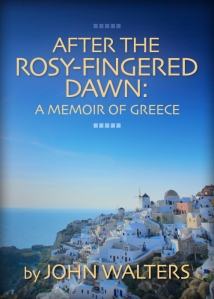
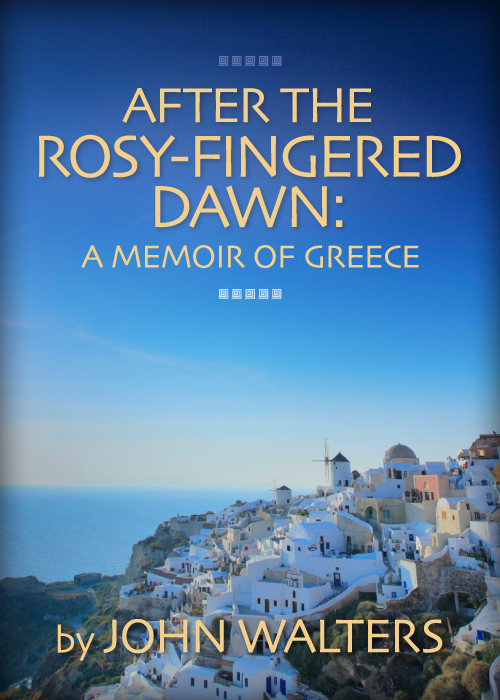
After the Rosy-Fingered Dawn: A Memoir of Greece – Now Available!

My new memoir “After the Rosy-Fingered Dawn: A Memoir of Greece is now available in an electronic Kindle edition here.  It will soon be available in a print edition as well.  Here’s the text of the back cover blurb:

“Greece has always been regarded as the birthplace of western civilization and a Mediterranean paradise.  In The Iliad and The Odyssey Homer uses the magical epithet rosy-fingered dawn to describe the sunrise over a land of myth, fascination, and mystery.  But when preconceptions and illusions are swept aside, what is Greece really like?

John Walters has lived in Greece for over fifteen years.  He has hitchhiked over many of its roads; traveled by camper; journeyed by plane, boat, bus, car, taxi, motorcycle, and on foot.  He has lived and worked and raised a family among Greeks.  He offers insight from an intimate perspective on aspects of Greek society and culture of which tourists are unaware.

Many have visited Greece and afterwards acknowledged that the country has profoundly changed them.  This memoir is for those who feel something special when they think of Greece and Greeks, those for whom Greece holds a special thrall, those who have visited and have their own memories of the place, and those who would like to visit someday and know that when they do they will obtain new insight, new clarity, and will never be the same again.”

My new story collection “Dark Mirrors: Dystopian Tales” which I recently announced available for Kindle is now in print too.  You can find it here.


Posted in Greece: A Memoir, Memoir, Travel | Tagged , , | Leave a comment

Book Review: The Sense of an Ending by Julian Barnes

I ordered this book as soon as I could after I learned that it had won the 2011 Man Booker Prize and had read some reviews.  The subject matter fascinated me.  I too am aging and am confronted with a sense of my own mortality, and I was anxious to see how a gifted writer would approach the many facets and ramifications of such a state of existence.

When the book arrived the first thing that surprised me was its length.  It is a very small, slim volume, little more than a novella.  No matter.  One of my favorite books is a novella, Ernest Hemingway’s classic “The Old Man and the Sea” – a story that approaches the theme of age from a very different perspective indeed.

So I began to read, and shortly I became aware that, despite its brevity, for me at least it was slow going.  I have encountered this problem before with British writers and their novels, in particular with Kazuo Ishiguro’s novel “Never Let Me Go”.  The background goes on and on and I have to hang on hoping that the pace will eventually pick up.  In Ishiguro’s novel’s case it was over 100 pages in before the novel got really absorbing.  In the case of “The Sense of an Ending” it was faster – 100 pages would have almost finished the book.  It is told in two parts:  first the protagonist/narrator’s school days with his buddies and his relationship with a certain girlfriend, and then about forty years later as he looks back on it all and re-establishes contact with the woman.  I don’t want to give away the ending, because it does build up to a wicked denouement.  There is just so much beforehand that leaves the reader baffled.  That’s the main trouble I had with this novel.  Don’t get me wrong – I don’t mind being left in the dark by a writer who is preparing for a mind-blasting ending.  But there has to be something of fascination along the way, and I didn’t feel there was enough of that.

Okay, I admit that maybe this novel just wasn’t my cup of tea.  It was certainly well-written, I have no hesitation in acknowledging that.  I was hoping though, for something fuller, richer, something that delved deeply into what the main character felt as age ravaged his body, negated all that he had accomplished in a mediocre life, sapped him of his vitality and his memories.  Obviously that’s not what Barnes had in mind.  Maybe I’ll have to write that one myself.  To me the protagonist was too much of a milquetoast, too passive; it seems to me he should have had something better to do than – nothing, other than pursue the fascination for digging up the past that is at the heart of the plot.

Anyway, it is well-written, as I said, and it has received a lot of acclaim, and I enjoyed the reading experience.  Just not as much as I thought I would.

Posted in Book Reviews | Tagged , , , | 2 Comments

Self-consciousness in Greek Society

Today I experienced one of the great tragedies in a writer’s life:  I irretrievably lost a piece of work.  In the midst of a busy morning I sat down to write a blog post – this same post, in fact – and it flowed out as if dictated by the whisper of a departed poetic soul.  I read it over afterwards and it was just the way I wanted it.  I saved it, I thought, and even backed it up on another drive.  A few minutes later I wanted to add a word or two, but when I clicked on the file it came up empty.  I ran a “restore previous versions” search unsuccessfully.  Gone.  It was gone for good.  I had a sinking, empty feeling in the pit of my stomach and wondered if I would ever be able to recreate it.  I wondered why it had happened for a long time.

This is my second attempt to deal with the subject, and I must emphasize that the above story has nothing directly to do with the subject itself – but then again, you never know.  Life, and especially what life means, the reason for it all, is ephemeral at best.  Who knows why things happen?

To business, then.  I have been acutely aware as I finish up my Greek memoir and prepare it for publication that much has been left out:  much that I observed, much that I experienced.  There is no possibility of being comprehensive.  Even a lifetime spent here would not suffice.  Even a small part of a life spent anywhere has so many offshoots, side stories, influences, variegations, each of which have their own subplots and motivations and so on – there is no end to it.  But I want to touch on this one more facet of Greek culture because it is below the surface, perhaps not noticeable at all by the casual visitor, but it strikes to the core of the Greek psyche and spirit, and for a native Greek is a powerful influence on all of life’s decisions, both major and minor.

The Greeks are a very self-conscious people.  By this I mean that they are intensely aware of others watching them, and also intently watch others.  The big cities have grown exponentially in recent decades; more than half of the population of the city of Thessaloniki, for example, came from a village either in this generation or the previous one.  It’s a village attitude, really.  Everyone knows what everyone else is doing.  Everyone knows that everyone knows what everyone else is doing.  Therefore in every decision that is made you have to take this into account.  You would think that the vastness of a big city would negate or dilute this attitude, that in a big city the sheer size of the population would enable people to disappear into the crowd, to become nonentities, but it is not so.  The high-rises that have sprouted up everywhere have become microcosms of village life.  Everyone watches everyone else.  There is no getting away from it.  The attitude is all-pervasive.

This was brought home to me as I conversed with my colleagues at the language school, highly intelligent women with dreams and hopes and desires who are nevertheless shackled by fear of what others will think and say.  Many young men and women nowadays leave home and live on their own, but they are nevertheless not free.  They long to be free; they moved out of their parents’ homes to be free, but they are bound by this peeping-tom spirit, the feeling that they are accountable to their neighbors and other casual acquaintances.

The same situation applies on a national scale.  It is true that everywhere in the world celebrities and politicians and other well-known figures are subject to public scrutiny, invasive paparazzi, creative ridicule.  But here it is the village spirit again, as if all of Greece were one huge village and the celebrities the town fools.  Should a public figure say the wrong word, or go out with the wrong person, or slip on a banana peel and fall flat on his or her face, the media instantly picks up on it and it is all over the nation.  It is on morning, afternoon, and evening talk shows, as well as prime time news programs.  It is shown in slow motion, fast motion, intercut with cartoons and old movie clips and outlandish sound effects.  The person is ruthlessly pilloried, scorned, judged, upbraided, psychically tarred-and-feathered.  There is no mercy and no end to it until the next scandal catches the public and media eye and replaces the current one.

That is what people fear, albeit on a smaller scale.  They fear the censure; they fear becoming anathema.  And this has a very real inhibiting effect on young people.  It causes them to become timid and traditional instead of bold and innovative.  And if the young people are afraid to step out and effect change, the country will stagnate, nay, even decay.  That is what has been happening for so long that people are not even aware any longer that it is so, but the young languish, as does the country and culture.  There is a vital need for people, young or old but with young minds and hearts, to rise up and think free thoughts and give those thoughts expression in word and deed.  But there is so much to overcome, so much weight of centuries.  Many Greek young people I have met are brilliant, and if their brilliance were allowed to shine it would have a dynamic positive effect on the society, government, and culture.  My fervent hope is that somehow in some way this brilliance will shine forth like the blazing sun rising on a summer morning, signaling a new dawn.

Posted in Greece: A Memoir, Memoir, Travel | Tagged , | Leave a comment

Book Review: The Seventies: The Great Shift in American Culture, Society, and Politics by Bruce J. Schulman; Part Two:The Book Itself

In the first post about this book I recounted what the seventies mean to me personally.  Heady times they were, to be sure, and integral to my development as a writer.  Now I will go into an analysis of the book itself.

In short, I found it a disappointment – but part of it was my fault.  I was hoping that it would be something it was not.  I should have had a clue when I realized how short it was.  No book of 250 pages can hope to be an in-depth look at a decade.  What it gives is a bird’s-eye view of some of the main events and trends, while what I had wanted was a comprehensive history of the era.  As I read I kept hoping for more.  The writer would touch on a fascinating point, but then that was it.  The elaboration I longed for would never follow.  It would be a touch here and a touch there, and then onwards to something completely unrelated.  It reminded me of when I used to make out with girls in high school:  there would be a bit of fondling, a bit of groping, but then a great deal of frustration afterwards.

What the author does fly over in his distant aerial reconnaissance is fascinating indeed.  There is a bit of culture, a dab of politics, a sprinkle of economics.  He writes of the presidencies of Nixon, Carter, and Reagan, of Reaganomics and yuppies and privatization, of the rise of ethnicity and feminism, of independent filmmaking and punk rock, of rural communes and environmentalism.  But brief glimpses, all – the tiniest of hors d’oeuvres when what I desired was a sumptuous feast.  What makes it even more thin and spread out is that the writer covers not just the seventies but the era from around 1968 to 1984.

Okay, I concede that it is not necessarily the writer’s fault.  Perhaps all he intended was to provide a peek.  Perhaps all he had in mind was an overview.  But it left me disappointed.  It was not what I was looking for.  I have yet to find a comprehensive history of the seventies, though I will keep looking.  Maybe the decade is too recent for historians to give it the meticulous treatment.  But I hope someone has, or will.  It is a fascinating era, and there is so much I missed that I want to catch up on.

Posted in Book Reviews | Tagged , , | Leave a comment

Book Review: The Seventies: The Great Shift in American Culture, Society, and Politics by Bruce J. Schulman; Part 1: What the Seventies Mean To Me

I graduated high school in the class of 1970, having just turned 17 years old.  After a few months of drinking and carousing I was off to university in California.  At the time I hadn’t a clue about what anything meant that was going on around me.  I had been raised in a particularly volatile era, an era of the Vietnam War, civil rights turmoil, youth revolution and many other manifestations of profound change.  I was clueless about it all, a slow learner, immature, unenlightened, stumbling around in a fog most of the time.  The only things I knew were books.  I read in my free time until my mother would drive me off the couch and outside, where I would play basketball by myself hour after hour until I came back in and got back down on the couch or on my bed and would stick my nose in a book again.

That’s how it went in my childhood years, and into my teen years as well.  Though I must say by the time I was sixteen I had quite a serious substance abuse problem.  It started out with alcohol at high school parties, with beer kegs and fifths of whiskey and vodka and rum and so on; we would all swill the sauce until we were stumbling about blindly.  It’s a wonder we ever made it home.  In my senior year in high school pot was added to the mix.  It’s much mellower in some ways; it slowed me down.  But I had no concept of moderation and so I’d combine the two to devastating effect.

So there I was at a California university in the San Francisco Bay area, an area that was still saturated with psychic effluvia from the cultural explosions of the sixties.  I simply couldn’t get my bearings for a long time.  Actually, during my year at university I never did.  I foundered.  One major reason was that hallucinogens were added to the mix.  But another reason was that I sensed the detritus of the sixties around me and I looked for something of substance from that era, the era of the Summer of Love and Woodstock, but couldn’t find it anywhere.  Oh, the trappings were there, no doubt about it.  But something had been lost, an innocence, an ideal, a feeling that the world could be changed for the better.  The world had got darker; a sense of evil stained the idealism after Altamont and the Manson murders.

Thus was my introduction to the ambivalence of the seventies.

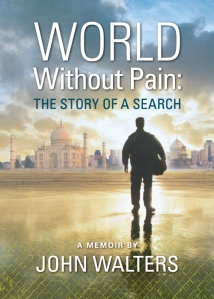
I never found a way out of the confusion in California, but I kept going back to California again and again, sure that something of value must have remained there.  But eventually, after I realized that that for which I searched was not to be found in a particular place, I journeyed farther afield.  I had gone to the San Fernando Valley thinking to try my hand as a Hollywood scriptwriter, but I was getting nowhere.  And at some point I realized I had to cut loose and embark on a real quest, and to do it properly I had to leave the US and get some world perspective.  So I hitchhiked across the States, flew to Europe, and eventually traveled to the Indian Subcontinent.  What I learned on my quest you can read about in my memoir “World Without Pain: The Story of a Search”.  I did finally develop an outlook on things that would see me through the years to come, and in addition to this, and much more importantly, I found my voice as a writer.

So the seventies for me were a time of self-discovery and discovery of the world, a time of travel and soul-searching and writing, of meeting friends and having affairs and taking odd jobs in order to survive.  In short, it was an inward journey.  I was not so much concerned with what was happening in the world around me, except as it affected my visa situation or my safety in the country in which I found myself.  I did spend time in the States off and on in the seventies, but it was time spent on the road and I was not well aware of the political and economic and social situations around me.

Therefore, much of what Schulman writes about in this book has been a revelation to me, an eye-opener.  I have been searching for texts on the seventies for some research, and there are not many available.  I picked this one out more or less at random, after having read the Amazon blurb and reviews.

Stay tuned.  I will review the book itself in part two.

Posted in Book Reviews, Memoir, Travel | Tagged , | Leave a comment

Dark Mirrors: Dystopian Tales – Now Available!

My new story collection, “Dark Mirrors: Dystopian Tales” is now available in an electronic edition in the Amazon Kindle Store, and will soon be available in a print edition.  Here is an excerpt from the Afterword:

We don’t ever seem to learn from history, do we?  Yes, we learn this and that technologically speaking, but we don’t learn our lessons, in the sense that the phrase used to apply.  As fast as technology tries to solve humankind’s problems and theoretically create a better world, even faster does evil evolve in sophistication, malice, and scope.  As far as real goodness is concerned, we seem to continually be taking one step forward and two steps back.  Is there no end to it?  I long for a better world too, but I just don’t see it happening any time soon.  People are too greedy, too self-centered, too prone to take the quick easy way out rather than accept the slower, more difficult long term solution.

That’s why the stories in this volume are, for the most part, pessimistic, or at least contain many pessimistic attributes.  They are mainly set on hypothetical future Earths, and when I gaze into my writer’s crystal ball I don’t see Earth becoming idyllic and paradisiacal any time soon.  I wish, I hope, but I just can’t see it, especially judging by the past and present.  Sure, something could happen tomorrow to turn it all around, but do any of us really believe that it will?  I don’t think so.
In the meantime, though we see evil men prevailing, the environment eroding, economies unraveling, armies warring with one another, we still teach our children to read and write and figure, we try to exercise and eat healthily, we drop our empty beer can into the recycling bin.

Hoping for the best.

As well we should.

Hope is what keeps us going.  Though we can’t foresee a better future, we hope for one.  Otherwise we would just despair, curl up, and die.  The hell with that.

When I postulate dark futures it is not to get you to despair.  When I hold up dark mirrors before your eyes it is not so that you will see the worst in yourself and do yourself in.  Far from it.  Some of my greatest illuminations have come from deep dark prose.  I have written before of Harlan Ellison’s “I Have No Mouth and I Must Scream”, for example, and Cormac McCarthy’s “The Road”.  No, dark literature is not meant to overwhelm us.  It is meant to purge us, to provide catharsis.  It is a cleansing and purifying process.  We must be aware of the evil within before we can clean it out, or at least we must get it under control.

Plus, let’s face it, battles of good versus evil are entertaining.  And despite Hollywood’s insistence, good cannot always win.  It doesn’t work like that.  But when good doesn’t win, when evil triumphs, it might hit us in the pit of the stomach for a moment, but then it should cause us to rise up like good knights or cowboys (or cowgirls) or star warriors and cry out, “No, this shall not be!  We shall rise again from the ashes of defeat and overcome the forces of darkness!”

As well we should.

After all, it’s not how many times you fall but how often you get up that’s important, right?

Posted in Uncategorized | Tagged , , , | 2 Comments

Book Review: The Best Science Fiction and Fantasy of the Year: Volume Five Edited by Jonathan Strahan

Last year I reviewed a volume of best science fiction of the year edited by Gardner Dozois.  There were good stories and mediocre stories, but overall it was a good read.  This volume, however, was even more enjoyable.  I think the inclusion of fantasy made the difference.  I am generally opposed to genre divides, and I would be happiest if the so-called mainstream took science fiction and fantasy more seriously and the best short stories of the year could simply be the best, regardless of origin or content.  This is wishful thinking on my part; the publishing world is not so idealistic.  Categories must be devised, which seem rapidly to devolve into pigeonholes, molds, and storage compartments.  Be that as it may, one has to take what one can find, and this book has many fine stories in it.

No best of the year collection really represents the best of the year, because best is a relative term.  Probably the fairest thing to do would be to have a vote of readers, and that is the value of awards such as the Nebula and the Hugo.  An anthology like this represents the best in the opinion of the editor, and we readers have to trust that the editor is widely read and has sampled at least most of whatever the field has to offer.  Even so, many gems may have been excluded.  There are several similar anthologies that come out every year, and their table of contents are quite diverse.  A few stories overlap, but not many.  In this anthology were absolutely sterling stories that leapt out of the pack, some so-so stories that were okay but not exceptional, and some stories that after reading I wondered what the editor was thinking and why they ended up among the other better ones.  None of the stories were really bad, but one or two I had trouble finishing.  However, that’s just the nature of the beast.  I am not Jonathan Strahan and naturally would have chosen a different mix.
Four stories were absolutely stunning, with superb writing and fascinating subject matter.  “The Sultan of the Clouds” by Geoffrey A. Landis is a hard science fiction story about a Venus whose atmosphere is replete with cities floating in the clouds.  Not only does the writer manage to evoke a stunning sense of wonder but also sustains believability throughout.  Considering he is a scientist at NASA currently studying Venus, he has a jump on the rest of us as far as raw data is concerned.  “The Lady Who Plucked Red Flowers Beneath the Queen’s Window” by Rachel Swirsky, however, is pure fantasy.  It begins at the protagonists death, and is told in stark scenes as she is called back from the dead to effect sorcery for those who call her.  It’s a very original, well-told take on classic themes of magic and alternative societies.  It won a well-deserved 2010 Nebula award for best novella.  “Alone” by Robert Reed was one of the most far-out in a collection of far-out tales.  A strange alien entity lives on the exterior of a massive intergalactic star ship, wandering by itself, exploring, trying to avoid contact with the diverse creatures it encounters.  Eventually it goes inside, and encounters strange environments and cultures in its ongoing millennia-long quest.  I didn’t so much like the ending; I felt it was a bit abrupt, but until the last few pages this long tale was so fascinating I was willing to put up with the less-than-satisfying conclusion.  “The Truth Is a Cave in the Black Mountains” is a fantasy by Neil Gaiman.  A strange small man searches for a fabled cave on an island, a cave in which vast treasure is supposed to be hidden.  As he travels he discovers truths about himself, and in the end when he enters the cave he finds that acquisition of the treasure carries a fearful price.

These four stories alone are worth the price of the book, and there were a number of other stories which I greatly enjoyed but did not measure up to the quality of those four I have described.  To sum up, I got what I expected.  I didn’t expect every story to blow me away, but there were enough that did to make this book a great ride.  Therefore, I recommend it.  I will probably try Strahan’s best of the year again in the future because, as I said, I appreciate it that he includes fantasy as well as science fiction.

Posted in Book Reviews | Tagged , , | 1 Comment

Short Story Author Highlight: Cordwainer Smith

Cordwainer Smith was the pseudonym of Paul Myron Anthony Linebarger, a military officer who specialized in East Asia and psychological warfare.  He wrote non-fiction and spy thrillers, but he is best known for the science fiction he produced in the 1960s.  He wrote one science fiction novel, “Norstrilia”, and a number of brilliant short stories, most of which are gathered together in the collection “The Rediscovery of Man”.  I have an edition from the British “SF Masterworks” series which was published in 1999.

Though Cordwainer Smith wrote only a little over thirty short stories, he is considered by many science fiction writers as one of the masters of the genre and a major influence upon their own work.  Most of his stories are set in the same universe, Earth and its colonies from 2,000 to 16,000 years in the future.  Humankind is ruled by a body called The Instrumentality of Mankind.  Animals, called Underpeople, have been transformed into human form to serve humans.  Considering how few stories he wrote, his unique universe is very richly developed.  I haven’t the space to go into details, though I will in brief in the descriptions of the specific stories below, nor would I want to deprive you of the pleasure of exploring and discovering these worlds for yourself.

In my post on my favorite short stories of all time I included one of his stories, “Alpha Ralpha Boulevard”, and for a description of that story you can look up the post.  Here are some of my other favorites:

The Game of Rat and Dragon“.  This was my first encounter with the author, long ago during my one abortive year at university when I took a course in science fiction short stories.  In the anthology which was our text I discovered the story that changed my life, “I Have No Mouth but I Must Scream” by Harlan Ellison, about which I have elsewhere written, but of all the other stories in that volume this one by Cordwainer Smith remained with me down through the years.  It tells of pinlighters and their feline companions who are sent out into deep space with starships to do battle with psychic creatures which live out in the darkness and feed upon souls.  The humans imagine these creatures as dragons and the cats see them as rats.  When these monsters are sensed, the humans launch their cat-partners at them to do battle with blazing light.  It is a wonderfully-imagined concept, wildly original at the time it was first published and still a great read today.

A Planet Called Shayol“.  Shayol is the Hebrew word for hell in the Old Testament of the Bible.  When crimes are so severe that criminals are deemed unfit for society, they are sent to Shayol as punishment.  Microscopic creatures that live on the planet’s surface burrow into them and the humans begin to sprout extra organs, which are surgically removed and used for transplants by the rest of society.  The prisoners are administered powerful pleasure-giving drugs after the surgery, ostensibly to keep them in some form of sanity.  The amazing thing is that even when describing the horrors of this place and the grotesque appearance of the prisoners, Smith is able to inject humanity and sympathy in their interaction with each other and their plight.  It is a stunning achievement in literature.

Scanners Live in Vain”  This is the story for which Cordwainer Smith is best known.  It appeared in the first volume of “The Science Fiction Hall of Fame”, stories of distinction selected by members of the Science Fiction Writers of America from the years before the Nebula Award was begun.  Scanners are humans who have been altered to be able to work in deep space.  They have enjoyed high social status, a privileged position, but new technology has made them redundant.  Furious at having been rendered obsolete, they decide to rebel, but one of them, Martel, tries to warn the rest of humankind.  Like all of Smith’s work, this story was absolutely original and unique when it first came out, and hasn’t aged at all – it is still a wonderful tale.  Other similar stories may have been written since, but Cordwainer Smith was the first to deal with these concepts in such a compelling way.

The Lady Who Sailed the Soul“.  This is a love story.  The Soul is a starship that plies through deep space, taking colonists and supplies to new worlds.  Special sailors are needed for these ships, who must be altered physically and then brave the dark loneliness of space for the sake of the passengers within.  In a short subjective space of time they age forty years, leaving young but arriving as old folks.  A beautiful woman, jaded with her fame and fortune, meets a sailor who has just sailed the stars and falls in love with him.  When he returns to the planet from which he has come in a state of cryonic sleep, she volunteers to sail the craft that takes him back, condemning herself not only to the loneliness and pain of the voyage but the realization that when it is completed she will be an old woman.  It’s a heart-touching love story and a rousing adventure too.

The Dead Lady of Clown Town“.  Clown Town is where the Underpeople, the animals that have been converted into humans for slave-service, live.  The dead lady is a computer replication of a deceased elder politician.  Into this strange world stumbles a woman named Elaine, who becomes involved in the struggle of the Underpeople for liberation.

I cannot recommend these stories, and the rest of Cordwainer Smith’s work, highly enough.  Just writing about them makes me want to read them all again right away.  They don’t write them like this anymore.  For that matter, they never have.  He is a unique, original writer.  He died of a heart attack in 1966 at age 53.  I wish he could have lived many more years and written many more books.  As it is, his scant output is worth more than countless volumes of a lesser writer’s prose.  He is one of the greatest science fiction writers ever, and if you are at all interested in science fiction and have not yet read Cordwainer Smith, you are in for a real treat, a great feast of unmatched and unmatchable prose.

Posted in Book Reviews, Reading | Tagged , , , , , , , | 3 Comments