Book Review: Chief Seattle and the Town That Took His Name: The Change of Worlds for the Native People and Settlers on Puget Sound by David M. Buerge

When I take my daily walks in my neighborhood in north Seattle, I marvel that so much of the indigenous foliage has survived the carpeting-over by houses, shops, streets, and sidewalks. Majestic evergreens tower high over the tallest buildings, and the area is otherwise replete with many other types of trees, bushes, shrubbery, flowers, and grass. After spending hours in front of a computer, my eyes drink in the deep natural colors and my nose the sweet sharp scent of pine and spruce resin like spiritual nourishment. I often imagine, as I stroll along, what the landscape would have been like without all the aforementioned shops, houses, streets, and so on. I attempt to picture the primal forest and its stark beauty.

There are too few books about the history of Seattle, so this new volume is essential. It comes across as being very well researched, and the stories it tells are fascinating. Having said that, I have to admit, for me at least, it is not an easy read. Much of it has to do with how the material is presented, which takes some getting used to. Instead of presenting the material with the simple English alphabet, the author has chosen to use phonetic symbols for many Native American names of people and places. After a time, when these words written in symbols multiply, it becomes very confusing to try to keep them straight. Additionally, although there are numerous pages of maps in the front of the book, so many places are mentioned so often that it dragged down the narrative as I had to continually search for the right map to consult and then locate the place being discussed. The author also comes across as more of a historian than a storyteller, and a smoother style would have eased absorption into the events on the page.

On the plus side, it’s a fascinating story. Buerge focuses on Chief Seattle and his influence in creating and nurturing the city of Seattle, beginning with the era on Puget Sound before pioneer settlers came and initiated the disruption of their way of life, through the years of early city growth, and on into the statehood of Washington and the primacy of Seattle in regional commerce and politics.

It’s a bloody tale. There’s little in it of peaceful, noble Native Americans or settlers. In the early days, Native Americans made savage, violent raids upon one another. When white people came, they warred with the Native Americans. When the Chinese came, both whites and Native Americans resented and fought them. Overall, Puget Sound in the early days comes across as a terrifying place to try to live and raise a family, but many settlers came and gave it their best.
As the book makes clear, in his early years, Seattle was quite a savage warrior himself, but as more and more white men settled in the area around Elliot Bay that eventually became a city that appropriated his name, he became a man of peace and reconciliation, attempting to blend the cultures of white men and Native Americans to mutual advantage. In his old age he converted to the Catholic faith, setting an example of integration that he hoped his people would follow to ensure their survival. His was a unique and interesting life that straddled great societal changes in the Pacific Northwest region.

Overall, I would recommend the book for its value as a historical document, although it’s a bit too effortful a read to qualify as relaxing entertainment.

Posted in Book Reviews | Tagged , , , , , , | Leave a comment

A Second Look: The Dragon Ticket and Other Stories

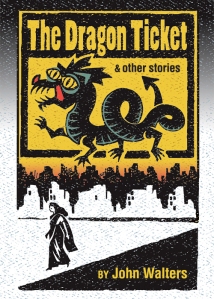
DragonTicketWEBBigHigh in the Himalayas a young woman receives an extraordinary gift.  Beneath the streets of Calcutta a man discovers a terrifying presence.  In a palace full of sybaritic pleasures a demigod incurs terrible retribution.  On a far desert planet teeming with venomous creatures a woman searches for ultimate truth. 

 In these and other strange and wondrous tales John Walters explores the ramifications of human/alien encounter. 

This is my first short story collection and first book. Since I had been publishing novelettes and short stories in magazines and anthologies for several years before it came out, all but one of the stories are previously published reprints. In later collections, there is more of an even mix of new and previously published material. Notice the beautiful cover crafted by one of my brothers-in-law, an accomplished and imaginative illustrator. As the image implies, most of the stories are set in India.

Click to buy from these distributors:

Trade Paperback

Amazon Kindle

Barnes and Noble

Kobo

Posted in Uncategorized | Tagged , , , , , | Leave a comment

Book Review: Barbarian Days: A Surfing Life by William Finnegan

In my search for new nonfiction books to read, I perused recent awards lists and came across this title. It surprised me that a book on surfing should have won a Pulitzer Prize, but as I read brief descriptions of the book I realized that there must be much more to it. I’m not really interested in surfing, either to participate in or to watch, but Finnegan is about my age, grew up in the same generation, experimented with drugs, including LSD, and traveled the world on the bum. All of this intrigued me so I decided to give the book a try.

It quickly drew me in. Finnegan is an accomplished writer. What he does in this book is tell the story of his life in relation to surfing, and use his fascination with surfing as a focal point. The settings range from his early years in California, his middle and high school years in Hawaii, an extended journey roaming the South Pacific and Australia looking for waves, a school teaching era in South Africa, and other years surfing and living in the San Francisco Bay area, the island of Madeira in Portugal, and recent surfing on the coasts of Long Island and New Jersey.

Surfing is obviously much more than a sport to Finnegan; it takes on a metaphysical aspect – something that directs and transforms his life, gives him comfort and serenity, and serves as a stabilizer and I might even say a spiritual practice. The respect that he accords surfing and the guidance he derives from it as well as a vision of its metaphorical value sort of rubbed off on me; I found myself thinking of my efforts, failures, and renewed efforts, while I was reading the book at least, in terms of riding waves: you paddle out, try, succeed or fail, paddle out again, and try again and again and again. Some rides are sweet and some rides are dangerous, but it’s just what you do. You live for the sweet rides. I thought of my life as a writer of stories and articles. The rejections are when you fall off the board, when the wave gets the better of you, but you pick yourself up and keep going because of that amazing feeling when you’re on a good ride and you lose, at least temporarily, the otherwise ever-present sense of your own mortality.

And Finnegan’s long odyssey around the world looking for waves – well, I could so empathize with that. I did something similar. When I was young I took off on the road not really knowing where I was going. What I was looking for was my voice as a writer. I knew I wanted to be a writer but I didn’t know what to say. I carried notebooks with me but for a long time they remained empty. It was only when I got far, far afield that the words began to spurt out: first on a beach in Goa, India, and then on a hillside at the edge of Katmandu, and then while walking along without map or guide on small paths in the Himalayas, and in other places. It took me awhile to realize that I had accomplished my goal: I had found my voice, and now all I had to do was use it.

So yes, this book goes far beyond being a memoir on surfing. It is a deeply nuanced book on countercultural changes in the early seventies, on the loneliness and uncertainty of travel, of racial inequalities in South Africa under Apartheid, and about coming to grips with something that is important to you spiritually and that drives the decisions you make in life.

In conclusion, I highly recommend this book. It turned out to be much more than I thought it would be. I found a kinship with Finnegan in so many ways. And trust me: you can get off on this book even if surfing means nothing to you one way or the other. Just hop on board and enjoy the ride.

Posted in Book Reviews, On Writing, Travel | Tagged , , , , | Leave a comment

Book Review: The Emerald Circus by Jane Yolen

I’m a graduate of the Clarion West science fiction writing workshop, and I am on their mailing list. I recently received notice of a one-day special workshop by the award-winning writer Kij Johnson taking place in November 2017. The workshop is called “Working With Other Works: Inspiration, Homage, Fanfic, and Plagiarism.” Before I received this news, I had attended her reading in July 2017 during which she read from her upcoming novel, which is a sequel to the famous children’s classic The Wind in the Willows. The long and the short of it is, if you draw from a work that is still under copyright, it’s plagiarism. Otherwise, it’s one of those other things.

This is an entertaining collection of stories by Jane Yolen, and almost all of them would come under the heading of fanfic, homage, or inspiration from other stories or legends. Yolen draws from characters and materials from Alice in Wonderland, Peter Pan, The Wizard of Oz, The Legend of Robin Hood, and The Legend of King Arthur, as well as poems by Edgar Allen Poe and Emily Dickinson. This is not to disparage the stories in any way. Yolen demonstrates how to do it the right way. In fact, two of the stories, “Lost Girls,” a unique take on the Peter Pan story, and “Sister Emily’s Lightship,” about a hypothetical source of Emily Dickinson’s inspiration, have won major awards.

Two of my favorites in this collection draw on historic or mythological characters for their storylines. “Evian Steel” is a novella that tells of a legendary island in the midst of a river where women forged sword blades, and how Guinevere made the sword Excalibur and Merlin found her to present it and her to King Arthur. Another, called “The Jewel in the Toad Queen’s Crown,” deals with the relationship between Benjamin Disraeli and Queen Victoria. A number of other stories are witty, clever, original interpretations of beloved classics that add relevancy and insight.

One other aspect of this collection that I greatly appreciate is the afterword in which Yolen comments on each story. I love introductions or afterwords in which authors explain how they came to write stories, their inspirations, any difficulties they encountered, and so on. For me it ties the stories in with the writer’s life. The first author I read who did this to great effect was Harlan Ellison. He always wrote long introductions to the overall books and to each story. Another is Robert Silverberg. When I started publishing story collections I made sure that I wrote extensive afterwords to each one, with a section for each story, as I wanted to link the stories with the rest of my work, especially my memoirs. I have always felt that the lack of some sort of comment by the writers in short story anthologies or collections diminishes their impact. So I am pleased that Yolen makes the effort to confide in her readers by letting them in on various aspects of her personal and professional life.

All in all, this collection is a light, entertaining read, just perfect for when you want to relax and lose yourself in the fantasies you enjoyed when you were young.

Posted in Book Reviews | Tagged , , , , | Leave a comment

I’m Not Home Here Either

Where is home really? Listening to a Bob Dylan song recently somehow made me think of another Bob Dylan song, “Don’t Think Twice, It’s All Right.” In it, the singer leaves a woman and heads back out on the road because things didn’t work out between them. That happened to me several times in my younger traveling days. I would meet someone, spend some time with them, perhaps we would even fall in love, but then I would feel compelled to leave, or she would have to go off and do whatever she had to do, and we would separate and be left with nothing but memories. I recount some of these instances in my memoir World Without Pain: The Story of a Search. During my travels I was relentless in my search for meaning, truth, metaphysical reality, and most of all my unique voice as a writer. Later, in lonely places and circumstances, I would look back and wonder if some of the relationships I left might have worked out. I deal with this in my short story “Katabasis” in the collection Heroes and Other Illusions.

Near the end of World Without Pain I write: “And home? I couldn’t go home again. Home was an abstraction from which one commenced a particular phase of the journey, not an absolute.” Of course I felt that way during my many years on the road. I still believe that in a sense. I felt isolated during the over fifteen years I lived and worked in Greece because I was a foreigner, a stranger in a strange land, and also I had no one with whom to share the wonderful experience of my budding writing career. On the other hand, as I look back, if there was any time I felt most at home as an adult, it was the period when we were raising our young family in Greece, first in Athens and then in various locations around Thessaloniki. But that’s the point. Home was not a physical place, because we moved often. Home was our family unit.

Children and adults have a different concept of what constitutes home. For children, ideally at least, it’s a place of safety and security where they can grow. For adults, well, I suppose I can’t really speak for all adults. I’m an anomaly in a sense. Most people I know life almost all their lives in one location and raise their families fairly close to where they grew up. I’ve lived in so many places for extended periods of time that I might not even be able to remember them all. Let’s see if I can recall at least a few of them: Seattle, Yakima, Los Angeles, San Diego, Assen, Rome, Naples, Palermo, Athens, Thessaloniki, Bombay, Madras, Calcutta, Katmandu, Bangkok, Jakarta, Auckland… Well, okay, I may have pegged at least the major ones where I’ve lived for a month or more at a time. If I list the places I’ve lived in for at least a few weeks there’ll be no end to it.

And what’s my own definition of home? It’s not a place at all. It has more to do with people. Sure, the place where I live now with some of my sons is home. But it’s temporary. We rent this apartment. It’s transient. It will pass. I don’t feel I have arrived here; I feel I am at another stage in the journey. Every day I take a walk through the neighborhood for exercise, and I wonder about the people whose houses I pass, and I wonder what it would be like to own a house. I’m not unfamiliar with the experience. We owned a house in Greece. It was during that wonderful stage when I felt that we really had a home. But it wasn’t the house that did it.

I realize I’m rambling, and I apologize. I came into this to put down some thoughts. I don’t know if I can come to any conclusions. I think about my time on the road and I marvel at what I did back then. I couldn’t do it now, at least not the same way. I’m not as strong, and I am much older. But those experiences shaped who I am, shaped my reactions to things, shaped my writing. Although there was a hint of melancholy as I recalled past adventures on my long walk today, there was also a sense of accomplishment, of fulfillment, and of satisfaction. I did what I had to do. I stayed on the road because I had a goal, and that goal was all-consuming and all-important. Come to think of it, I’m still on the road, and still in pursuit of my goal or goals. That’s what life is: a journey. Especially the life of a writer. There is no end point. There are always more stories to tell. There are always more worlds to explore.

Posted in Memoir, On Writing, Travel | Tagged , , | Leave a comment

The Best American Science Fiction and Fantasy 2017 Edited by John Joseph Adams and Charles Yu

I’ve been reading a lot of short stories lately, what with The Best Science Fiction and Fantasy of the Year 2017 edited by Jonathan Strahan, The Rediscovery of Man by Cordwainer Smith, and now this volume. Normally I like to alternate between reading a volume of fiction and then a volume of nonfiction, but the reason I jumped right into reading this one after finishing Cordwainer Smith is that I had ordered it from the library months ago, before the library even had it, and it finally arrived, and I had to grab it and read it when I did because if I didn’t, someone else in the growing waiting list would take it. I won’t go into another explanation of why my poverty forces me to wait for new books from the library instead of buying them.

I have in the past read more than one best of the year short story collection in the same year, but never so closely together. It allows me to compare the choices of the editors and brings out the dramatic difference in tone between the two volumes. So far (I haven’t finished the Adams and Yu book yet) I have seen that Strahan leans much more heavily towards fantasy and fairy tales, while Adams and Yu, although offering an even mix of fantasy and science fiction, tend more towards realism with just one element of fantasy or science fiction mixed in, rather than immersion in alternate worlds. Strahan also has numerous more dark offerings, while Adams and Yu lean towards more light-hearted fare. There are several repeats from Strahan’s collection, but they also omitted three of my favorite stories that Strahan included, all of which are exceedingly dark and yet exceedingly lovely: “You’ll Surely Drown Here If You Stay” by Alyssa Wong, “Red Dirt Witch” by N.K. Jemisin, and “Red as Blood and White as Bone” by Theodora Goss.

One dark devastating tale that Adams and Yu include is “Vulcanization” by Nisi Shawl. I’ve read a few others of her stories, but this one stands out. Set in Africa during the time of her new novel Everfair, it describes a particularly evil haunting of the Belgian king Leopold, which would have been no more than he deserved.

I have read the other volume of best of the year 2017 so recently that I have been skipping over the stories that are repeats from Strahan’s book. One story that is unique to this volume and that first saw light in a small literary magazine called the Beloit Fiction Journal, though, stopped me in my tracks. It’s called “Openness” by Alexander Weinstein. It’s one of those rare things: a perfect gem of a story, exactly the right length, with precise prose, brilliant characterization, and a uniquely presented idea. It concerns a near future in which people scarcely speak to each other but instead give access to their personalities through various layers of networked interaction. At the heart of it is a love story concerning two people who meet and let down various levels of defenses until they make a decision to open themselves completely to each other. Highly recommended. Great story.

*     *     *

As for the rest of the stories in the book, most are readable and entertaining. “Not by Wardrobe, Tornado, or Looking Glass” by Jeremiah Tolbert is a very clever portal story with a fine twist ending. “The Story of Kau Yu” by Peter Beagle is an elegant unicorn fantasy set in China. Overall, the collection is a good read, although it contains several stories that I personally would not have chosen as representing the best work of the year. If I had read only this “best of” collection, I might have come to the conclusion that it was simply a weak year for speculative fiction, but because I read the other collection first, I realize that the inclusion of certain other stories would have made it significantly stronger.

Posted in Uncategorized | Leave a comment

On Rereading The Rediscovery of Man by Cordwainer Smith

Most of you have probably never heard of Cordwainer Smith, whose real name was Paul Linebarger, and yet he is one of the greatest science fiction writers ever. You don’t have to take only my word for it; he has been praised for his profound influence on the genre and on their own work by science fiction luminaries such as Harlan Ellison, Ursula Le Guin, Stephen Baxter, Robert Silverberg, and Frederick Pohl. These are the names of some of the writers who have written their praise of Smith on the edition of the book I own, but I have read and heard of others who have acknowledged the debt they owe Smith for the intelligence and insight that he brought to the field.

Why is he not better known? Perhaps part of the reason is the volume of his output. Most speculative fiction writers publish dozens of books during their careers, but Smith’s reputation rests mainly on one short story collection, The Rediscovery of Man, and one novel, Norstrilia. His most significant stories take place in a vast future history that covers over fourteen thousand years. The imagination he displays in constructing all the details of his worlds has never been and probably never will be equaled. I have written about Cordwainer Smith and his works in past posts in which I list some of my favorites among his short stories and I review a couple of his more obscure books that I managed to get my hands on. In those posts you can read more about his background and some of the main themes in his future history.

Why do I return to the subject of Cordwainer Smith’s incomparable short stories? Because I heard of a book of his that I had never seen and I found out that the library system has a copy and I reserved it. The book, called When the People Fell, was part of a comprehensive reissuing of his works, and has six hundred pages of stories. I thought that perhaps in this volume are some of his stories that I have not yet read. And just for fun, I thought I would reread all the stories that I have already read as well. Unfortunately, the person who had checked out that one library copy was hanging on to it, so then I thought (because I already had the brilliance of Cordwainer Smith on my mind) that I could read The Rediscovery of Man now, as a warm-up so to speak, since I already had a copy, and then when I finally got hold of the new volume, I’d read whatever else was in it.

That was the plan, anyway. The book has still not become available, but I can be patient. At least I’ve had a good dose of Cordwainer Smith through The Rediscovery of Man to satisfy my most urgent craving. Then, when the other volume arrives, you’ll hear more from me about this amazing author and the singular brilliance of his fictional worlds.

Posted in Book Reviews | Tagged , , , | Leave a comment

Book Review: The Best Science Fiction and Fantasy of the Year 2017 Edited by Jonathan Strahan

I’m only about halfway through this book but I’m starting the review. There’s precedent for it. Sometimes I begin reviews as thoughts occur to me. For instance, the last time I read Martin Eden by Jack London I wrote a review in three installments and published it as three separate blog posts. It just depends on how much there is to say. This anthology is a very long one, though, and I want to jot down some comments while stories are still fresh in my mind. It’s difficult to remember twenty-eight stories covering six hundred pages after the fact. Unless they’re unforgettable, of course. Some of these are, but so far not many.

That’s the thing with best of the year collections: the selection constitutes the opinion of one or two editors, and we all have our own criteria of how we select our favorites. This collection leans heavily on fantasy, which is not often my forte. (Although I have put out one collection of exclusively fantasy stories: Fear or Be Feared: Fantasies, and fantasies do make occasional appearances in some of my other collections.) Many of the stories I would consider readable but so-so. Some, however, stand out.

I often comment on individual stories in collections and anthologies in the order in which they appear in the book, but I’m going to break rank and give first place to a story that blew me away as few stories have in recent decades. I’m not exaggerating in saying that this story alone makes buying and reading the entire anthology worthwhile. (We’ll put aside for the moment that I couldn’t afford to buy it and had to borrow it from the library. That’s been an ongoing issue with me for awhile, the finances, so we won’t bring it up again.) The story – novelette, actually – is “You’ll Surely Drown Here If You Stay” by Alyssa Wong. It is pitch-perfect, not a word wasted. Wong won the Nebula Award last year for her short story “Hungry Daughters of Starving Mothers” – which was a good read – but I think this story is even better. I’ve seldom felt so strongly about a story in recent decades. The visceral thrill I got while I was reading it and the gut-punch at the end reminded me of my reaction to Harlan Ellison’s stories in the late sixties and early seventies when he was turning out one brilliant masterpiece after another. Alyssa Wong is a major talent, and if she continues to improve, we are going to see some amazing work from her.

Another story that stood out for me, not because of its idea but because of its execution, is “Mika Model” by Paolo Bacigalupi. The plot has been done many times before, both in literature and in film: it’s about an android call girl who is well nigh irresistible to men, even men such as cops who should know better. What’s unique about this story is that Bacigalupi tells it in a sleek, lean, condensed style that rapidly leads up to its strong climax.

Fan fiction, which is the borrowing of other universes and character for story ideas, varies from poor or mediocre amateur efforts to award-winning stories from major writers such as “Lost Girls” and “Sister Emily’s Lightship” by Jane Yolen. Delia Sherman dives into a steampunk version of the world of Sherlock Holmes in the imaginative and entertaining novelette “The Great Detective.” It’s an origin story, in a sense, but a most unusual and innovative one.

*     *     *

From this point on, the review may become a bit disjointed, because I have begun research on a new writing project that may involve reading several books, and I am finishing up the reading of this book at the same time.

I mentioned that there are a number of so-so stories in this volume. There are also a number of pretty good stories.

But one story that stands out in the latter half of the book is “The Art of Space Travel” by Nina Allan. It’s a character-driven story about a woman who works at a hotel near an airport in London, and the hotel is about to briefly grab the attention of the world because two astronauts who are heading for Mars will soon stay in the hotel for one evening. The woman’s mother used to work in aeronautics, and she has been incapacitated and is in an advanced stage of early-onset dementia because of an accident concerning the previous Mars attempt. A beautiful story that quietly but deeply touches the heart.

The story “Red Dirt Witch” by N.K. Jemisin is so pure and powerful that I was weeping by the end of it. Few stories do that. And I realized that the strength in this one is born of a life lived in its deepest truths; that is, if the author had not lived through what’s in the heart of the story, she would never have been able to tell it with such clarity and heartfelt emotion.

Another story that strikes deep and true: “Red as Blood and White as Bone” by Theodora Goss. It’s a sort of fairy tale set in Eastern Europe. It immediately follows “Red Dirt Witch,” and the two stories have remarkable similarities in that they both seem to spring from the writers’ pasts and somehow link those pasts to the present in the conclusions. Beautiful tales, both of them.

Posted in Book Reviews | Tagged , , , | Leave a comment

“The Lady of the Lost Valley” in Lost Worlds: Short Stories


Lost Worlds

Lost Worlds: Short Stories is part of the Gothic Fantasy short story series by Flame Tree Publishing. It’s a beautiful hardbound volume with an embossed cover that features works by classic and current authors on the subject of lost and hidden worlds. It includes well-known stories such as “The Country of the Blind” by H.G. Wells, “The Man Who Would Be King” by Rudyard Kipling, and “At the Mountains of Madness” by H.P. Lovecraft as well as excerpts from The Lost World by Arthur Conan Doyle, Journey to the Center of the Earth by Jules Verne, Herland by Charlotte Perkins Gilman, and King Solomon’s Mines by H. Rider Haggard. Why do I make this announcement? Apart from the fact that the book is awesome and I can hardly wait to dive into it, amongst this august company is a little-known contemporary author named John Walters. Not only that, but because the editor placed the stories in alphabetical order, “The Lady of the Lost Valley” by John Walters is sandwiched in between works by Jules Verne and H.G. Wells. Maybe that has more significance to me than to anyone else, but I find it amazing to find myself in a table of contents surrounded by giants of literature such as these that I grew up reading and admiring.

Posted in Uncategorized | Leave a comment

Book Review: The Fifty-Year Mission: The Next 25 Years: From the Next Generation to J.J. Abrams by Mark A. Altman and Edward Gross

The first book in this two-book series, which told about the original series of Star Trek and the movies based on the original series, was highly entertaining and difficult to put down, at least to a long-time Star Trek enthusiast like me. I hesitate to call myself a fan, a Trekkie, because I have never acted on my enthusiasm other than watching the shows. I don’t dress up like a Federation officer, I haven’t learned Klingon, and I wouldn’t go nuts if I encountered one of the star actors or writers of the series or movies. I have had indirect association with people who have written for Star Trek. Harlan Ellison, the writer of “The City on the Edge of Forever,” which many people consider the greatest Star Trek episode of all time, was one of my Clarion West teachers long, long ago, and the writer of the animated series episode that won an Emmy award was one of my classmates. And I do enjoy watching the various TV series and movies.

The first book, which I thought a rather weighty tome, was about 500 pages long. This follow-up book is 840 pages, and the print is smaller and more compact on the pages. There’s a lot of information in all those words. Similar to the previous volume, the history is told in spliced-together interviews of many of the people involved in production, and also similar to the first one, it is fascinating and full of strange but true stories of which I was unaware.

It kicks off with the history of the birth and seven-year run of Star Trek: The Next Generation, and it is full of horror stories of misused and unappreciated personnel. The production of any series that involves shooting twenty-six episodes in a single season is bound to be problematic, but the problems with The Next Generation concerned ripping off the work of other writers and then not giving them sufficient pay or credit for it, arbitrarily imposing restrictions on what writers could write about, creative sabotage, and other nefarious deeds.

By the time The Next Generation was going into its final seasons and the Next Generation movies were being produced, Deep Space Nine began, and at the same time Gene Roddenberry, the creator of Star Trek and a powerful force behind what creative direction it was allowed to take, died. This set DS9 free to embark upon multi-episode story arcs, which previously were forbidden, and to take a darker approach to its material. Then, during the final years of DS9‘s run, came Star Trek: Voyager, and near the end of Voyager‘s run, the prequel series Enterprise premiered. After that, there was a Star Trek production void until 2009 when J.J. Abrams revived the franchise with his new movies.

The book goes into detail on the creation of each of these series and films. It begins with the initial ideas for each, how the creators planned for the new productions to fit into the overall Star Trek universe, the hiring of producers, writers, and cast, and how each series evolved in response to ratings, the visions of their writers, and reactions of fans and producers.

I doubt that these books find much readership among those who are not already Star Trek fans. There are too many details, too much trivia. It’s a shame, in a way, because they offer a lot of insight in how the creative process works, both in TV series and in feature films. I would recommend them to people interested in a career in television or film writing – and also, of course, to those who have grown up appreciating the cultural phenomenon that is the Star Trek universe.

Posted in Book Reviews | Tagged , , , , , , | Leave a comment